
What Jackery announced at IFA 2026
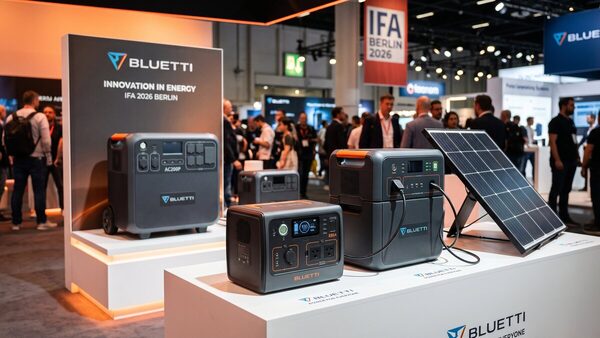
On 17 August 2026, Jackery had published the list of what it would show at IFA in Berlin, Europe’s consumer electronics show, held this year from 4 to 8 September. The launch event went ahead as planned on 4 September at 3 pm CEST (hall 2.2, stand 114), and the brand finally handed over the full specifications of its two headline products.
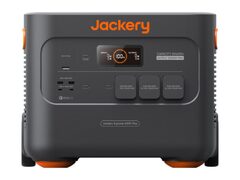
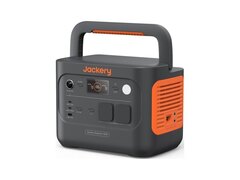
First, a second generation of the Explorer Plus range: Explorer 1000 Plus v2, Explorer 2000 Plus v2 and a new flagship, the Explorer 3600 Plus. Second, the FridgeGuard, a far more unusual object: a slim backup battery designed to protect a single appliance in the home, the refrigerator, and one Jackery is now moving from the US market alone to worldwide distribution.
Around those two, Jackery is also pushing its fixed residential ecosystem (SolarVault 3 series, solar roof tiles, EnergyGuard Max storage), which belongs to the world of professional installation rather than the portable power station. We are focusing here on what plugs into a socket and travels with you.
Explorer Plus v2: three modular stations from 1 to 3.5 kWh
All three models share the same technical base: a CTB 2.0 battery architecture, ceramic-coated LiFePO4 (lithium iron phosphate) cells rated for more than 6,000 charge cycles while retaining at least 70 % of capacity, a UPS function that switches over in 10 ms, and add-on battery packs that let you grow capacity after the purchase.
| Model | Capacity | Expandable to | AC output | Weight | AC charge |
|---|---|---|---|---|---|
| Explorer 1000 Plus v2 | 1,024 Wh | 11 kWh | 1,800 W (3,600 W surge) | 10.8 kg | about 1 hr 15 min |
| Explorer 2000 Plus v2 | 2,048 Wh | 12 kWh | 2,400 W (4,800 W surge) | 18.8 kg | about 1 hr 30 min |
| Explorer 3600 Plus | 3,584 Wh | 21.5 kWh | 3,600 W | 35 kg | about 2 hr |
The real selling point of this generation is not capacity, it is bulk. Jackery claims the Explorer 1000 Plus v2 is 44 % smaller and 26 % lighter than its predecessor (31.4 × 20.1 × 23.4 cm for 10.8 kg), and the Explorer 2000 Plus v2 60 % smaller and 33 % lighter (36.6 × 25.5 × 27.2 cm for 18.8 kg). On a unit you stow in a car boot or under the stairs, that kind of progress matters more than a line on a spec sheet. The Explorer 3600 Plus owns its 35 kg with wheels and a telescopic handle.
On the input side the three models separate more clearly: 400 W of solar charging for the Explorer 1000 Plus v2, 800 W for the 2000 Plus v2 and 1,000 W for the 3600 Plus. Mains charging stays quick across the range, from roughly 1 hr 15 min to 2 hr for a full charge. The connector set is consistent: three 230 V sockets, two USB-C, one or two USB-A and a 12 V output depending on the model.
Those 6,000 cycles deserve a moment of translation: at one full cycle a day, that is more than sixteen years before the pack drops to 70 % of its original capacity. It is one of the concrete advantages of LiFePO4 over conventional lithium-ion, a comparison we break down in our feature on Li-ion versus LiFePO4. In real household use, where a station rarely takes a full cycle every day, that lifespan comfortably outlasts your buying horizon.
Be careful how you read those capacities, though: the headline figure is the cell capacity, not what comes out of the socket. Between inverter efficiency and standby draw, expect 10 to 20 % less in practice on a mains output. We ran through that calculation in what a power station’s Wh figure is really worth.
FridgeGuard: keeping the fridge cold through an outage
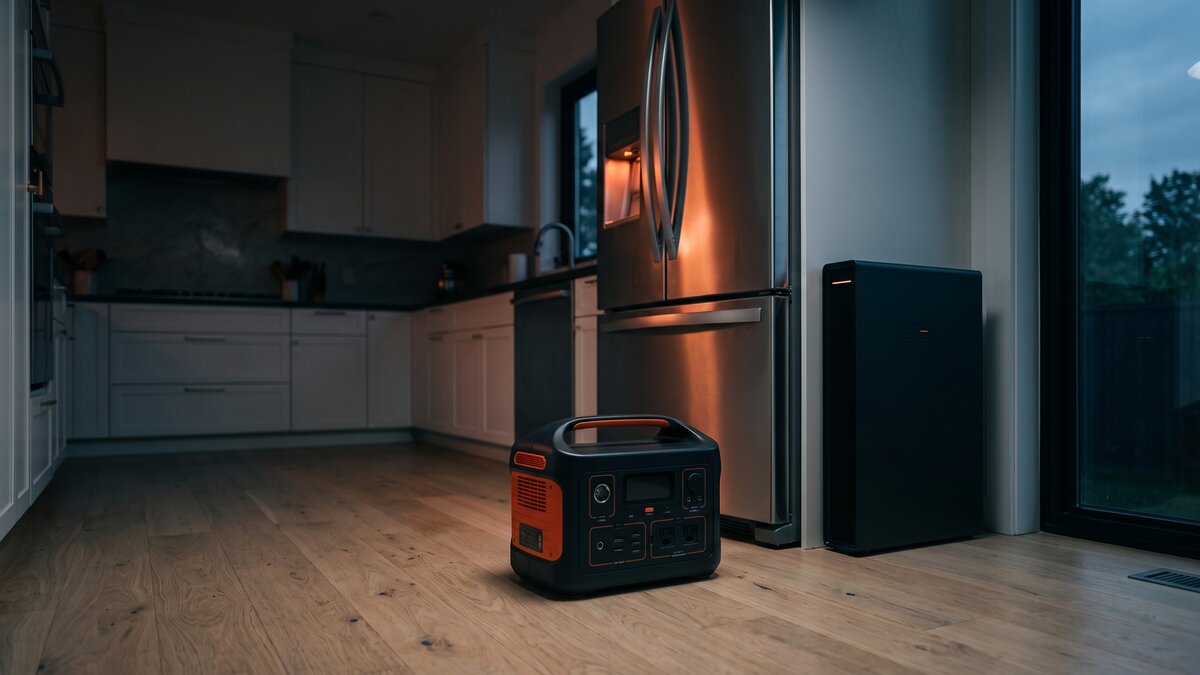
This is the genuine curiosity of the announcement, and Jackery used IFA to confirm its move to worldwide distribution. The FridgeGuard is not a general-purpose power station: it is a dedicated home UPS, slim (about 6.6 cm thick, for 10.5 kg), designed to slide beside or behind the refrigerator and serve nothing else.
- 1,024 Wh of capacity, expandable to 2,048 Wh with an add-on battery;
- 800 W continuous, 1,600 W peak to absorb the inrush current when the compressor kicks in;
- switchover to battery in under 10 ms, meaning a genuine UPS function rather than a simple transfer relay;
- up to 15 hours of stated runtime on a refrigerator, 30 hours with the expansion pack;
- under 40 dB in operation, and it can sit on the floor, on top of the fridge or be wall-mounted;
- a built-in display and a mobile app, including a delayed-start function that staggers compressor restarts;
- bypass mode: once charged, mains power passes straight through the unit without going via the battery.
The 10 ms figure is the one to remember. A fridge compressor shrugs off a one-second cut, but the control electronics in recent appliances will reboot. That switchover time puts the FridgeGuard in the same category as a computer UPS, and makes it usable on other sensitive loads: a CPAP machine, an aquarium pump, a home office setup. Jackery claims compatibility with “99 % of modern refrigerators”.
This very specialised format answers a real instinct: during an outage, the first worry is the contents of the freezer. We covered the right reflexes in our guide on what to do during a power cut, where rule number one remains keeping the door shut.
Pricing and availability: orders on 14 October, tariffs still unknown
This is the disappointment of the press conference: Jackery announced no European prices at all. It did, however, set a precise calendar, which is more than it had before Berlin.
| Milestone | Date |
|---|---|
| Launch event, IFA Berlin | 4 September 2026 |
| Pre-launch campaign (sign-up) | 4 September to 13 October 2026 |
| Orders open across Europe and the UK | 14 October 2026 |
| European prices | not disclosed |
The pre-launch campaign means signing up before 13 October to get 35 % off a selection of accessories (charging cables, carry bags) and a free 102 W GaN charger, quoted at £54.99, when you buy an Explorer 1000 Plus v2 or 2000 Plus v2 bundled with a solar panel from 14 October. Signing up costs nothing, but it does not commit Jackery to a price either.
With no European list, the only reference point remains the US market. The same range has been on sale there since June 2026 under the HomePower name, and the FridgeGuard since the summer. The capacities line up watt-hour for watt-hour with the figures now confirmed for Berlin.
| European name | US equivalent | Capacity | US launch price |
|---|---|---|---|
| Explorer 1000 Plus v2 | HomePower 1000 v2 | 1,024 Wh | $849 |
| Explorer 2000 Plus v2 | HomePower 2000 Plus v2 | 2,048 Wh, expandable to 12 kWh | $1,799 |
| Explorer 3600 Plus | HomePower 3600 Pro Max | 3,584 Wh, expandable to 43 kWh | $2,999 |
| FridgeGuard | FridgeGuard | 1,024 Wh | around $550 |
Treat those numbers as an order of magnitude, not a European price list, and keep two caveats in mind. First, a US price is shown before local sales tax, whereas a European price includes VAT. Second, the configurations are not identical: the European Explorer 3600 Plus tops out at 21.5 kWh of expansion, where the US flagship goes considerably further, and the socket and mains frequency differ too.
What is worth keeping is the scale: an entry model priced like a good current 1 kWh station, a flagship playing in the home-backup league, and a FridgeGuard positioned as a household fixture rather than an outdoor accessory.
Should you wait until 14 October to buy?
It depends on what you are after, and the answer is not the same in both cases.
You want a versatile power station now
Do not wait. A generation change is above all the moment when the outgoing generation gets discounted. The Jackery Explorer 1000 v2 and the Explorer 2000 Plus remain excellent machines, and the direct competition has not gone anywhere: our comparison of the best power stations still stands. Nothing shown in Berlin makes those models bad overnight, and a range with no announced price compares to nothing.
You want to protect your home
Here, hold on until 14 October. Home backup is precisely the ground Jackery is moving onto, and you are better off comparing the FridgeGuard and the Explorer 3600 Plus against their rivals with European prices in hand. Several stations already on sale include a comparable automatic backup function, among them the EcoFlow Delta 3 Plus, with no need to wait for October: we review them in our 2026 comparison.
We will update this article when orders open on 14 October, as soon as European pricing is published.