
How much capacity (Wh) do you really need?
Capacity, measured in watt-hours (Wh), is the very first question to answer: it determines how many devices the station can power, and for how long. The calculation is simple: Wh = device power (W) × usage time (h). A 65 W laptop used for 3 hours consumes about 195 Wh; a 60 W mini-fridge running overnight for 10 hours consumes 600 Wh.
To estimate your real needs, list the devices you plan to power, their power draw (found on the label or charger) and the intended usage time, then add them up. Add a 20 to 30 % safety margin on top, since no station ever delivers 100 % of its advertised capacity (conversion losses, self-discharge). Our measurement of the real usable capacity across 46 power stations found an actual efficiency ranging from 74 to 98 % depending on the model.
- 200 to 300 Wh: charging phones, a tablet, a laptop, lighting; the backpack-friendly range.
- 500 to 1,000 Wh: adds an electric cooler, occasional kettle use, small power tools; the camping and van range.
- 1,000 to 2,000 Wh and above: a permanent mini-fridge, several devices at once, home backup lasting several hours.
What output power (W) should you choose?
Output power, in watts (W), determines which devices the station can actually run, independently of its capacity. A 1,000 Wh station limited to 300 W continuous output will never start a 1,000 W microwave, even fully charged: a device's power draw must stay under the station's rated continuous output.
Two figures matter on a spec sheet: continuous power (what the station sustains in normal operation) and surge (peak) power (a brief spike, often 1.5 to 2 times the continuous rating), essential for compressor or motor-driven appliances (fridge, pump, power tool) whose starting current draw far exceeds their running consumption.
LiFePO4 or NMC: which battery chemistry?
The vast majority of recent power stations use LiFePO4 (LFP) chemistry, which has largely replaced the NMC (lithium nickel manganese cobalt) cells found in early models. LFP typically lasts 3,000 to 4,000 charge/discharge cycles before dropping below 80 % of its original capacity, versus 500 to 1,000 cycles for NMC, a lifespan three to four times longer under regular use. The International Energy Agency confirms that LFP now dominates newly installed battery storage capacity worldwide. It is no coincidence that certification body UL Solutions devotes an entire guide to portable power station safety: cell thermal stability is a central criterion for this kind of mobile product.
LFP is also known for better thermal stability: the risk of thermal runaway is markedly lower than with NMC, which explains why it now dominates stations built for camping, van life or home backup, where safety comes first. The trade-off: at equal capacity, an LFP battery is slightly heavier than an NMC one, a compromise manufacturers readily accept for the longevity and safety gained.
Check the stated chemistry on the spec sheet before buying: a model still running NMC at a very attractive price often hides a much shorter lifespan.
What charging speed and sources matter?
Charging speed shapes real day-to-day usability: a station that takes 6 to 8 hours for a full AC recharge won't be back to full capacity between two close uses, while the fastest models on the market drop under an hour. Look at the maximum advertised charging power in watts, not just the charging time shown for a best-case scenario.
Three charging sources are worth considering depending on your use case:
- AC (mains): the fastest, essential for daily use or home backup recharged between outages.
- Solar: full independence outdoors, but the actual yield depends on real sunlight (see our report on the reality of solar charging); check the maximum accepted solar input power, often the limiting factor.
- Car socket (12 V): a handy top-up in a van or car, generally the slowest of the three.
A model that supports simultaneous multi-source charging (mains and solar at the same time, for example) recharges faster in emergency situations, a criterion worth considering for home-backup use.
What connectivity do your devices need?
Connectivity should match the devices you actually use, not a theoretical maximum of ports. Check: AC outlets (how many, and whether they handle enough power for your hungriest devices), USB-C ports with PD fast charging (100 W and above on recent models, useful for a modern laptop), USB-A ports for older accessories, a 12 V/car socket output, and possibly a built-in wireless charging pad.
Two points are often overlooked: whether the station has a UPS (uninterruptible power supply) function, which switches to battery power within a few milliseconds during an outage (useful for protecting a router, a computer or medical equipment); and how many outputs can actually be used simultaneously at full power, since some models cap total combined output beyond a certain threshold.
Weight and portability: which format for which use?
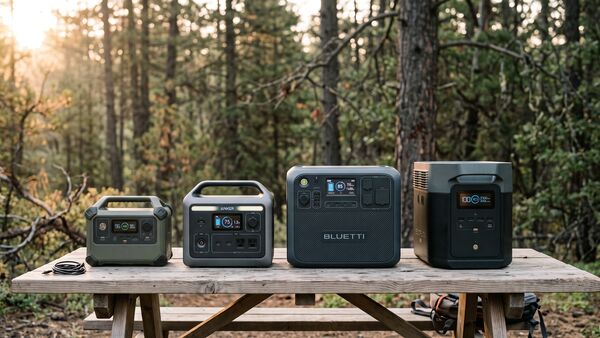
Weight and bulk should match the intended use, not just the capacity you're after. A 3 to 5 kg station slips into a backpack or car boot without a second thought; above 10 to 12 kg, a sturdy handle (or even wheels on the largest home-backup models) becomes essential for comfortable use.
The form factor dictates real-world usage: compact stations favour mobility over capacity, 10 to 20 kg models strike a balance for van life or family camping, and stations above 20 kg, meant to stay put (garage, basement, utility room), favour capacity and expandability over portability.
Do you need an expandable power station?
Some stations accept one or more expansion batteries, add-on modules that connect to the main unit to multiply capacity without changing the whole device. This is a decisive criterion for home-backup use: you start with a modest, affordable capacity, then add modules as your budget or needs grow, up to several dozen kilowatt-hours on some ecosystems.
Conversely, for nomadic use (camping, van, hiking), expandability matters little: weight and bulk come first, and a well-sized fixed capacity from the start is enough. Before buying, check whether the model you're eyeing belongs to an expandable ecosystem: not every station offers it, and adding a module isn't always backward-compatible across a brand's generations.
Our 4-question method to choose
Four questions are enough to frame a power station purchase before even comparing models against each other:
- Which devices, and for how long? This sets the minimum capacity (Wh), safety margin included.
- What starting power do my compressor or motor-driven appliances need? This sets the minimum output power (W), continuous and peak.
- Nomadic use or home backup? Nomadic use favours weight and portability; home backup favours capacity, expandability and AC charging speed.
- What charging sources are available on the ground? Mains only, solar, car socket, or a combination: this points you towards multi-source-compatible models.
Once these four answers are settled, comparing models becomes much simpler: check our ranking of the best power stations, which scores 50 models on an identical grid (capacity and efficiency, sustained power, charging, connectivity, build quality, noise).