

Why two identical road trips do not use the same power
After ten years fitting out vehicles, the question we hear most often is the wrong one. People ask us « how many days will 100 Ah last? », when the only honest answer starts with « where are you going, and in which month? ». Runtime is not a property of your battery: it is the result of a daily subtraction between what your panels produce, what the alternator recovers while you drive, and what you consume.
That is not a figure of speech. The horizontal solar irradiation measured by PVGIS, the European Commission service, gives 7.92 kWh/m² per day in Andalusia in July, against 0.53 kWh/m² per day in Scotland in January. The same panel, lying flat on the same roof, therefore produces fifteen times less. All of a road trip's electrical planning lives inside that gap.
How much sun by destination and month?
Here are the real figures, in kWh/m² per day, for average horizontal irradiation over the five years 2016 to 2020. Horizontal is the right quantity for panels lying flat on a vehicle roof, which is the most common case.
| Region | January | April | July | October |
|---|---|---|---|---|
| Scotland | 0.53 | 3.55 | 4.48 | 1.45 |
| Southern England | 0.79 | 3.96 | 4.99 | 1.66 |
| Brittany, Normandy | 1.05 | 4.42 | 5.97 | 2.10 |
| Rhône valley | 1.42 | 4.86 | 6.60 | 2.42 |
| Provence | 1.96 | 5.55 | 7.45 | 2.95 |
| Central Italy | 2.05 | 5.20 | 7.04 | 3.04 |
| Andalusia | 2.78 | 5.95 | 7.92 | 3.63 |
| Morocco | 3.80 | 6.55 | 7.70 | 4.63 |
Three lessons jump out. First, the winter to summer gap is far more brutal than the north to south gap: between January and July in Brittany, production is multiplied by nearly six. Second, leaving in April or October changes everything: April behaves almost like July, October almost like January. Third, heading south never fully compensates for winter, unless you cross the Mediterranean.
The fridge decides everything else
In a fitted-out vehicle, cooling regularly accounts for 70 to 85 % of daily electricity use. Everything else, LED lighting, water pump, phone charging, router, fits in the crumbs. Put another way, sizing an installation without first quantifying your fridge makes no sense.
A 90 litre compressor fridge uses between 536 and 995 Wh over 24 hours at 30 °C (86 °F) in partial shade, or 58 Ah at 12 V for the typical value. At 12 °C (54 °F) the same unit drops to 90-153 Wh, or 9 Ah. Outside temperature therefore swings your main load by a factor of six, and once again it is the destination and the month that set it.
The case you absolutely need to know is the three-way absorption fridge running on 12 V. It has no thermostat: its heating element runs continuously, and it draws around 225 Ah per day. That is more than four times a 100 Ah lead-acid battery. On gas or on mains it is very useful; on the leisure battery while parked, it empties it in half a day. Our fridge consumption calculator quantifies both families and offers around a hundred real models from the market.
How much panel and battery for your route?
The calculation rule is simple, and it beats any ready-made chart. Your panels' daily output is roughly: peak power in Wp, multiplied by the irradiation from the table above, multiplied by 0.72. That last coefficient bundles the MPPT controller's efficiency, cabling losses, soiling and cell temperature. With an entry-level PWM controller, use 0.56 instead.
A concrete example. With 200 Wp in Provence in July: 200 × 7.45 × 0.72 = 1,073 Wh per day. The same kit in Brittany in January: 200 × 1.05 × 0.72 = 151 Wh per day. Against a daily need of 700 Wh, the first case is comfortably in surplus, the second barely covers a fifth.
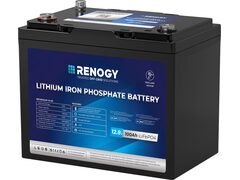
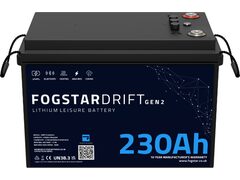
On the battery side, what matters is not the rated capacity but the energy you can actually use. A 100 Ah lead-acid or AGM battery should not go below 50 % if you want it to last, so around 620 Wh available. A 100 Ah LiFePO4 accepts 90 % depth of discharge, so around 1,150 Wh. At identical rated capacity, lithium therefore delivers nearly double, which explains its wholesale adoption in camper conversions despite the price.
To avoid doing the arithmetic by hand, our runtime simulator produces the full balance with the 19 regions from the table, the 42 most common loads and a trip mode that plots your state of charge day by day over the length of the journey.
Driving, the only charging that ignores the weather
Many road trips fail electrically because they are planned as static stays. Yet as soon as you drive, the alternator becomes your best source, and the only one that works in the rain.
Watch the device, though. A plain voltage-sensitive relay regulates nothing: charging drops away quickly as the leisure battery's voltage climbs, and on recent vehicles with a smart alternator it collapses further still. Count on around 12 A effective. A DC-DC charger, by contrast, holds its rated current: 27 A effective for a 30 A model, 45 A for a 50 A one.
In practice, two hours of driving a day with a 30 A DC-DC brings in around 690 Wh, which is more than 200 Wp of panels deliver in the depths of January at British or French latitudes. On a winter route where you move camp every two or three days, that charging is what saves you, not the solar.
Three routes, three different installations
Here is how we size three profiles we meet constantly, with a daily need of around 700 Wh including a 90 litre compressor fridge.
| Route | Solar advised | Battery | Charging while driving |
|---|---|---|---|
| Atlantic coast in July | 200 Wp | 100 Ah LiFePO4 | optional |
| Spain and Portugal in April | 200 Wp | 100 Ah LiFePO4 | useful in bad weather |
| Alps or Scotland in January | 400 Wp | 200 Ah LiFePO4 | essential, 30 A DC-DC |
The third case deserves an explanation. In January at those latitudes, even 400 Wp only produce 150 to 300 Wh per day. No sensible quantity of panel covers a 700 Wh need. The right answer is therefore not to pile on solar, but to combine a bigger reserve with alternator charging. Oversimplified calculators hide this point, and it costs dearly when you learn it on the road.
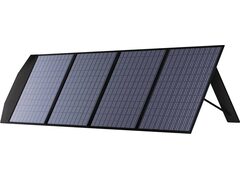
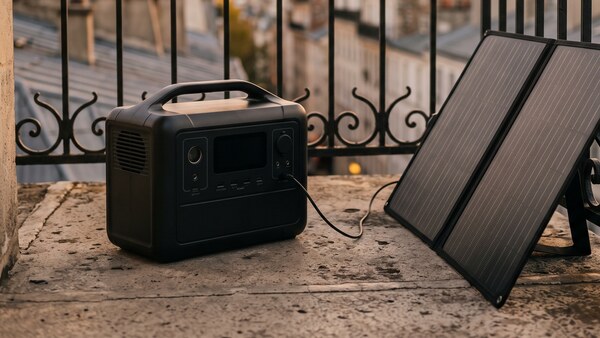
If you are starting from scratch, look first at our portable solar panels and our power stations: depending on whether your vehicle is already wired for 12 V or not, the simplest solution is not the same.
The checklist before you turn the key
Seven checks, in order, that avoid most of the nasty surprises.
- Quantify your fridge before anything else: it is 70 to 85 % of the total.
- Note the irradiation for your destination in your departure month, not the annual average.
- Work out usable energy, not rated capacity: 50 % for lead-acid, 90 % for LiFePO4.
- Check your controller: moving from PWM to MPPT gains nearly 30 % of output, often for less than the price of another panel.
- Clear the fridge vent: an obstructed grille can make the unit run almost non-stop.
- Plan for the grey scenario: three overcast days in a row, not the monthly average.
- Decide your driving rhythm: it is your only guaranteed charging.
A last word on mindset. A well-sized installation is not one that covers the average, it is one that absorbs the bad week. The irradiation data we use are measured monthly averages, clouds included: a genuinely grey day produces about 30 % of that average, a bright one about 35 % more. It is that range, not the middle figure, that you should look at before leaving.