
How we chose
A rigid solar panel is not chosen like a portable one you stow in the boot between uses. Permanently fixed to the roof, it has to last for years, withstand road vibration, rain and temperature swings, while staying light enough not to eat into the vehicle's payload. For this selection, we weighed five criteria:
- Cell efficiency: expressed in %, it determines how much power you get from a given roof area, always a limited resource on a van or motorhome.
- Weight per surface area (kg/m²): a rigid glass-and-aluminium panel weighs noticeably more than a portable or semi-flexible one, a parameter to watch so as not to exceed the vehicle's gross weight rating.
- Waterproofing and ruggedness: IP rating, aluminium frame, resistance to vibration and impacts from hail or branches.
- Voltage and connector: open-circuit voltage must stay within your MPPT controller's input range, especially when wiring several panels in series.
- Warranty: a panel fixed to a roof is hard to replace mid-season, so the manufacturer's warranty length is a real trust signal.
Worth noting: these panels are permanently installed, unlike the models in our best portable solar panels comparison, designed to be unfolded and packed away at every stop. The two uses complement each other rather than compete.
Why choose a rigid panel over a portable one for the roof?
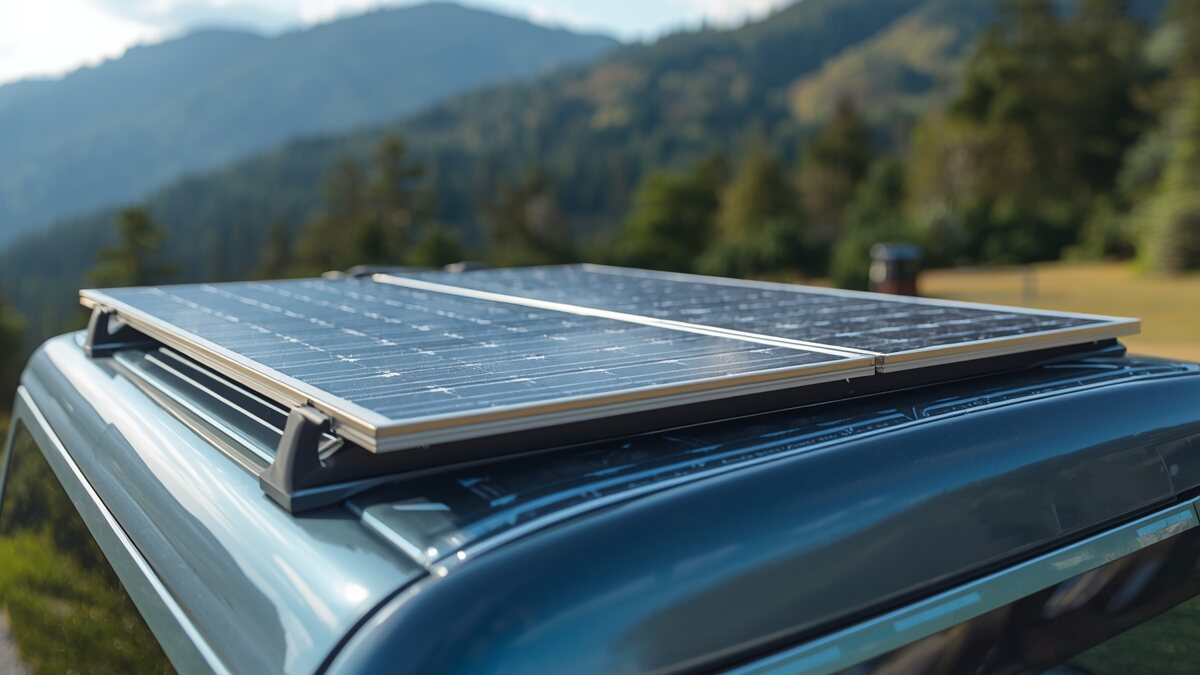
The main appeal of a rigid roof-mounted panel is that you never have to think about it again. No unfolding it, laying it on the ground and packing it away before setting off: it charges the battery continuously, even on the move, as soon as the sun hits it. It's the natural choice for a van conversion or a motorhome used regularly, where a portable panel suits occasional use or a camping top-up better.
The flip side: once installed, its orientation and tilt are fixed by the shape of the roof, usually flat. A portable panel can be manually angled toward the sun at every stop, which partly offsets its lower ruggedness. The two approaches actually complement each other well: many travellers pair a rigid roof panel for baseline charging with a portable panel for extra power on days spent parked in partial shade.
Rigid or semi-flexible: which one for a van roof?
The semi-flexible panel (no aluminium frame or glass, a thin ETFE or PET laminate) is appealing for its weight: 2 to 4 kg for 100 to 400 W, against 6 to 22 kg for an equivalent rigid model, roughly three times lighter per square metre. On a motorhome where payload is already counted kilo by kilo, that argument carries real weight.
Another common difference: warranty. Rigid glass-and-aluminium panels typically carry a 10 to 25 year power output warranty, while many semi-flexible panels are limited to 2 to 5 years, their laminate being more prone to ageing and micro-cracks. Some manufacturers do buck that trend with extended warranties, so always check this figure product by product rather than trusting a general rule. For a sufficiently large flat roof and a permanent install, a rigid panel remains our default recommendation; semi-flexible keeps its appeal on a curved roof or as a light add-on.
Technical criteria to check before buying
Beyond efficiency and weight already covered, three technical points avoid nasty surprises at install time:
Open-circuit voltage (Voc). Every panel has a no-load voltage that rises in cold weather. Wiring several panels in series adds these voltages together: check they stay below your MPPT controller's maximum input voltage before wiring, or risk damaging it.
The MC4 connector. It's the near-universal standard on rigid panels for motorhomes, compatible with the vast majority of MPPT controllers on the market. If you wire it yourself, simply check polarity and that the crimped connectors are properly sealed.
IP waterproofing. An IP65 rating protects against water jets, IP68 against temporary immersion: more than enough for permanent exposure to the elements on a vehicle roof.
Browse our full range in the nomad solar section.
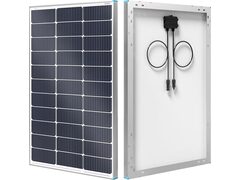
1. The entry-level compact: Renogy Rigid Panel 100W
At 5.9 kg (13 lb) for 0.5 m², the Renogy 100W is the lightest rigid panel in our selection, and the most affordable. Its monocrystalline cells deliver 20% efficiency, decent without being outstanding, and its aluminium frame with an IP65 rating easily handles road vibration. Its 10-year warranty is a pleasant surprise for an entry-level price.
A solid choice to round out an existing setup or start a modest roof top-up on a budget, with a standard MC4 connector that makes it easy to hook up to most power stations on the market.
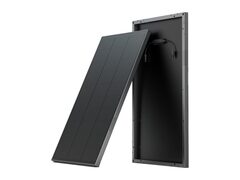
2. The best efficiency: EcoFlow Rigid Panel 100W
For the same power output and a very similar weight (6.2 kg / 13.7 lb), the EcoFlow 100W climbs to 23% efficiency thanks to more capable cells, and steps up to an IP68 rating (temporary immersion) where the Renogy settles for IP65. On the same roof area, it therefore produces more, an advantage when space is tight.
Its 5-year warranty is shorter than some competitors, a point to weigh against its better efficiency depending on your intended use.
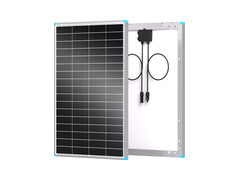
3. The technical upgrade: Renogy 16BB 175W
16BB refers to the cell technology (16 busbars instead of 9 or 12 on older panels), which improves current collection and reduces resistive losses. At 9.6 kg (21.2 lb) for 0.85 m² and 20.6% efficiency, it strikes an excellent balance between power output (175 W), footprint and weight per square metre. Its IP67 rating easily handles rain and splashes, backed by a 5-year warranty.
It's an interesting mid-size option for a medium van roof, between the small 100 W top-up and the large 400 W panels reserved for the biggest roofs.
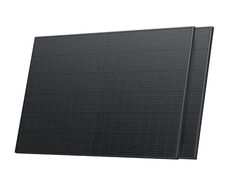
4. The high-capacity option: EcoFlow Rigid Panel 400W (pack of 2)
For a setup aiming at near-total independence, EcoFlow's 400 W panels (sold in a pack of two) add up to 800 W on the roof, with 23% efficiency and IP68 waterproofing. At 21.8 kg (48.1 lb) each, or roughly 11 kg/m², the weight stays in line with other rigid panels despite their large size (1.72 x 1.13 m / 5.6 x 3.7 ft each).
A 10-year warranty comes with this format, consistent with an install meant to last the vehicle's lifetime. Check the available roof space before ordering: two panels this size take up nearly 4 m² (43 sq ft), which not every van roof can offer.
Roof installation: mounting, wiring and sealing
Three mounting methods coexist: bonding with double-sided VHB adhesive foam, L-brackets bolted to the roof rails, or a mini roof rack fixed to the vehicle's factory anchor points. Adhesive alone rarely holds up over time against road vibration: most installers combine adhesive with bolted brackets, running a bead of silicone or polyurethane sealant (Sikaflex-type) around every drilled point to keep the roof watertight.
Positive and negative cables pass through the roof via a cable gland (or a dedicated double waterproof cable entry), never through a bare drilled hole. The cables then reach an MPPT charge controller, installed inside the vehicle, which matches the panel's voltage to the battery's and optimises charging according to actual sunlight.
Fixed angle: the real impact on output
Unlike a portable panel that can be tilted toward the sun, a rigid panel bolted to the roof sits almost flat (close to a 0° angle). Peak panel output in temperate Europe is achieved with a 30 to 35° tilt facing the equator, and industry guidance considers that a tilt between 20° and 60° causes no significant loss. Mounted flat, a roof panel therefore falls outside that optimal range and typically produces less than a correctly tilted one, with the gap more pronounced in winter (low sun angle) than in midsummer.
That loss is an accepted trade-off: the simplicity of a fixed, maintenance-free install is well worth it for everyday use. To estimate expected output for your latitude and your roof's actual tilt, the European Commission's free PVGIS tool lets you model different scenarios before buying.
Recap: which rigid panel for which profile?
| Model | Power | Efficiency | Weight | Weight/m² | Waterproofing |
|---|---|---|---|---|---|
| Renogy 100W | 100 W | 20% | 13 lb (5.9 kg) | 2.4 lb/sq ft (11.8 kg/m²) | IP65 |
| EcoFlow 100W | 100 W | 23% | 13.7 lb (6.2 kg) | 2.2 lb/sq ft (10.8 kg/m²) | IP68 |
| Renogy 16BB 175W | 175 W | 20.6% | 21.2 lb (9.6 kg) | 2.3 lb/sq ft (11.3 kg/m²) | IP67 |
| EcoFlow 400W (x2) | 400 W (x2) | 23% | 48.1 lb (21.8 kg) each | 2.3 lb/sq ft (11.2 kg/m²) | IP68 |
In short: for a small top-up, the Renogy 100W stays the most budget-friendly; for the same power with better efficiency, the EcoFlow 100W takes the lead; the Renogy 16BB 175W offers the best mid-range compromise; and for near-total independence on a large roof, EcoFlow's 400W pair remains the reference. Pair your choice with a power station or a lithium battery sized to your daily consumption.