
How we chose
A jump starter is bought hoping never to use it, but the day you need it, it must not let you down. Our criteria:
- Power matched to the engine: peak current matters less than the real ability to crank your displacement, petrol or diesel.
- Safety: protection against reverse polarity, short circuits and sparks. Non-negotiable.
- Internal battery capacity: it sets the number of possible starts before recharging.
- Versatility: many also serve as a power bank (USB ports), even as an air compressor or a light.
- Ruggedness and cold tolerance: it is precisely in winter, in the cold, that you need it.
Five jump starters, five profiles, from the occasional rescue to the demanding professional.
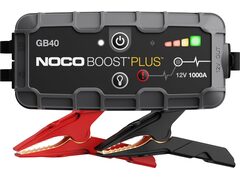
1. The versatile reference: NOCO Boost Plus GB40
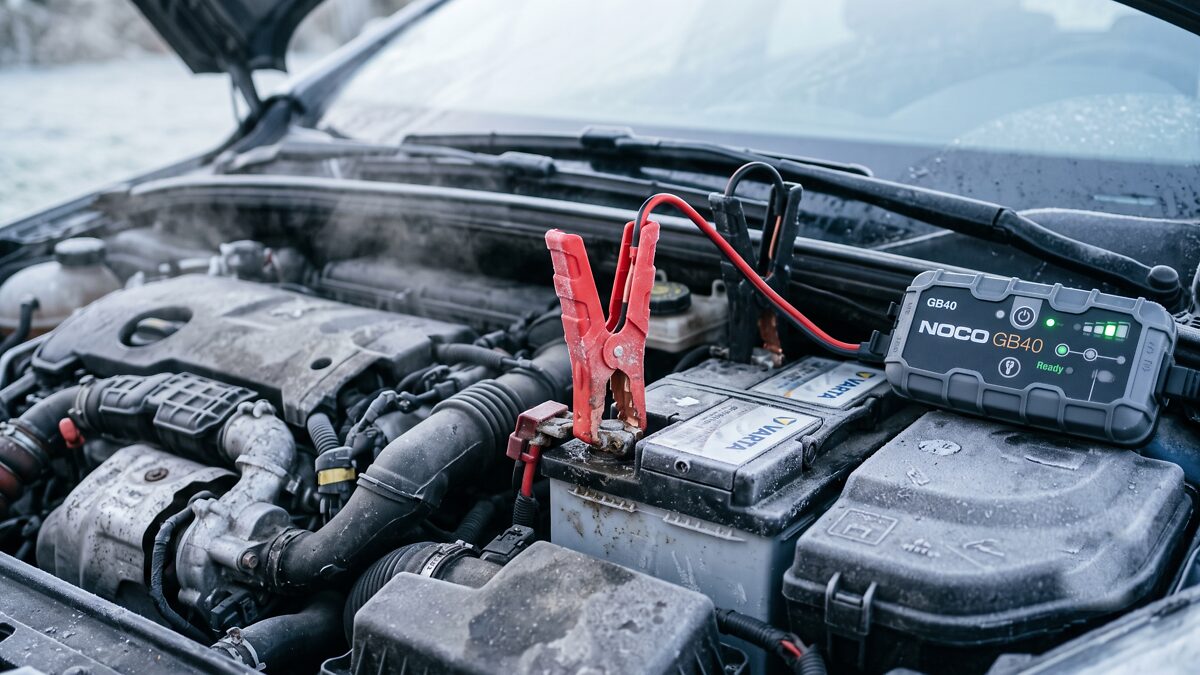
This is the model we recommend most often, and the one many mechanics keep in their boot. With 1,000 A of peak current, the NOCO GB40 effortlessly starts the vast majority of petrol cars and small diesels. Its smart clamps protect against reverse polarity and sparks: impossible to get it wrong, even in the dark.
Compact, it slips into the glovebox, works as a USB power bank to recharge a phone and includes an emergency light. Reliable, safe and enough for the vast majority of drivers: the default choice.
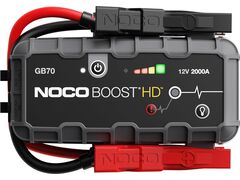
2. The heavyweight for big engines: NOCO Boost HD GB70
Big SUV, 4x4, van, large-displacement diesel, boat: when the GB40 reaches its limits, the GB70 takes over with 2,000 A of peak current. It restarts engines the small jump starters cannot even turn over, and takes several starts before tiring.
Heavier and pricier, it is aimed at those with a real need for power or several vehicles to cover. Its rugged build and energy reserve also make it an excellent backup power bank for gear. The choice of the demanding and of professionals.
3. The best value for money: DBPOWER 1600 A
Not everyone needs a premium brand. For occasional rescue on a petrol city car or saloon, a well-rated mid-range booster does the job perfectly at half the price. The DBPOWER, with its generous peak current and a screen showing the remaining level, ticks the essential boxes.
You still get the indispensable safety protections, USB ports and a light. The finish is less refined than a NOCO and longevity perhaps lower, but for rare emergency use, the value for money is unbeatable. Ideal for equipping a second car without breaking the bank.
4. The compact 2-in-1: pocket USB-C booster
The new generation of mini-boosters fits in the hand and does double duty: jump starter on one side, a real power bank with fast USB-C Power Delivery charging on the other. Perfect for those who want a single object in the bag, able to restart a small car and recharge a laptop.
The trade-off: a smaller energy reserve, so fewer consecutive starts, and power that tops out on big engines. For a city car, a scooter or a motorbike, and versatile on-the-go use, it is a clever, discreet companion.
5. The all-in-one: booster with compressor
For the adventurous and the cautious, some models combine a battery booster with a built-in air compressor. Flat battery and an under-inflated tyre the same morning? A single device solves both problems. A powerful light and USB outputs are often added.
It is the complete safety tool to keep in the boot for long trips, the mountains or remote areas. Bulkier, it fully earns its place as soon as you drive far from everything. A true breakdown Swiss army knife, to store alongside your other car accessories.
Using your booster safely
A booster handles large currents: a few simple rules prevent accidents.
Respect the connection order given by the maker: the red clamp on the positive terminal, the black one on a metal ground of the engine or the negative terminal depending on the model. Good boosters flag a polarity error and refuse to work: never force it if a warning light comes on.
Do not let the clamps touch while the device is on, and keep clear of the engine's moving parts. Once the vehicle has started, disconnect in reverse order and let the alternator recharge the battery as you drive.
Finally, a booster rescues but does not cure: if your battery keeps going flat, it is a sign it is at the end of its life or that an electrical fault is draining it. Have it checked, and plan to replace it before the next winter.