
A Hub, Not a Station: What the Hub 2000 Actually Does
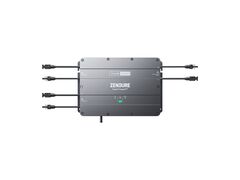
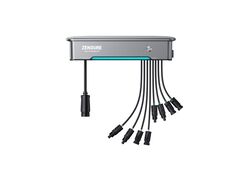
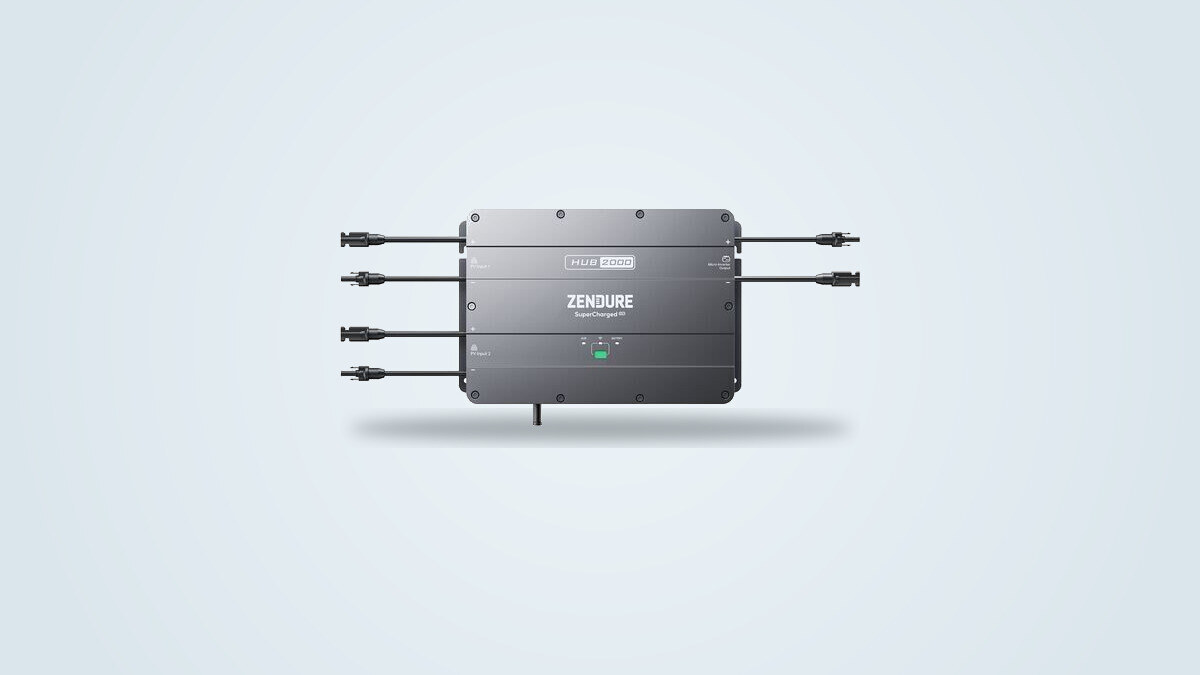
The Zendure Hub 2000 is not a standalone power station: it is an intermediate piece between balcony solar panels and the home's electrical circuit. Its role comes down to two precise tasks, regulating solar input through two independent MPPT trackers, and controlling the charge and discharge of Zendure's AB-series batteries. Unlike the Hyper 2000, which combines an inverter (1200 W) and four MPPT trackers in a single unit, the Hub 2000 supplies neither inverter nor battery: both are added separately, at the buyer's own expense.
This division of roles has a direct impact on the budget. The Hub 2000 alone sits around £399 (list price £499) from the manufacturer, well below an all-in-one system such as the Hyper 2000. But this price covers neither the AB battery, essential for storing any energy at all, nor the microinverter, essential for feeding power into the home. The Hub 2000 is aimed first at anyone who already owns one of the two pieces, or who prefers to choose them separately rather than buying a closed bundle. This two-block architecture, a direct-current hub paired with a separately certified microinverter, also makes it possible to stick with plug-and-play equipment rather than a hybrid inverter built into the consumer unit, which avoids the full electrical inspection that second scenario would require.
| Criterion | Zendure Hub 2000 | Zendure Hyper 2000 | Zendure SolarFlow 800 |
|---|---|---|---|
| Built-in inverter | No (external required) | Yes, 1200 W | Yes, 800 W |
| MPPT trackers | 2 (1800 W) | 4 (1800 W) | 2 (1200 W) |
| Expandable storage | Up to 7.68 kWh | Up to 7.68 kWh | Up to 11.52 kWh |
| Multiple units linked together | No | Yes, ZenLink | No |
1800 W of Claimed Solar Input: Two Official Figures That Do Not Match
The manufacturer's current product page states 1800 W of total solar input, split into 900 W recommended on each of the two MPPT trackers, with a tolerance of up to 2400 W of connectable panels. The user manual downloadable from that same site, however, states 1200 W recommended per tracker, or 2400 W recommended in total, with a maximum current of 26 A per input against under 32 A on the product page. Both figures come from official manufacturer documents, with neither presented as outdated.
Under a simulated lab solar charge combined at 1800 W, the input stays stable, with no cutout. Under that same load, a thermal camera in cool conditions (about 15 °C ambient) places the hottest point of the casing at around 32 °C and the connector at around 35 °C, for a rise of about 15 °C on the cells of the paired battery. The time needed to fill 3840 Wh of batteries at 1800 W runs close to two hours, consistent with simple arithmetic. The conversion efficiency, stated by the manufacturer at 98% on output and 99% for MPPT tracking, has no independent confirmation identified to date, however: treat it as a spec-sheet figure, not a verified result.
The fact that almost every retailer and comparison site repeats the total 1800 W figure is not an independent confirmation: it reflects the reuse of a single manufacturer press release, not a figure independently confirmed by each site that republishes it.
Choosing the Right Microinverter: the Real Ceiling Is Not the Hub's
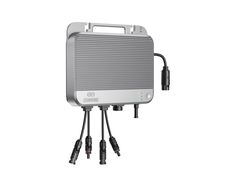
The Hub 2000 only prepares direct current: it is the microinverter chosen separately by the buyer that converts this energy into alternating current and sends it into the home. On the hub side, output to the microinverter caps at 1200 W according to the manufacturer's manual. On the grid side, a completely different limit applies: 800 W, the injection convention adopted in both France and Germany for balcony kits (covered further down). These are two distinct ceilings, at different points in the chain: the first belongs to the hub, the second to the chosen microinverter and to the regulatory framework of the country of installation.
The manufacturer states broad compatibility with microinverters on the market, with Hoymiles and Deye explicitly named; TSUN and APsystems round out the list of common pairings in the ecosystem. A practical limit emerges consistently across several installations, however: the Hub 2000 reliably drives two MPPT inputs on the microinverter side, no more, even when the chosen microinverter offers four. Connecting all four inputs of such a model through splitters then amounts to grouping two panels per input rather than exploiting the four channels separately, risking unstable regulation and a power ceiling that does not climb as high as expected.
| Brand | Finding |
|---|---|
| Deye | No compatibility difficulty identified |
| Hoymiles (multi-MPPT HMS series) | Unstable regulation between 30 and 90 W when all four inputs are used through splitters |
| APsystems EZ1-M | Ceiling stuck around 450 to 520 W after a microinverter firmware update, an issue acknowledged by the hub manufacturer's support team with a software fix announced |
What these frictions have in common is not the hub itself, but the difficulty of making two different brands of electronics work together, each with its own regulation logic. Checking the precise compatibility of the intended microinverter model, beyond the simple MC4 connector, remains the only way to avoid an unpleasant surprise after buying.
Up to 7.68 kWh of Storage: a Budget That Adds to the Hub
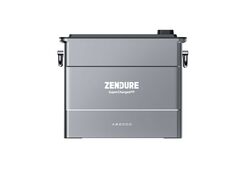
The Hub 2000 drives Zendure's AB-series batteries: the AB1000 (960 Wh) or the AB2000 and AB2000L (1920 Wh each), up to four units per hub, for 7680 Wh (7.68 kWh) at most. It also pairs with a SuperBase V. Charging power on the battery side changes with the number of units installed: it caps at 1200 W with a single AB2000, and climbs to 1800 W once two AB2000 units are connected. With a single AB1000, by contrast, it is limited to 800 W, raised to 960 W after a firmware update.
This expandability comes at a cost: a single AB2000L battery adds several hundred pounds to the price of the hub alone, and the budget climbs quickly when aiming for the full 7.68 kWh. Unlike the Hyper 2000, the Hub 2000 does not benefit from the ZenLink function, which links several units together to pool their power: each Hub 2000 remains an independent system, even when installed next to another one.
No Backup Power: a Consequence of the Architecture, Not an Oversight
The manufacturer's user manual is explicit on this exact point: this product cannot be used during a power cut. The mechanism is explained by the system's own architecture: the Hub 2000 only prepares direct current, and never produces alternating current itself; it is the external microinverter, plugged into the grid, that handles this conversion, and a microinverter of this type stops working the moment the grid goes down, for the safety of technicians who might be working on it. With no built-in inverter capable of running off-grid, the Hub 2000 therefore cannot power any device during a cut, even with fully charged batteries.
For this specific need, the manufacturer itself points to other references in its range capable of a backup mode, such as the Hyper 2000 or a dedicated accessory limited to a few hundred watts. A buyer whose main priority is a backup solution in case of a grid outage should therefore look elsewhere in the SolarFlow ecosystem: that is simply not what the Hub 2000 is for.
App and Control: Total Dependence on the Manufacturer's Cloud Service
Start-up follows an automated logic: on power-up, the Hub 2000 enters pairing mode on its own, detectable directly from the Zendure app. The system can wake up either from incoming solar power or from the battery's own supply, a useful point if the battery were to discharge completely: restarting the whole setup then needs either an available solar input or a prior mains charge of the battery. Compatibility with Shelly sensors makes it possible to fine-tune control based on the home's actual consumption.
One architectural point is worth knowing before buying: supervision never runs locally, it goes entirely through the manufacturer's cloud service. A server-side outage therefore makes every hub unreachable from the app, even when the local Wi-Fi connection is working normally. The Wi-Fi connection itself can drop recurrently, on the order of once a week in some cases, which requires a manual restart of the unit or the internet router to restore monitoring.
Fine-tuned injection control, which aims for zero consumption sent back to the grid, adds its own margin of error: when demand rises sharply, power only climbs in increments of a few watts per second, and reaching 800 W under real-time control can take several minutes, where the Hyper 2000 responds within seconds. A scheduled operating mode, less responsive by nature but simpler, runs stably for its part over several months: the slowness specifically concerns real-time control via a third-party clamp meter, not the scheduled operation. Some of the malfunctions attributed to the control logic also stem from this probe's clamps being wired in reverse, a source of error worth checking before blaming the hub itself.
Another behaviour worth knowing: when switching between battery charging and a direct pass-through mode (battery full, or the reverse), transmitted power briefly drops to zero, which causes a cutout of a few minutes on the microinverter side. This behaviour appears structural rather than occasional, and a software-managed switch-over without this cutout remains unaddressed to date.
France: the 800 W Threshold Is Not Set by the Often-Cited Order
The 800 W threshold repeated for balcony solar kits in France is often presented as based on an order dated 9 May 2017. A direct reading of that text on Legifrance, the French official legal database, shows that it actually covers the purchase terms for electricity produced by fixed installations using photovoltaic solar energy, up to 100 kilowatts-peak installed, with no connection at all to a wattage ceiling for small balcony kits.
The 800 W threshold actually comes from an operational convention set by Enedis, the French electricity distribution network operator, tied to the simplified declaration procedure (a self-consumption-without-injection agreement, or CACSI), rather than from a dedicated piece of legislation explicitly setting that precise value. This convention nonetheless remains the market practice widely followed by manufacturers, Zendure included.
On this point, one distinction matters particularly for the Hub 2000: the hub itself, on the direct-current side, is not directly bound by this threshold, since it can prepare up to 1200 W towards the microinverter according to the manufacturer's manual. It is the microinverter chosen by the buyer, on the alternating-current side, that must respect the locally adopted injection limit. The choice and configuration of the microinverter, not the hub's own specifications, therefore determine the installation's actual compliance.
Germany: a Clearer Legal Framework, an Ambiguity Specific to the Hub 2000
The German market has had a noticeably clearer framework since Solarpaket I, in force since mid-2024: an explicit legal cap of 800 VA on grid injection, for an installed module peak power of up to 2000 W. The only administrative step required is registration with the federal market master data register (Marktstammdatenregister), within a month of commissioning, with no separate declaration to the network operator.
An ambiguity specific to the Hub 2000 nonetheless complicates this registration: the manufacturer's documentation does not clearly specify, for this particular model, which coupling type to declare among the form's options, a detail that is, by contrast, explicitly given for the Hyper 2000. This documentation gap can leave a buyer unsure which value to enter (the hub's discharge power, the power assigned to the microinverter, or the battery's usable capacity), with no unambiguous answer provided by the manufacturer to date.
On price, the German market also benefits from a specific rate: the Hub 2000 alone sits there around £299 from the manufacturer, below the £399 charged across the rest of the euro area, a gap consistent with the VAT exemption applicable in Germany to small residential solar installations rather than with a distinct pricing policy.
Build Quality and Reliability: Two Years of Track Record, No Safety Incident Identified
The Hub 2000 has been on sale since 2024, giving it a noticeably longer track record than most of the more recent balcony kits in the same ecosystem. No safety incident or product recall has been identified for this specific model to date. A fire that occurred on an entirely different product from the brand, the AiO 2400 (an all-in-one unit with a built-in battery, a different architecture), concerns that other product exclusively and does not apply to the Hub 2000.
The IP65 casing withstands rain and dust for outdoor mounting, on a balcony, a roof or in a garage, with one caveat from the manufacturer itself: despite this sealing, full immersion in water means the unit must be scrapped rather than reused. An operating range of -20 °C to 45 °C is stated; at least one documented case around -3 °C shows a system refusing to output power despite available sunlight, resolved after manually warming the battery, which suggests a cold-protection logic more cautious in practice than the stated range alone would suggest.
The hardware friction points identified remain isolated: a contact fault on the cable connecting the hub to a battery, and a recurring recommendation to replace the original Y-splitter solar cables with better-quality ones whenever a contact is in doubt. After-sales service quality varies considerably from case to case, across a sample too small to draw a reliable trend from.
Against the Hyper 2000: When the Hub Remains the Right Choice
The Hyper 2000 packs into a single unit what the Hub 2000 spreads across several purchases: an inverter (1200 W), four MPPT trackers instead of two, and the ZenLink function for linking several units together. The Hub 2000 nonetheless keeps a clear advantage for two specific types of buyers: anyone who already has a compatible microinverter installed on their balcony and only wants to add storage, and anyone who prefers to build their own system piece by piece rather than buying a closed bundle.
The budget calculation must, however, factor in the two missing purchases. An AB2000L battery adds several hundred pounds, and a compatible microinverter adds several tens to more than a hundred pounds more depending on the model chosen. Once these two pieces are counted, the price gap with an all-in-one system like the Hyper 2000 narrows considerably, without always disappearing completely.
Who It's For, Who Should Look Elsewhere
It suits anyone who already has a compatible microinverter on their balcony and only wants to add storage at a lower cost, anyone who wants to build their own system piece by piece with a deliberate microinverter choice (Deye leading the pairings with no friction identified), and anyone who does not need a backup function in the event of a power cut.
It does not suit anyone looking for an all-in-one system with no extra piece to buy or configure, anyone aiming for backup power during a grid outage, or anyone planning to link several units together to pool their power, a function reserved for the Hyper 2000. The choice of microinverter deserves particular attention: pairings with models offering more than two MPPT inputs, driven through splitters, remain the most frequent friction point for this product.