
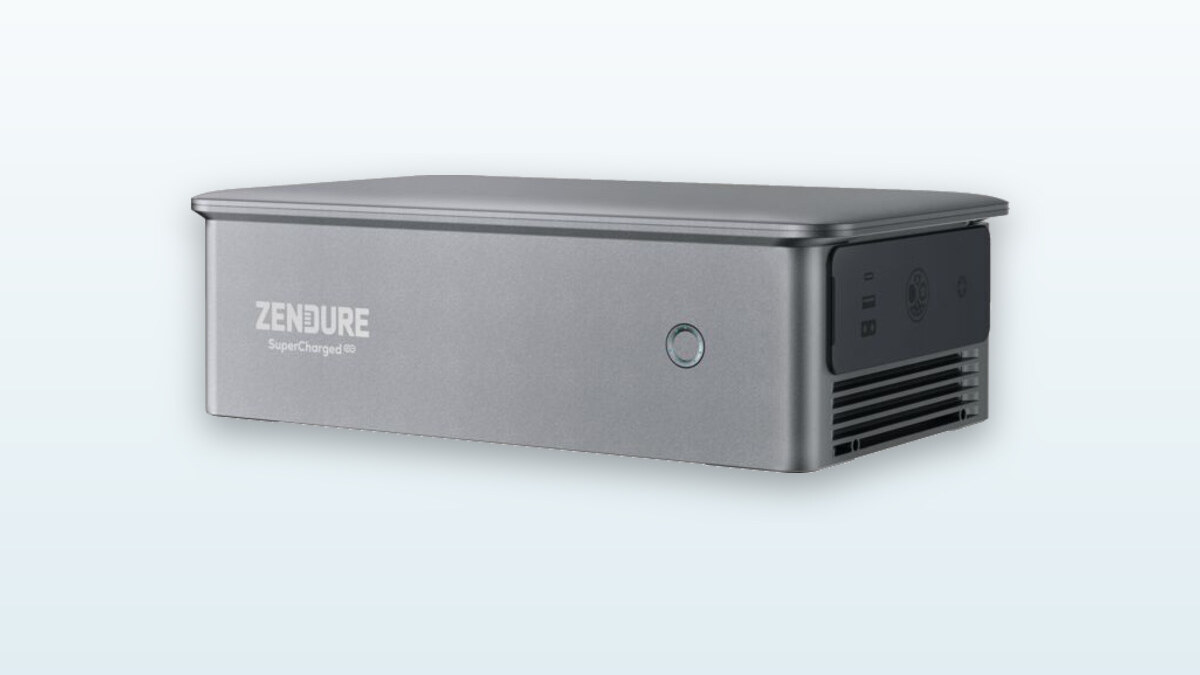
On paper: a hub, not a conventional station
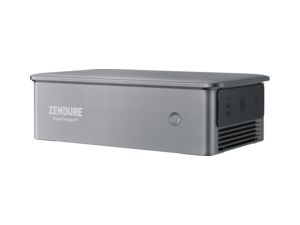
The Zendure Ace 1500 is a portable power hub that handles only energy conversion and distribution: it ships with no battery included. Its capacity comes entirely from the additional AB1000 (960 Wh) or AB2000 (1920 Wh) packs paired with it, up to 4 units and 7680 Wh in total. It delivers up to 1500 W continuous (3000 W peak), with two AC outlets, one 65 W USB-C port, one USB-A port and one bidirectional XT60 port for solar. Compact (4 kg, 326 x 200 x 108 mm), it is controlled over Wi-Fi and Bluetooth through the Zendure app.
On-grid: a backup function, not grid injection
The Ace 1500's on-grid mode is easy to misread: unlike a typical balcony solar setup, it does not feed any energy back into the home network. On-grid simply means the hub can charge from the mains (up to 900 W) and switch automatically to battery power during an outage, in around 20 ms, through its own built-in outlets. Energy always comes back out through the hub's own outlets and ports, never through the home's electrical panel. Genuine grid injection, the kind a balcony solar system provides, requires a different product in the Zendure lineup, pairing a separate hub with a standalone microinverter.
1500 W: an output that depends on how many batteries you have
The advertised 1500 W continuous output is not a fixed spec of the hub on its own: it depends directly on how many batteries are connected. With a single AB1000, continuous output caps at 960 W; with a single AB2000, at 1200 W. You need at least two batteries to reach the advertised 1500 W. A buyer who starts with just one battery should scale their power expectations down accordingly.
| Configuration | Continuous output |
|---|---|
| 1x AB1000 | 960 W |
| 1x AB2000 | 1200 W |
| 2 batteries or more | 1500 W |
6000 cycles: a headline number worth putting in context
The paired batteries (the hub itself has no cycle rating of its own, since it stores no energy) are rated for 6000 cycles at 70% remaining capacity, a figure that looks impressive at first glance. But it is the same battery rated elsewhere at 3000 cycles at 80%, the threshold most competitors in this segment use for comparison. At an equal comparison threshold (80%), the stated lifespan sits in the upper-average range for the market, without being exceptional: the 6000-cycle figure earns its headline effect by choosing a more generous measurement threshold than the one typically used elsewhere.
Asymmetric efficiency between charging and discharging
Measured efficiency is not symmetrical. On discharge, energy return reaches around 92% of stored energy, a good result. On mains charging, by contrast, losses climb to around 30%, for an efficiency of only about 70%. The USB-C and XT60 outputs, for their part, show efficiency close to 97%. This more pronounced charging loss is not an isolated case: an earlier generation in the same lineup showed the same behavior, with the inverter particularly inefficient at partial load.
Warranty: 5 years for the hub, 10 years for the batteries
The warranty differs between the hub and the batteries: 5 years for the Ace 1500 itself (1 year on accessories), but 10 years for the paired AB1000/AB2000 batteries, a notable duration for the category. Another point worth knowing: the original AB1000/AB2000 batteries are being phased out of Zendure's catalogue, replaced by a newer generation that adds an aerosol fire-suppression system. The exact battery model available at purchase may therefore differ from the one described here.
IP31 and plastic construction: the housing's real limits
The hub's housing is rated IP31 only, a modest level of protection against the elements: the manufacturer itself advises against using it in heavy rain, snow or storms. The paired AB1000/AB2000 batteries, by contrast, are rated IP65, considerably more resistant. The hub's construction is entirely plastic rather than aluminium, seen as lower quality than the rest of the lineup, and a plastic smell is noticeable at unboxing.
Software reliability: signals worth knowing about
Several signals, to be weighed with the caution their nature calls for, point toward software reliability concerns within the SolarFlow ecosystem: app updates that reduced control over operating modes, Wi-Fi connection bugs, and unexplained output cutoffs on the Ace 1500 itself in isolated cases. Most of the more detailed incidents, however, concern a different product in the lineup, the Hub 2000, paired with the same batteries: power drops, battery non-recognition and overheating appear among these incidents, with customer support described as slow but ultimately effective after escalation. None of this is enough to establish a failure rate, but it is worth knowing before buying.
The 1707 W figure explained
The 1707 W figure sometimes quoted for the Ace 1500 adds up the maximums of every output used at the same time: 1500 W on AC, 65 W on USB-C, 12 W on USB-A and 130 W on the XT60 port used as an output. It is not a continuous power figure you can actually stack, since the AC output alone already caps at 1500 W. The XT60 port is in fact bidirectional: it accepts up to 400 W of solar input, but can also deliver up to 130 W as a 12 V output for a compatible accessory, a useful detail missing from the product's usual presentation. In exchange, the Ace 1500 does not offer a standard 12 V cigarette lighter socket.
Who it suits, and who it does not
It suits anyone who wants to build their own storage capacity at their own pace, with a genuine automatic backup function during outages, without buying the conversion electronics again at every upgrade.
It does not suit anyone looking for a ready-to-use conventional power station (the price of the hub alone includes zero runtime), anyone who wants to feed energy back into the home network like a balcony solar system, or anyone who needs it for outdoor use exposed to the elements.