
A charger that drops cylindrical cells to focus on AA/AAA
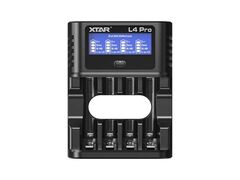
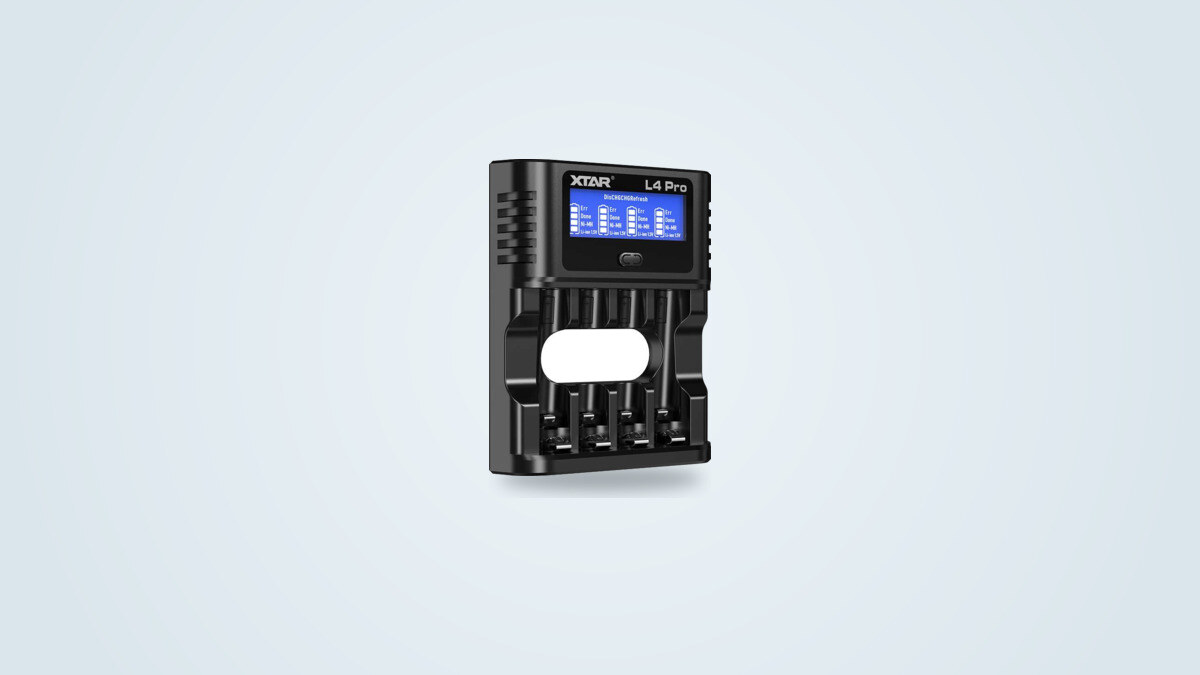
The Xtar catalogue already includes several four-bay chargers able to take both an AA battery and a cylindrical 18650 or 21700 cell. The L4 Pro takes the opposite approach: it focuses entirely on AA and AAA formats, in both 1.2V NiMH and regulated 1.5V Li-ion, a chemistry increasingly common in cameras, remote controls, and Bluetooth accessories. This narrower focus isn't just a marketing choice: it allows a simpler housing, a more compact contact mechanism, and a price noticeably below the brand's more versatile chargers.
The L4 Pro succeeds the plain L4, which used simple LED indicators instead of an LCD screen: the switch to a screen is the main upgrade of this Pro version, even before the regeneration functions detailed further down.
Two chemistries, four bays, detection that never picks the wrong profile
Each bay works independently of the other three: you can insert two partly discharged NiMH cells, a fresh 1.5V Li-ion cell, and leave the fourth bay empty at the same time, without one affecting the charge of the others. The charger identifies the chemistry of each inserted cell on its own and switches to the matching charge profile, with no fiddling or setup required.
This genuine independence isn't the norm on this segment: the GP ReCyko AR02, for instance, charges its cells in pairs or as a set of four with no individual distinction, which forces you to match cells at a similar charge level for an even result. The L4 Pro has no such constraint, a real argument against an entry-level charger, even though both share the same AA/AAA scope.
A fixed 500mA current, but precision that delivers
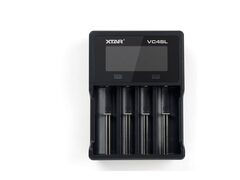
The L4 Pro delivers a constant 500mA per bay, whether one or all four are occupied at once: unlike the Xtar X4 (up to 2A with two cells) or the VC4SL (adjustable from 0.25A to 3A), nothing speeds up when charging just one cell, and no manual adjustment is offered. The trade-off for this simplicity is slower, but steady and predictable, charging.
On 2450mAh NiMH cells, restored capacity averages 2424mAh, a figure practically identical to what a dedicated analysis charger used as a benchmark delivers: the L4 Pro doesn't shortchange the cells' real capacity along the way, despite the lack of any numeric readout to check it yourself. The charge cutoff kicks in at 1.45V ± 0.1V for NiMH, with a cutoff current of 100mA maximum: thresholds in line with standard industry practice.
| Chemistry and capacity | Stated time |
|---|---|
| Xtar 1.5V Li-ion, 4150mWh | 2h54 |
| Xtar 1.2V NiMH, 2500mAh | 6 hours |
These figures apply to high-capacity Xtar cells charged across all four bays at once. In practice, an older NiMH cell can reach a full charge in a little over 3h30, and a set of fresh 2600mAh Xtar cells in a little over five hours: the gap comes down to each cell's condition and real capacity, with charging current always fixed at 500mA.
Charging that stays cool, the L4 Pro's most understated strength
Xtar's own CVSA (Constant Voltage and Stable Algorithm) technology splits charging into three stages instead of imposing a constant current from start to finish, explicitly to limit heat build-up in NiMH cells. On a full charge at 500mA, cell temperature doesn't exceed 29 °C to 31 °C in a room at 24 °C, barely 5 to 7 °C above room temperature.
That's noticeably less than what many fast chargers put their cells through, and it's a point that genuinely matters for the longevity of a stock of NiMH cells cycled regularly: a cell that heats up little ages better than one that heats up hard on every charge, even if the benefit isn't visible right away.
Discharge, Refresh, and 0V reactivation: the L4 Pro's real speciality
Beyond straightforward charging, the L4 Pro offers a Discharge mode for quick maintenance and a Refresh mode that runs several discharge/charge cycles in a row to ease the memory effect on NiMH cells. Across a set of four NiMH cells around ten years old, restored capacity averages a rise from 1847 to 1910mAh after a full Refresh cycle, a gain of about 3.4%, real but modest: Refresh gives a bit of a boost to cells that still work, it doesn't turn a tired cell into a new one.
The full cycle takes time: about 36 hours in total for a NiMH cell, with the discharge phase alone accounting for close to 6 hours at around 333mA. In short, Refresh is something you start the night before a day you won't need the cell, not right before heading out.
An important caveat: both functions only apply to NiMH cells. Regulated 1.5V Li-ion cells only get a standard charge, with no discharge or Refresh available. The micro-current activation technology, on the other hand, applies to NiMH cells that have dropped to 0V, which most consumer chargers detect as dead and simply refuse to charge.
A screen that informs without ever putting a number on it
The L4 Pro's backlit LCD screen shows, for each bay, the current mode (Charge, Discharge, Refresh), the detected chemistry (Ni-MH or 1.5V Li-ion), a battery icon that fills up as charging progresses, then a Done status at the end of the cycle or an Err code if there's a problem. A single button is enough to move between the four bays: it's more readable than a simple two-tone indicator light, and enough to check on four cells at a glance.
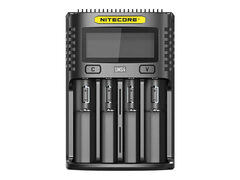
What the screen never does, though, is put a number on anything: no voltage, no current, no capacity in mAh, unlike the Xtar VC4SL or the Nitecore UMS4, which show all three figures per bay, and even internal resistance for the VC4SL. The L4 Pro runs entirely on automatic, with no current or mode setting to adjust by hand: that simplifies use, but leaves a curious owner without any precise tracking data.
Full protections and a 2-year warranty, on a still-young product
The L4 Pro brings together every protection expected on a charger left unattended: overcharge, overcurrent, overvoltage, short-circuit, reverse polarity, and soft-start current ramp-up. This last protection, combined with the thermal management already covered, limits the risk of a current or heat spike the moment a cell is inserted. The unit is CE, RoHS, and FCC certified.
The housing measures 102 x 80 x 27.5mm for 87g, cable excluded, a slightly larger footprint than Xtar's most compact AA/AAA chargers, without being bulky. The manufacturer states a 2-year warranty, a length several chargers in the same catalogue, the VC4SL included, don't state at all, matching the best warranty in the segment.
The one real caveat: the L4 Pro is a recent product, without several years of track record on long-term reliability. No structural issue shows up at this stage, but the model's age doesn't yet allow judging how it holds up beyond a few months of use.
USB-C everywhere, mains nowhere
The L4 Pro runs exclusively on USB-C at 5V/2A, via a 74cm cable included in the box. Despite what its shape might suggest, it never plugs directly into a mains outlet: it needs to be connected to a USB adapter, a computer, a power bank, or even a phone charger the owner already has.
That's a real flexibility win for anyone travelling or without a free mains socket near their desk, but it's also a frequent source of disappointment: no mains adapter is included in the box, only the cable. A buyer who doesn't already own a suitable USB charger will need to find one before using the unit, an extra cost and step the L4 Pro's list price doesn't hint at.
Against Xtar siblings, Nitecore, and AA/AAA specialists
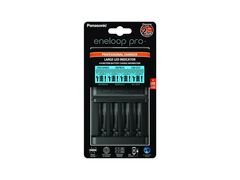
With seven battery chargers in the catalogue, the most useful comparison isn't only within the brand. The table below sets the L4 Pro against a versatile alternative (Nitecore UMS4), a minimalist one (GP ReCyko AR02), and a high-end alternative that's also limited to AA/AAA (Panasonic BQ-CC65).
| Criterion | Xtar L4 Pro | Nitecore UMS4 | GP ReCyko AR02 | Panasonic BQ-CC65 |
|---|---|---|---|---|
| Accepted formats | AA/AAA only | 10440 to 26650, plus AA/AAA | AA/AAA only | AA/AAA only |
| Chemistries handled | NiMH/NiCd + regulated 1.5V Li-ion | Li-ion, IMR, LiFePO4, NiMH/NiCd | NiMH only | NiMH only |
| Independent bays | Yes, 4 | Yes, 4 | No, in pairs or all 4 | Yes, 1 to 4 |
| Screen | LCD, no numeric value | Full LCD (V, A, mAh, health) | None, simple light | 3-inch LCD (V, mAh, Wh) |
| Regeneration | Discharge, Refresh (NiMH), 0V reactivation | Capacity test, internal resistance, regeneration | None | Refresh (discharge then recharge) |
| Power | USB-C 5V/2A, cable included | USB-C, Quick Charge needed for full speed | Direct mains | Direct mains 100-240V |
| Observed price | ≈ £15 | ≈ £29 | ≈ £9 | ≈ £70 |
This line-up sums up the L4 Pro's position well: it matches neither the versatility of the Nitecore UMS4 nor the display richness of the Panasonic BQ-CC65, but it clearly beats the GP ReCyko AR02 on bay independence and the range of chemistries handled, for barely more money. Against Xtar's own generalist siblings (VC4, VC4SL, VC8, VP4 Plus, X4), AA/AAA specialisation is only a real drawback for anyone who already owns cylindrical 18650 or 21700 cells: for a strictly AA/AAA use, it mostly translates into a simpler housing and a lower price, not a worse charge.
Who the L4 Pro is for
The L4 Pro is aimed first at anyone who only uses AA and AAA batteries day to day, whether classic NiMH or regulated 1.5V Li-ion for demanding cameras or accessories, and who wants a simple, automatic charger able to extend the life of a stock of cells through Refresh rather than binning them at the first drop in capacity.
It suits less well anyone who also owns cylindrical 18650 or 21700 cells for a flashlight or an e-cigarette: a second charger will be needed regardless, so it's worth looking straight at a Xtar VC4SL or a Nitecore UMS4, both able to cover both needs at once. It also suits less well anyone keen on tracking their cells' condition precisely over time: with no numeric value on screen, that kind of tracking simply isn't possible with this model, unlike the Panasonic BQ-CC65 or the VC4SL. Between these two profiles, the L4 Pro sits in a coherent spot: a serious AA/AAA charger, cheaper than a full-display specialist, more capable than an entry-level model.