
Nitecore UMS4 Charger
(20 reviews)
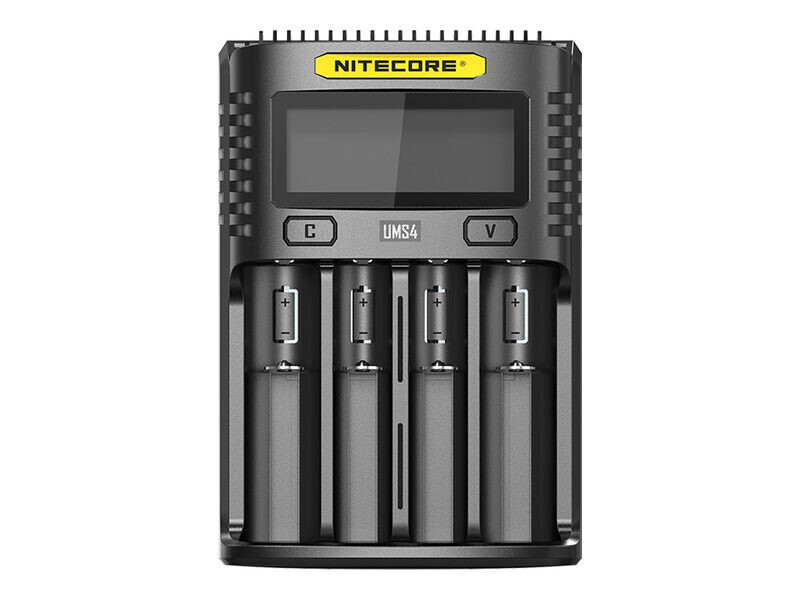
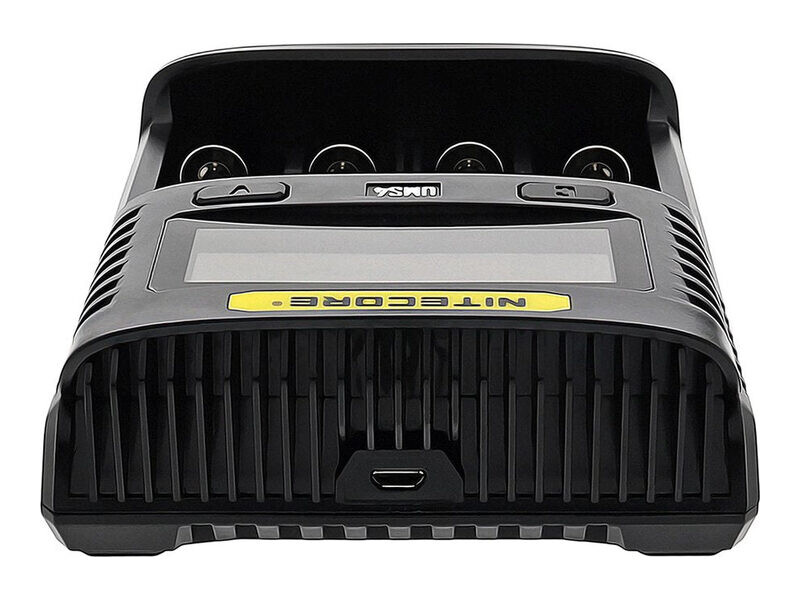
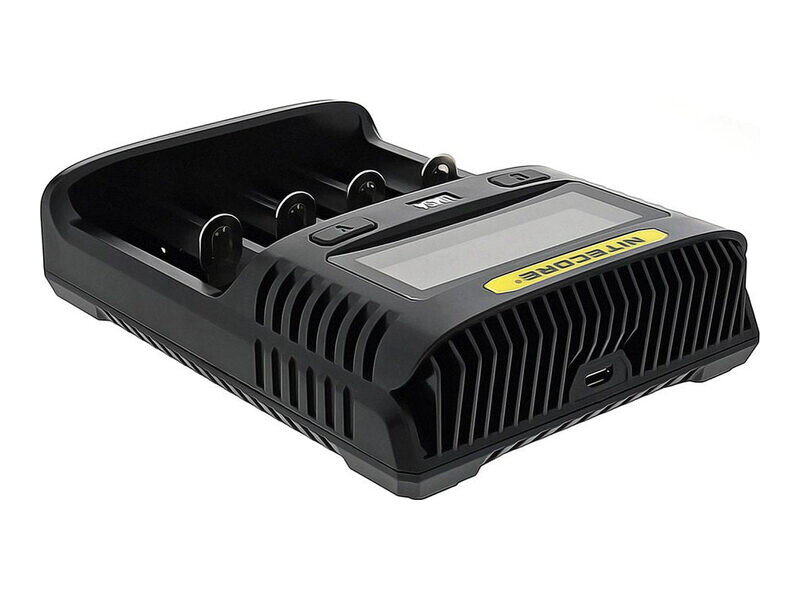
The four-bay big brother of the UM2: the Nitecore UMS4 charges four cells at once over USB, up to 3A per bay, with a large and very complete LCD screen.
Characteristics
- Bays: 4 independent bays
- Charging: USB QC input, up to 3A per bay (4A total)
- Display: LCD: voltage, current, capacity, health
- Compatibility: Li-ion 10440 to 26650 + NiMH AA/AAA
- Four cells at once with detailed LCD monitoring
Detailed overview: Nitecore UMS4 4-slot LCD battery charger
The Nitecore UMS4 is the four-bay version of the UMS range, built for anyone who charges a lot of cells: torch, vaping, photography and RC enthusiasts. It plugs in through a simple USB cable, automatically detects the chemistry of each cell inserted, and shows everything on a large, highly readable LCD screen.
Its compatibility is very broad. It recharges Li-ion, IMR and LiFePO4 cells in the most common formats, from 10440 to 26650, including the 18650, 20700 and 21700, plus rechargeable NiMH batteries in AA and AAA formats. The four bays are independent: you can charge four cells of different types, sizes or charge levels at the same time.
Speed depends on the power source. Plugged into a Quick Charge adapter, the UMS4 delivers up to 3A on a single bay, and up to 4A shared when several are occupied. The large LCD screen shows in real time, for each cell, the voltage, charging current, charged capacity, cell type, cut-off voltage and health, a far richer readout than simple indicators.
Three charging modes are available, from a gentle current to protect a small cell to a fast current for a large 21700. The UMS4 protects against reverse polarity and short circuits, and stops at the end of the cycle. For anyone who wants to charge and precisely monitor four cells at once, without multiplying chargers, the UMS4 is one of the best choices.
Full specifications
Detailed characteristics (EAN: 6952506492824)
Charging capacity
| Number of slots?Number of batteries that can be charged at the same time. | 4 |
|---|---|
| Compatible formats?Accepted battery formats (AA, AAA, 18650, 21700...). | AAAA, AAA, AA, C, D, 10440, 14500, 14650, 16340, 16650, 17350, 17500, 17650, 17670, 18350, 18490, 18500, 18650, 18700, 20700, 21700, 22650, 25500, 26650 |
| Compatible chemistries?Recognised battery chemistries (Li-ion, LiFePO4, NiMH, NiCd...). | Li-ion, LiFePO4, NiMH, NiCd |
| Max charging current?Maximum charging current per slot, in milliamps. | 3000 mA |
| Adjustable charging current?The user can manually pick the charging current. | Yes |
| Independent charging per slot?Each slot manages its own charge, independent of the other cells (different formats and chemistries can be mixed). | Yes |
Power input
| Power source?Built-in mains plug, USB port (Micro-USB or USB-C) or 12 V car socket. | USB-C |
|---|
Output and features
| USB output (device charging)?The charger can also act as a power bank: it uses the inserted cells to charge another device. | No |
|---|
Display and diagnostics
| Display?Type of visual feedback on charging status. | Detailed LCD screen |
|---|---|
| Automatic chemistry detection?The charger automatically adapts its charging profile to the inserted cell, with no manual setting. | Yes |
| Test / repair functions?Advanced functions beyond plain charging: real capacity measurement, internal resistance, reconditioning of worn cells, discharge cycles. | Real capacity test, Internal resistance test, Reconditioning / revival |
Size
| Weight?Weight of the empty charger, in grams. | 255 g |
|---|---|
| Dimensions (L × W × H)?Length × width × height, in millimetres. | 159 × 107 × 41 mm |
Warranty
| Warranty?Length of the manufacturer's warranty. | 1 year |
|---|
User manual / Instructions for use (PDF)
Our tester's review: Christophe Delpuech
The UMS4 is the charger we keep on the bench when juggling a lot of cells. Four bays, a large and very complete LCD screen that shows, for each cell, voltage, current, charged capacity, type and health, and fast charging that reaches up to 3A on one bay with a Quick Charge adapter. It swallows the 18650, 21700 and 26650 cells of torches without complaint, and also takes AA and AAA NiMH. We like its simplicity: one USB source, and everything reads at a glance. Two honest reservations: you need a good QC adapter to get the full 4A total, and there is no clean cut-off without unplugging. But for charging and monitoring four cells at once, it remains a safe bet.
In-depth review Nitecore UMS4: our full review 4.4/5 Read our full review → Actual charging current not measured Battery compatibility not measured Safety and protections 4.2 Build and endurance 4.0 Cables and connectors not measured Actually delivered power not measured Multi-port power sharing not measured Protocol compatibility not measured Size and technology not measured Format and chemistry compatibility 4.6 Charging precision 4.4 Display and control 4.5Frequently asked questions: Nitecore UMS4 4-slot LCD battery charger
Li-ion, IMR and LiFePO4 cells from 10440 to 26650 (18650, 20700, 21700, 26650...) plus NiMH batteries in AA and AAA formats. It automatically detects the chemistry of each cell inserted.
Four, in independent bays. You can charge four cells of different types, sizes or charge levels at the same time, each monitored separately on the LCD screen.
Plugged into a Quick Charge adapter, it delivers up to 3A on a single bay and up to 4A shared across the four. With a standard USB source, charging is slower.
Its large LCD screen shows, for each cell, the voltage, charging current, charged capacity, cell type, cut-off voltage and health, for precise monitoring.
Other products in the "Battery chargers (AA/AAA/18650)" category
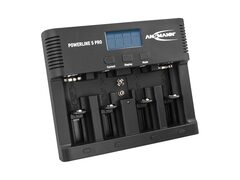
Ansmann Powerline 5 Pro charger
See price (17)
The charging and reconditioning station for enthusiasts: all formats (AA to D, 9V), LCD screen and test, discharge and refresh programmes to maintain your batteries.
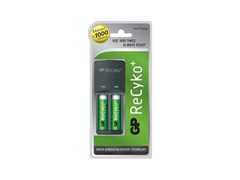
GP ReCyko AR02 charger
£8.54 (11)
The clever entry-level charger: simple, compact and affordable, supplied with 2 ReCyko AA cells ready to use. Perfect to start with rechargeables.
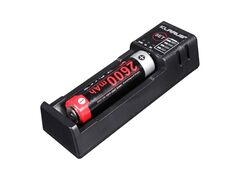
Klarus K1 Charger
See price (6)
The Klarus K1 charges your Li-ion cells and NiMH or NiCd batteries over USB from a single bay, with a clear LED indicator you can trust.
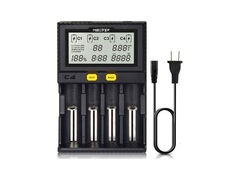
MiBoxer C4 Charger
See price (27)
The MiBoxer C4 charges 4 cells at once, shows voltage, current and capacity on its LCD screen, and even handles LiFePO4: the clever universal charger.
Published on 19/07/2026, updated on 14/08/2026