
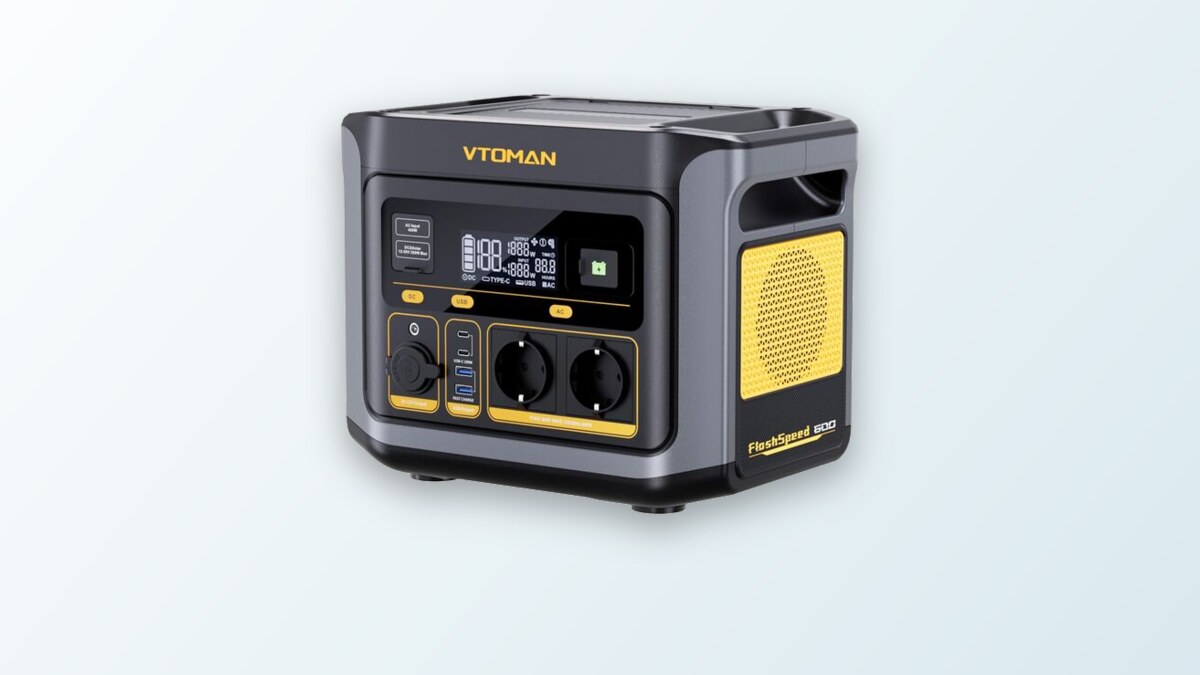
Up against its real rival: the Bluetti EB3A
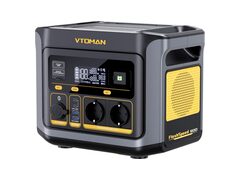
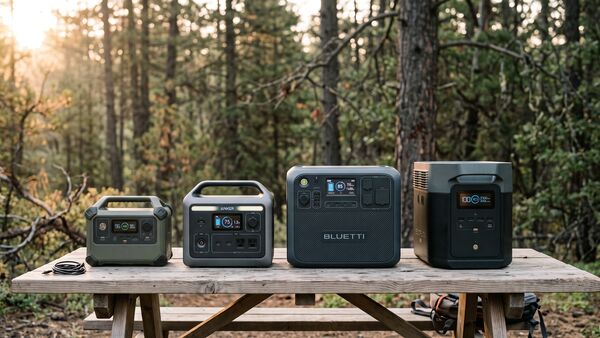
The FlashSpeed 600's spec sheet often puts it next to compact units like the Anker SOLIX C300 or the Jackery Explorer 300 Plus. That comparison is misleading: both of those models cap out at 300 W continuous, half the FlashSpeed 600's power output. The only device on the market that shares its exact power class (600 W continuous, 1200 W peak) is the Bluetti EB3A.
| Criterion | Vtoman FlashSpeed 600 | Bluetti EB3A | Anker SOLIX C300 | Jackery Explorer 300 Plus |
|---|---|---|---|---|
| Capacity | 499 Wh | 268 Wh | 288 Wh | 288 Wh |
| Continuous power | 600 W (peak 1200 W) | 600 W (peak 1200 W) | 300 W (peak 600 W) | 300 W |
| Observed price | ≈ 284 to 299 € | ≈ 269 € | ≈ 227 to 289 € depending on variant | ≈ 299 to 349 € |
| Price per Wh | ≈ 0.57 to 0.60 € | ≈ 1.00 € | ≈ 0.79 to 1.00 € | ≈ 1.00 € and up |
Against the EB3A, the only comparison at strictly equal power, the FlashSpeed 600 offers nearly double the capacity at a comparable price, a clear and easily verified gap. Against the SOLIX C300 and the Explorer 300 Plus, the comparison matters less: both of those models target a power need half as large, and a buyer whose real-world use tops out at 300 W has no reason to pay for extra capacity they will never use.
499 Wh and 600 W: what it really covers
On real everyday loads (a TV drawing around 200 W, two fans totaling around 90 W, a mini PC with an external monitor around 40 W), the unit runs normally. These observations stay qualitative, without a precise measurement of total energy drawn, but the takeaway is simple: for everyday electronics and small appliances, the FlashSpeed 600 delivers on its promise.
The limit is logical and expected: appliances with high instantaneous draw (microwave, hair dryer, toaster, induction hob) frequently exceed 600 W continuous and stay out of reach.
No dedicated power button: a real everyday irritant
The unit has no dedicated master power button. To start charging a plugged-in device, you have to press the button on the relevant output (AC or USB) to "wake" the electronics. This is not a malfunction, the unit charges normally once active, but it is a less intuitive setup than stations with a clear master switch, and it takes some getting used to on first handling.
The USB-C port: 100 W advertised, 12 W in practice
The USB-C port is rated at 100 W, a figure aimed at laptop charging. For phone charging, the power actually delivered caps around 12 W, well short of the fast charging you would expect, and even short of a standard wall outlet, which typically delivers more than 22 W to the same phone. This ceiling does not undermine the port's usefulness for higher-power use (a laptop), but it is worth knowing for anyone counting on this port to fast-charge a smartphone.
Fan and noise level: what's known, what isn't
No decibel measurement with a credible protocol is available for this exact model: the only figure found has neither a stated instrument nor a described procedure, and contradicts other figures on the same page. It is not used in this review.
The fan, on the other hand, kicks in frequently, including under moderate load, with a cycle in the range of 10 to 15 minutes, noticeable in a quiet room. With no reliable decibel figure to give, this qualitative observation is worth knowing before buying for indoor or bedroom use.
Real-world efficiency: an acknowledged unknown
No methodical measurement of actually delivered capacity (a full timed discharge under constant load, real Wh calculated) is available for the FlashSpeed 600. The topic is only addressed qualitatively ("as expected"), without precise instrumentation.
For context, and without this figure being attributable to the 600 model itself, a more powerful model in the same lineup (sharing the same battery management electronics the brand claims across the range) actually delivers a capacity more than 8 % below what is advertised. This is not proof of a similar gap on the FlashSpeed 600, but it justifies not assuming the advertised 499 Wh shows up in full during actual use, given the lack of data available for this exact model.
Expansion to 2047 Wh: sound on paper, never independently tested
Adding a separately sold add-on battery brings the advertised total capacity up to around 2047 Wh, a calculation that is arithmetically consistent with both components' specs. No test of this combined setup (pairing procedure, possible loss in use, real-world behavior) is available to date. This is a genuine blind spot rather than an established downside, worth keeping in mind for anyone considering this purchase specifically for its expandability.
A less established brand: what the available track record shows
Vtoman is a newer brand with less coverage from the specialist press than EcoFlow, Bluetti, or Anker. The brand's after-sales service is sometimes slow to respond, or even goes silent in the face of repeated follow-ups. On the FlashSpeed 600 itself, one unit stopped charging beyond 92 % before its first year of use, with email and chat follow-ups left unanswered. This is an isolated case, not a failure statistic, but its nature (a real fault, unreachable support) justifies mentioning it.
Other experiences with more responsive service exist too, so the picture is not uniformly negative. What remains is a brand whose after-sales consistency inspires less confidence than the sector's established names, without calling the product's basic operation into question for the vast majority of users.
The real price worth knowing
The catalogue price listed for the FlashSpeed 600 runs around 499 €, presented as a reference price against a permanent "promotion" that brings the real price down to around 299 €, an identical mechanism across several markets. In practice, the commonly observed price sits more between 284 and 299 €, a range that stays stable over time rather than a one-off exceptional deal. It is worth knowing this to avoid rushing into a "promotion" that is actually just the regular selling price.
Camping, remote work, backup power: where it shines
While camping, its 499 Wh and 600 W output cover a typical weekend: an electric cooler, a fan, lighting, and charging for several devices all run without trouble, with margin for extended use if the add-on battery is added. For nomadic remote work, it powers a laptop, an external monitor, and a home router or modem for a full day, and its UPS function (20 ms switchover) guards against brief power blips during a video call, even though the lack of a power button means getting used to pressing the right output to wake it.
As backup during a power cut, it keeps essential devices running (home internet box, phones, lighting) for several hours, but stays sized for topping up rather than full replacement: a fridge running continuously or an entire household will exceed its 600 W continuous output. On a film shoot or a light reporting assignment, it easily recharges camera batteries, drone battery packs, and microphones, with a built-in LED torch useful as backup lighting.
Who it suits, who it doesn't
It suits anyone looking for a compact 600 W class station with the best possible capacity for the budget, with no need for an app, Bluetooth, or flawless after-sales support if something goes wrong.
It does not suit anyone who needs reliable fast phone charging over USB-C, a very quiet environment, or who values above all the peace of mind of a long-established brand in case of a problem.