

A charger built to separate two electrical circuits
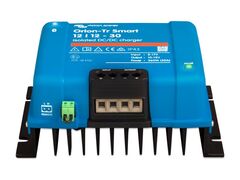
On a converted van or a boat, tying the starter battery's ground directly to the leisure battery's ground is not always possible or advisable. The Orion-Tr Smart Isolated answers exactly this case, with full galvanic isolation between the two circuits.
30A continuous, with power that varies by temperature
The unit delivers up to 30A continuous at 40 °C (40A for ten seconds), for 360W of power at that temperature and up to 430W at 25 °C. This dual temperature-based figure is a welcome piece of transparency, rare for this kind of product: it clearly shows that the actual power available depends on operating conditions, rather than quoting a single optimistic number. The current actually delivered at low engine speed (extended idle) remains manufacturer data, with no independent measurement to confirm it.
Lead-acid and lithium LiFePO4 through adaptive profiles
The unit is compatible with lead-acid batteries (flooded, Gel, AGM) and lithium LiFePO4, thanks to a three-stage adaptive charge algorithm (bulk, absorption, float) specific to each chemistry. The input accepts 8 to 17 volts, covering typical 12V systems with comfortable margin for alternator voltage swings.
Native Bluetooth, engine detection and smart alternators
Built-in Bluetooth gives access to the VictronConnect app to choose the battery profile, set the engine-detection start and stop thresholds, and track charging in real time. The unit works with variable-voltage smart alternators (Euro 6 standard), without always needing a dedicated ignition wire. Multiple units can be connected in parallel to increase the total power delivered to the leisure battery.
A 5-year warranty, but ventilation worth planning
The casing weighs 1.6 kg in a compact 130 x 186 x 81 mm footprint, and works from -20 °C to +55 °C, an operating range fully stated on the product page. Victron warrants the unit for 5 years. The casing runs properly hot at full power, normal behaviour given the electrical conversion involved, but worth planning some ventilation for if mounted inside a closed cabinet.
Against the non-isolated version and the Renogy DCC50S
How does the Orion-Tr Smart Isolated compare with other on-board charging solutions?
| Criterion | Orion-Tr Smart Isolated | Orion-Tr Smart non-isolated | Renogy DCC50S |
|---|---|---|---|
| Current | 30A | 30A | 50A |
| Galvanic isolation | Yes, 200V | No | Not stated |
| Solar MPPT input | No | No | Yes (built-in) |
| Observed price | £179.19 | ≈ £140 | £199.99 |
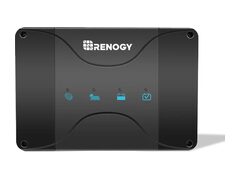
The non-isolated version of the same unit costs a little less and is plenty once the two battery grounds can safely be tied together. The Renogy DCC50S pushes current to 50A and adds a built-in solar MPPT controller, a genuine advantage for a van combining alternator and solar panels, but without the Victron's galvanic isolation. For a genuine need to electrically separate two circuits, the Orion-Tr Smart Isolated remains the reference.
Who the Victron Orion-Tr Smart 12/12-30 Isolated is for
This charger suits anyone with a genuine need to electrically separate the starter battery from the leisure battery, typically a modern van with sensitive electronics or a boat. If the two battery grounds are already common, the non-isolated version of the same unit is enough for less; for a setup combining alternator and solar, the Renogy DCC50S builds in both functions.