
What the 1080 Wh rating is really worth against depth of discharge
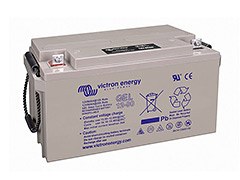
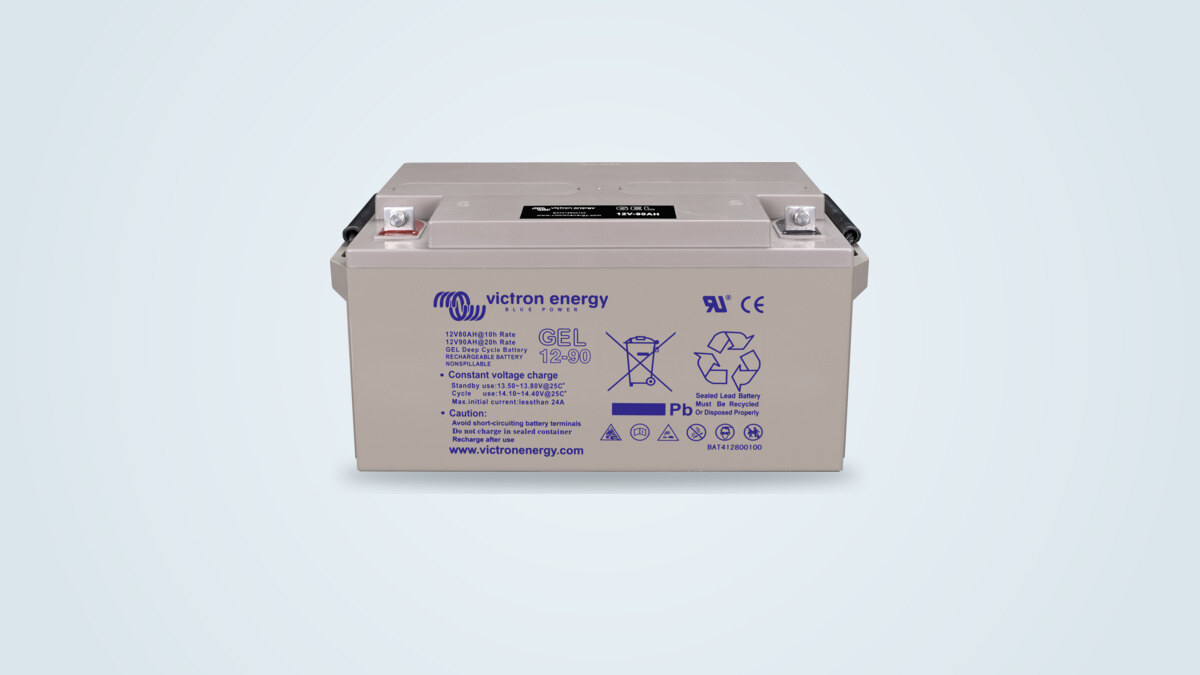
The technical sheet for this Victron battery shows 90 Ah at the C20 rate (a slow 20-hour discharge), and only 80 Ah at the faster C10 rate, for 1080 Wh nominal at 12V. This gap between C20 and C10 is not a flaw: it is a normal trait of any lead-acid battery, whose capacity mechanically drops as the drawn current rises. The figure that matters for a typical solar setup, with slow charge and discharge over several hours, remains the C20 rating.
The real question is not the nominal capacity, but the depth of discharge (DoD) it is actually cycled at. Victron publishes a table here that is unusually precise for this segment: 500 cycles rated at 80% depth of discharge, 750 cycles at 50%, and 1800 cycles at 30%. The shallower the daily discharge, the longer the battery lasts, a rule that applies to any lead-acid chemistry but that few competing manufacturers quantify with this level of detail.
At 50% depth of discharge, generally the recommended threshold for a Gel battery's longevity, it delivers around 540 Wh of usable energy out of the 1080 Wh rated. Pushing to 80% (the maximum covered by the manufacturer's table) raises usable energy to 864 Wh, but drops the cycle count from 750 to 500. Both figures are derived directly from the numbers Victron publishes, not from an independent measurement: no third-party test protocol was found for this specific 90 Ah model.
Against LiFePO4 lithium: an economic contest that has flipped
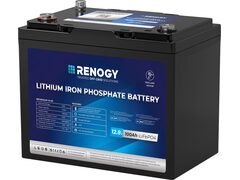
By 2026, the balance of power between lead-acid Gel and LiFePO4 lithium in this segment is no longer what it was a few years ago. A LiFePO4 battery like the Renogy 100Ah, already in the catalogue, is rated for 1280 Wh usable at 100% of its stated capacity and over 6000 rated cycles, for €209.99, a lower price than this Gel Victron's €245 even though it delivers far less usable energy.
| Criterion | Victron Gel 90Ah (this product) | Renogy 100Ah LiFePO4 |
|---|---|---|
| Nominal energy | 1080 Wh | 1280 Wh |
| Recommended discharge | 50 to 80% depending on longevity target | 100% rated |
| Actually usable energy | 540 to 864 Wh | 1280 Wh |
| Rated cycles | 500 to 1800 depending on depth | 6000 |
| Price | €245 | €209.99 |
On cost per actually-usable Wh alone, lithium now wins clearly, where lead-acid Gel still dominated this market on price not long ago. That does not make this Victron obsolete, though: it still works with any charger, solar controller or alternator relay already set up for a lead-acid chemistry, with no BMS handshake protocol to check, a real asset for completing or replacing an existing setup without changing anything else.
Self-discharge and long-term storage: Gel's real strength
Victron rates self-discharge for this Gel range under 2% per month at 20 °C, a rate that doubles for every 10 °C rise in ambient temperature. That is markedly better than a classic flooded lead-acid battery, and it avoids a constraint found on several LiFePO4 batteries already reviewed on this site, whose cell warranty is conditional on recharging at least every 3 months: no equivalent clause was found in Victron's warranty policy for this Gel range.
This comfort has a trade-off that modern lithium has specifically fixed: with no BMS, nothing actively disconnects the battery during a prolonged accidental discharge. A Gel battery left fully discharged for several weeks can suffer sulfation that permanently reduces its capacity, a risk a lithium battery's BMS generally avoids by cutting the discharge at a low voltage threshold before reaching that point. The lack of a quarterly-recharge clause does not remove the need for basic care before a long motorhome or boat lay-up: it is worth disconnecting it from any residual load and planning a top-up charge every 2 to 3 months as a precaution.
Early failures reported on this Gel range, put in perspective
The stated promise, up to 12 years of float service life and 500 to 1800 cycles depending on depth of discharge, does not hold up consistently in the field. Early failures exist on this same Victron Gel battery range, in several independent and converging cases: a capacity loss within 6 months to 2 years instead of the rated service life, including at moderate depths of discharge around 30%, well short of the 80% ceiling covered by the manufacturer's table.
In one specific case, a warranty claim was denied despite a complete charge and discharge history logged by a battery monitor from the same brand, which showed an average depth of discharge of only 30% with no deep-discharge event at all. These cases do not concern this exact 90 Ah model, and they are not unanimous: a contrary view also exists, which pushes back on how widespread the problem really is, and the overwhelming majority of product pages and retailer pages available for this model show no complaint of this kind.
This reserve does not erase Victron's overall reputation, but it is worth knowing before investing in the higher end of the brand's Gel range rather than an entry-level capacity that is easier to replace if a problem arises.
Safety and construction: the structural advantage of sealed lead-acid
Gel technology (VRLA, Valve Regulated Lead Acid) makes this battery fully sealed with no gas venting in normal use, relying on a pressure-relief valve rather than a water fill cap. It is rated compliant with both the European CE mark and the American UL standard, in a casing Victron describes as flame-retardant ABS. Unlike lithium, no electronic BMS protects this battery: that is as much a strength as a limitation, since there is no single electronic point of failure that could cut power abruptly, and no thermal-runaway risk comparable to a damaged lithium cell.
This sealed design allows installation in a poorly ventilated space (a motorhome locker, an enclosed technical room), a use case explicitly covered by the manufacturer and impossible with a classic flooded lead-acid battery, which vents hydrogen while charging. The product label lists a standby (float) voltage of 13.50 to 13.80V at 25 °C, a cycle-charge voltage of 14.10 to 14.40V at 25 °C, and a maximum initial charge current under 24A: useful reference points for manually configuring a charger or controller that does not offer a preset Gel profile.
Against the Antarion Gel 125Ah: same chemistry, two different ratings
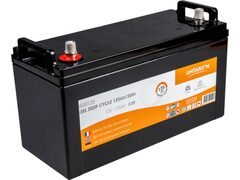
In the still-limited segment of Gel batteries aimed at nomadic solar setups, the Antarion Gel 125Ah is the most direct rival by chemistry: same gelled-electrolyte technology, same lack of BMS or onboard electronics, for a larger capacity and footprint.
| Criterion | Victron Gel 90Ah | Antarion Gel 125Ah |
|---|---|---|
| Capacity | 90 Ah (1080 Wh) | 125 Ah (1500 Wh) |
| Cycles at 50% depth of discharge | 750 | 1000 |
| Weight | 26 kg | 36 kg |
| Warranty | 2 years | not stated |
| Price | €245 | €302.20 |
Antarion rates more cycles at the same depth of discharge (1000 versus 750 at 50%), though neither figure can be independently verified: both are manufacturer values, not third-party measurements. What genuinely sets Victron apart here is the transparency of its technical documentation: a full table across three depths of discharge, where most rivals in this segment settle for a single flattering figure without stating the matching depth of discharge, an issue that one finds elsewhere in the catalogue too. For a tighter budget and a more compact footprint, this Victron 90Ah remains the more sensible pick of the two; for anyone who needs more autonomy and can live with 10 kg more, the Antarion 125Ah takes the lead on capacity alone.
Charging and compatibility: the advantage of a classic lead-acid profile
This battery charges from any mains charger, solar controller or alternator relay offering a generic Gel or sealed lead-acid profile, including older equipment already installed before the purchase. That is a real practical advantage over LiFePO4 lithium, whose BMS sometimes struggles to communicate with a third-party charger not designed for its exact end-of-charge detection protocol, an issue already noted on other LiFePO4 batteries in the catalogue.
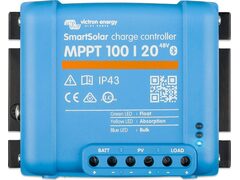
Victron's own solar controllers already reviewed on this site, such as the SmartSolar MPPT 100/20, ship from the factory with a ready-to-use Gel charge profile, with no manual setup needed for this exact battery. For a charger or controller from another brand with no Gel profile explicitly named, the voltages printed on the product label (13.50 to 13.80V on standby, 14.10 to 14.40V on cycle, both at 25 °C) are enough to configure a reliable custom profile.
Victron's reputation put to the test: strong electronics, shakier lead-acid
Victron built much of its reputation for excellence on its electronic products. On this site, the Phoenix 12/1200 inverter scored 4.5, the BMV-712 Smart battery monitor 4.4, and the SmartShunt 500A 4.3: three high, consistent scores, with no reliability reserve comparable to the one described above on the Gel range.
This Gel battery is a passive product with no onboard electronics: it does not automatically inherit the reputation built by the brand's powered products. The early failures seen above concern specifically the manufacturing and consistency of the lead cell itself, an industrial domain different from the power electronics or battery-monitoring gear that Victron otherwise excels at. A very well-rated electronics ecosystem therefore does not guarantee the same consistency on a passive storage range, and the brand's two strengths deserve to be judged separately rather than lending each other undue credit.
Who it's for, and who should look elsewhere
This Gel battery is best suited to anyone who already owns a charger, solar controller or charging system set up for lead-acid and is not ready to move to lithium just yet, or who needs a battery tolerant of installation in a poorly ventilated space. Its compact footprint (35 x 16.7 x 18.3 cm for 26 kg) and Victron's reputation for after-sales support on its flagship products make it a reassuring choice for a first solar kit or a like-for-like replacement.
It suits less well anyone starting from a blank slate who can freely choose their chemistry: at current prices, a LiFePO4 battery like the Renogy 100Ah offers noticeably more actually-usable energy for a lower price, with a far longer service life. It is also not the right fit for anyone who wants electronic monitoring of state of charge: with no Bluetooth, no screen and no app, only a multimeter or a paired controller's display shows the real state. Finally, given the early failures reported on this range, it is worth keeping proof of purchase and checking local warranty terms before intensive use.