What the advertised 74Wh are really worth
The Nexode 45W's nominal 74Wh never fully reach the USB output, no power bank escapes that. What sets this model apart is the scale of the output actually delivered: 12,940 mAh delivered at 5V for the most detailed measurement, compared with the 13,000 mAh the manufacturer itself advertises for this specific output, or about 64.7 Wh of usable energy. Using a second method, less detailed in its protocol, total output comes out to 89% of the nominal capacity. Both figures converge on a result well above what most power banks of this format show, where 60 to 70% output remains the norm.
The most likely physical explanation lies in the internal architecture: the pack is built from two cells wired in series, which brings the pack voltage closer to the 5V output voltage and limits conversion losses. A single-cell architecture, more common in this format, has to step up the voltage much more and therefore typically loses more along the way.
Power held on a single port used alone
On a single port used alone, the Nexode 45W lives up to its promise, and even slightly exceeds it. The integrated cable delivers between 47 and 48W measured, the second USB-C port between 42 and 47W, and the USB-A port between 22.5 and 25W depending on the load connected. PPS negotiation works across the 5-11V/5A range, which covers Samsung fast charging.
On a laptop whose port requests 100W, negotiation adapts correctly to the power available: the device settles for what the power bank can supply, without the charge failing.
Three-device charging, and what it's really worth
This product's central selling point, highlighted even in its commercial name, is simultaneous three-device charging. The manufacturer's own technical documentation states plainly, however, that total available power drops to 15W as soon as two or three ports are used at the same time, regardless of how many devices are connected.
The actual distribution confirms this figure: with two devices connected, each port receives only about 7.3 to 7.5W; with three devices, about 5W each. A smartphone charging alone at 45W therefore drops to under 8W as soon as a second device joins the first, nearly six times less.
Simultaneous three-device charging is therefore only useful for small devices, earbuds or a smartwatch, or for slow top-up charging. To quickly recharge two smartphones at the same time, using one port at a time remains the only option that delivers on the 45W promise.
Behavior under sustained high-power charging
Behavior under sustained high-power charging, above 40W, is not documented consistently. In one case, power drops from 45 to about 33W after the casing surface temperature rises to near 55 °C, a classic thermal-protection throttling pattern. In another case, on a laptop under continuous charging, the behavior is more pronounced: a complete output cutoff occurs after 15 to 20 minutes of sustained charging, requiring the cable to be unplugged and replugged to resume, a cycle that then repeats.
The two cases do not involve the same charging device nor over the same period, several months apart, which could explain the gap through a firmware update or batch variability. The common point remains clear: sustained full-power charging triggers thermal protection that degrades or interrupts charging, a point worth knowing before relying on this power bank to charge a demanding laptop over a long session.
Recharging the battery itself
The power bank fully recharges in 3h24 to 3h40 with a suitable charger, a result that matches, or even slightly beats, the "up to 4 hours" advertised by the manufacturer.
The integrated cable: convenient, but not a handle
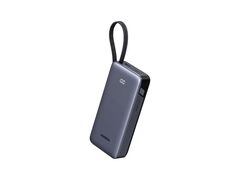
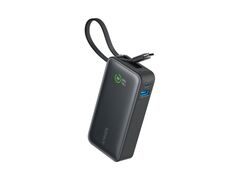
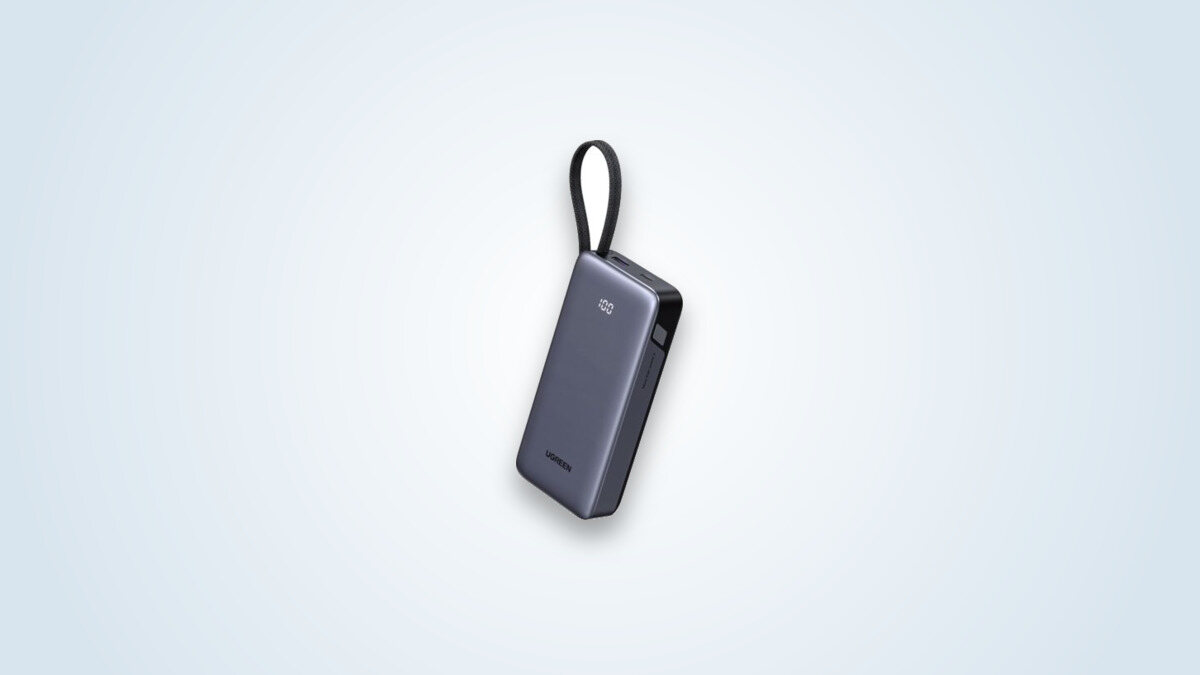
The integrated USB-C cable, presented by the manufacturer as a carrying handle, is in practice limited to a simple loop that stows the cable without ever replacing a real handle: it comes loose easily and is not designed to carry the unit while hanging. The real benefit lies elsewhere, in never having to look for a separate cable, with a measured voltage drop limited to 2.1% at full charge, a decent result.
The trade-off of a non-removable cable is structural: if the cable wears out or fails, there is no way to replace it independently of the rest of the unit, unlike a power bank with a detachable cable.
Weight, the top complaint in reviews
At 468g for 20,000 mAh, the Nexode 45W ranks among the heaviest power banks of its capacity, and this is the remark that comes up most often, even in otherwise favourable reviews. Power banks of comparable capacity, built on more compact architectures, come in well under 300g, at the cost of more modest output power. The trade-off chosen here clearly favours power over portability.
Reliability over time
A pattern recurs with notable frequency in feedback from verified buyers on the French market: a stoppage, whether of the cable or the battery itself, between one and four months of use. No swelling or safety incident adds to this pattern, and a refund or exchange obtained without difficulty through after-sales support comes up just as often. The signal is worth taking seriously without being alarming: it is a functional defect documented across several independent units, not a safety issue.
The price actually observed
The official listed price is €34.99, but the price actually observed at the partner retailer drops to €29.99, about 14% less. A gap of this size is worth knowing before buying: at that price, the value for money becomes noticeably more favourable than at full price.