
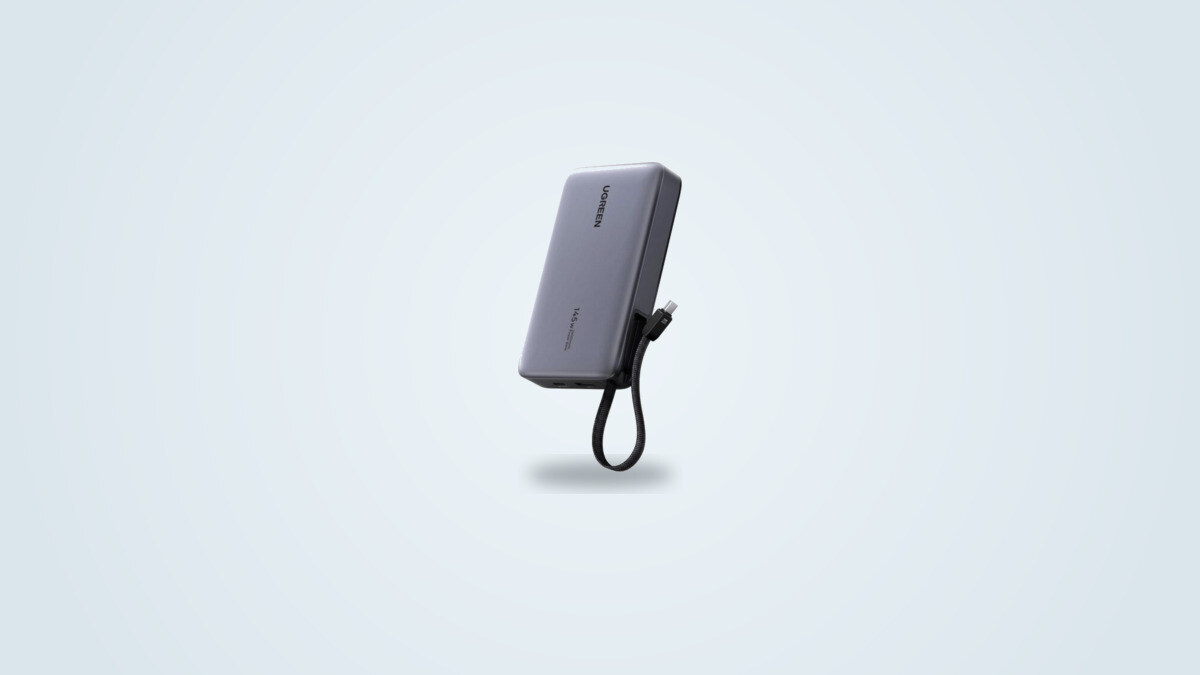
72 Wh on paper: what they actually cover
The casing is rated at 20,000 mAh, a figure calculated at 3.6V, the nominal voltage of a single lithium cell. Converted into energy, that works out to 72 Wh, the value Ugreen publishes on its spec sheet across the six markets this site covers. That conversion method is standard across the industry rather than a quirk of this model: two power banks rated at the same mAh figure can show different Wh numbers depending on the voltage each brand chooses for the calculation.
In everyday terms, those 72 Wh cover 3.7 charges of an iPhone 17 Pro, 3 charges of a Galaxy S25 Ultra, 2 charges of an iPad mini 6, or 1.3 charges of a 13-inch MacBook Air. A more power-hungry laptop than a MacBook Air, a 16-inch MacBook Pro for example, will only get a partial charge out of it: this Nexode cannot fill a high-power laptop from empty to full, it is built to offer a substantial top-up on the move, not to replace a wall outlet for a full day.
That 100 Wh ceiling is exactly what matters most to a traveller: above it, airlines require prior approval to carry a power bank in the cabin. With 72 Wh, the margin is comfortable, 28 Wh, more than enough to never have to justify the bag at boarding. One caveat is worth stating plainly: this 72 Wh figure is the one published by the manufacturer, and no third-party measurement of the energy it actually delivers to a connected device could be found for this specific reference at the time of writing. As with any battery of this kind, some of that energy is necessarily lost in voltage conversion, but the exact scale of that loss remains, here, missing information rather than an invented number.
The manufacturer states a standard lithium-ion chemistry for this pack, without publicly specifying the cell format or brand used, information that teardowns available for other power ratings in the same lineup cannot be reliably carried over to this particular reference.
The built-in cable: 100W, where most cap out at 20 or 30W
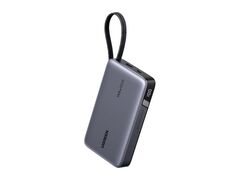
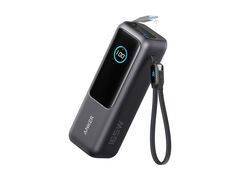
This is the feature that genuinely sets this model apart from the rest of the market. A braided USB-C cable, about 18cm long, stays permanently attached to the casing and folds back against it to double as a wrist strap. The idea of a built-in cable is nothing new, several brands already offer it; what is different here is the power that cable is allowed to carry.
On most power banks with a built-in cable currently sold, that cable only ever helps out a phone, capped at 20 or 30W. The one on the Nexode 20000 145W reaches 100W, the threshold at which it becomes fair to talk about charging a laptop rather than just topping one up. A 16-inch MacBook Pro regains about 43% of charge in half an hour directly through this cable, with no extra accessory required.
The trade-off for that choice lies in the length. 18cm is enough to plug in a device sitting right next to the casing, or to hold it in hand while it charges, but it does not replace a regular cable if the device needs to stay further away, for example resting on a train tray table while the power bank stays at the bottom of a bag. For that specific use, either bring the two closer together or use the second USB-C port with a longer third-party cable.
The 145W headline figure: a shared ceiling, not a per-port addition
Three outputs share the casing's 145W: the built-in cable (100W maximum), a second USB-C port (45W maximum) and a USB-A port (33W maximum). Added together, those three individual ceilings reach 178W, well above the 145W the casing advertises as its total output. That gap is not a communication error, it is how the product is built: each output can, on its own, reach its own maximum, but all three never reach it together.
With two devices, the constraint stays theoretical: plugging a laptop into the built-in cable and a phone into the USB-C port lets the split happen automatically, without either device seeming throttled. It is from the third device onward that the limit becomes concrete, each output then receiving noticeably less than its individual maximum, with the built-in cable itself able to drop below 100W. Ugreen does not hide this behaviour, it is spelled out in the product's spec sheet; it simply deserves to be known before buying, since the label "charges 3 devices at once, 145W" can suggest an addition rather than a shared budget to manage.
The "3-in-1" marketing name Ugreen uses does describe the function well, three devices powered from a single casing, but it can suggest that each output works independently from the other two. The graph above shows that is only partly true: the individual maximums never add up beyond the shared 145W ceiling.
USB PD 3.0 and PPS: broad compatibility, no surprises
Both USB-C ports support the USB Power Delivery 3.0 standard as well as PPS (Programmable Power Supply), which lets certain Samsung phones and several recent Android models adjust voltage in fine steps rather than fixed ones, for more precise fast charging. That is broad compatibility, in line with what the best power banks in this category offer, with no exotic proprietary protocol to check before buying.
A recent iPhone, a Galaxy S25, a USB-C laptop, a Nintendo Switch or a Steam Deck all charge normally from either USB-C port, each device drawing the power it knows how to request. The USB-A port, capped at 33W, covers older devices or accessories that only exist with that connector: headphones, speakers, controllers, some cameras. A pass-through function rounds things out: the power bank can recharge itself while powering a device plugged into one of its outputs, useful at a desk or in a hotel room with only one outlet.
Recharging itself: about 1.5 hours, faster than its own lineup
The battery accepts up to 80W on input, through the built-in cable as well as the USB-C port, and goes from 0 to 100% in about 1.5 hours with a sufficiently powerful charger. That is markedly faster than what is common on power banks of comparable capacity, where three to four hours remain typical, and faster too than its own bigger sibling in the catalog, the Nexode 145W at 25,000mAh, which caps input at 65W and takes about 2 hours despite 28% more capacity.
| Model | Nexode 20000 145W | Nexode 145W (25,000mAh) | Nexode 100W |
|---|---|---|---|
| Maximum input | 80W | 65W | Not stated |
| Full recharge time | ≈ 1.5 hours | ≈ 2 hours | Not stated |
The condition worth knowing before buying: no charger is included in the box, and a standard 20 or 30W phone charger will never get close to the 80W needed to deliver on this figure; recharging will then take several hours instead. For anyone who already owns a USB-C wall charger of at least 80W, often the same one used for a recent laptop, this is a non-issue. For anyone who does not, it is an extra cost to factor in to get the full benefit of the stated speed.
450g, 27mm thick: a bag power bank, not a pocket one
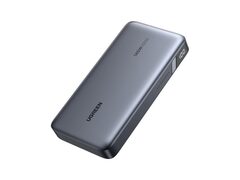
What makes it possible to charge a laptop comes at a cost in weight and bulk: 450 g for 139 x 80 x 27mm. That is noticeably thinner and lighter than the higher-power built-in-cable power banks from the same brand, around 480 to 520 g for the 130W and 165W versions, but it remains an object meant for a bag rather than a jacket or trouser pocket.
The cable folded against the casing adds to that sense of bulk. Unlike a power bank with no built-in cable, which stays a simple flat slab, this one permanently carries its own cable against it, which keeps it from lying truly flat in an already full bag.
Relative to its capacity, the resulting density works out to about 160 Wh per kilogram, casing and cable included. The trade-off pays for itself in what it delivers: a power bank purely dedicated to a phone, with no built-in cable and no ambition to charge a laptop, would weigh noticeably less. Here, the extra weight serves a real purpose, no longer having to choose between carrying one more cable and risking running out of power on a laptop while travelling.
A useful display, simpler than the catalog's flagship models
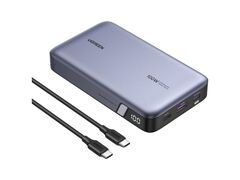
The built-in LED display continuously shows the remaining percentage, voltage and delivered power. That is enough to follow a charge in progress and spot a faulty cable or charger: an abnormally low power reading on a given port is the first thing to check before blaming the connected device.
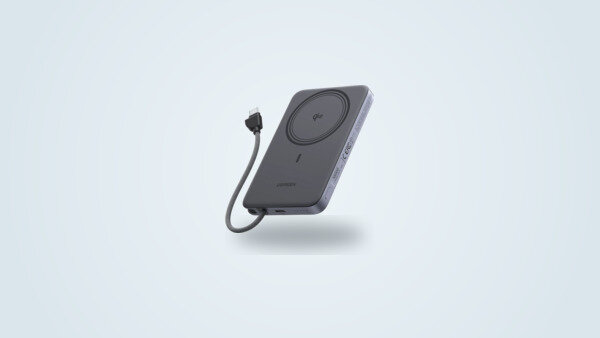
That display remains simpler, though, than the one on the wireless Qi2 variant in the same lineup, which carries a color TFT panel, or the one on the catalog's Anker A1695, which also shows the number of charge cycles completed and a cell health indicator. That is not a flaw in itself: this Nexode does not target the same price segment, and a simpler display also draws less power from the available reserve. But anyone looking for a detailed record of their battery's wear over several years should look at those pricier models instead.
Against the rest of the Ugreen lineup and the Anker Prime 20000 200W
Within Ugreen's own catalog, this Nexode 20000 145W sits between two different approaches. The Nexode 145W at 25,000mAh offers 28% more energy but no built-in cable; the Nexode 100W costs a little less but caps its single fast output at 100W, also with no built-in cable. Neither one spares the user from carrying a separate cable, precisely the item most often forgotten while travelling.
| Criterion | Nexode 20000 145W | Nexode 145W (25,000mAh) | Nexode 100W | Anker Prime 20000 200W |
|---|---|---|---|---|
| Capacity | 20,000mAh (72 Wh) | 25,000mAh (92.5 Wh) | 20,000mAh (72 Wh) | 20,000mAh (72 Wh) |
| Built-in cable | Yes, 100W | No | No | No |
| Total power | 145W | 145W | 100W | 200W |
| Full recharge | ≈ 1.5h (80W) | ≈ 2h (65W) | Not stated | ≈ 1h (100W) |
| Weight | 450 g | 505 g | 420 g | 545 g |
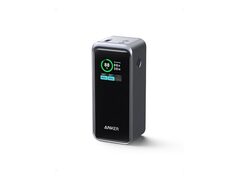
Against the Anker Prime 20000 200W, the gap plays out elsewhere: the Prime targets those powering two laptops at full speed at the same time, for a nearly doubled budget. For everyday travel with a single laptop and a phone, the built-in cable on the Nexode 20000 145W delivers a daily benefit that the Prime's higher raw power does not make up for.
Build, protections, and what the research could not settle
The casing carries a protection system stated at 13 layers, covering overheating, overcharging, deep discharge, short circuit, overcurrent and automatic circuit cutoff. These are by now standard protections on this type of product from an established manufacturer, with no stated feature that sets this particular model apart on this point. The manufacturer's warranty runs 2 years, a fair standard for the category.
What is missing, in all honesty: an independent measurement of surface heat during a sustained charge, a teardown of this specific reference (the teardowns available for the built-in-cable Nexode lineup cover other power ratings, 45W or 130W, whose internal components cannot be assumed identical), and a multi-year track record, this model still being relatively recent on the market. No structural defect or recall shows up in the information available at the time of writing, which is a positive sign without being a final guarantee.
At brand level, Ugreen has spent more than a decade building its name on charging accessories, GaN chargers, cables, power banks, with a now-wide presence at mainstream retailers. That reach does not replace a failure record specific to this exact reference, but it does suggest an established after-sales process and easy-to-find spare parts, a compatible wall charger for instance, should an issue arise with a third-party accessory.
Who it suits, and who it does not
It suits, first of all, anyone who travels or works away from an outlet with a laptop and a phone and wants to stop thinking about the cable. That is a precise profile: anyone who has already left a USB-C cable behind in an office drawer or a hotel room knows exactly what this model solves. Its 72 Wh, comfortably under the 100 Wh threshold, also make it a safe pick for frequent flyers.
It suits less well anyone who only charges a smartphone: for that use, a power bank two to three times lighter and cheaper does the job just as well, and the 100W cable serves no purpose. It is also not a fit for anyone who wants wireless or inductive charging, a feature absent here and reserved for the Qi2 variant in the same lineup, nor for anyone who regularly powers three demanding devices at once, where the shared 145W shows its limits. Finally, anyone who needs a detailed record of their battery's condition over several years, cycles, cell health, will find that information elsewhere in the catalog, on pricier models.