
What PWM technology changes, and what it does not
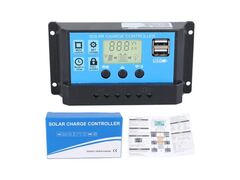
The Thlevel 30A PWM regulates the charging of a lead-acid battery through pulse width modulation (PWM): the controller connects the panel directly to the battery and chops the current to adjust the charge, without ever actively tracking the panel's optimal power point. It is a simpler, cheaper technology than an MPPT controller (maximum power point tracking), but it imposes a strict condition: the panel voltage must stay close to the battery's to limit conversion losses.
A PWM controller works with so-called "12V nominal" modules (36 cells, optimal voltage around 17 to 18V) or "24V nominal" modules (72 cells), wired in parallel rather than in series to stay under this voltage ceiling. Connecting a higher-voltage panel (60 cells, optimal voltage close to 30V) to this controller would waste a significant share of the available power: that is exactly the gap that MPPT tracking is designed to recover, absent here.
Battery compatibility: lead-acid only, zero lithium
The Thlevel 30A PWM is advertised as compatible with the three main lead-acid battery families: flooded, AGM and GEL, each with a three-stage charge management (bulk, absorption, float). Thresholds are adjustable via the screen and the three buttons: float charge at 13.7V by default, low-voltage disconnect at 10.7V and reconnect at 12.6V, values that can be changed to fit a particular battery profile.
The controller offers no lithium profile at all, whether generic lithium-ion or LiFePO4, nor any NiMH profile. This total exclusion is not a simple marketing oversight: a lead-acid charge profile (bulk and absorption voltages, cutoff thresholds) differs markedly from a lithium profile matched to a BMS, and applying one to the other risks an incomplete charge or premature battery wear. By locking the unit to lead-acid only rather than offering a poorly calibrated generic lithium setting, as the Victron range does by default with a 2h absorption time judged too long for LiFePO4, the Thlevel at least avoids that specific pitfall, at the cost of much narrower versatility.
Watch out for confusion: an MPPT version compatible with lithium carries an almost identical name
One point deserves particular attention when ordering: the Thlevel brand sells, on the same marketplaces, a second "Thlevel 30A" reference with MPPT tracking, compatible with both lead-acid and lithium batteries (ternary and LiFePO4). The two products share much of their commercial name and a similar visual presentation, with product listings that look alike at first glance.
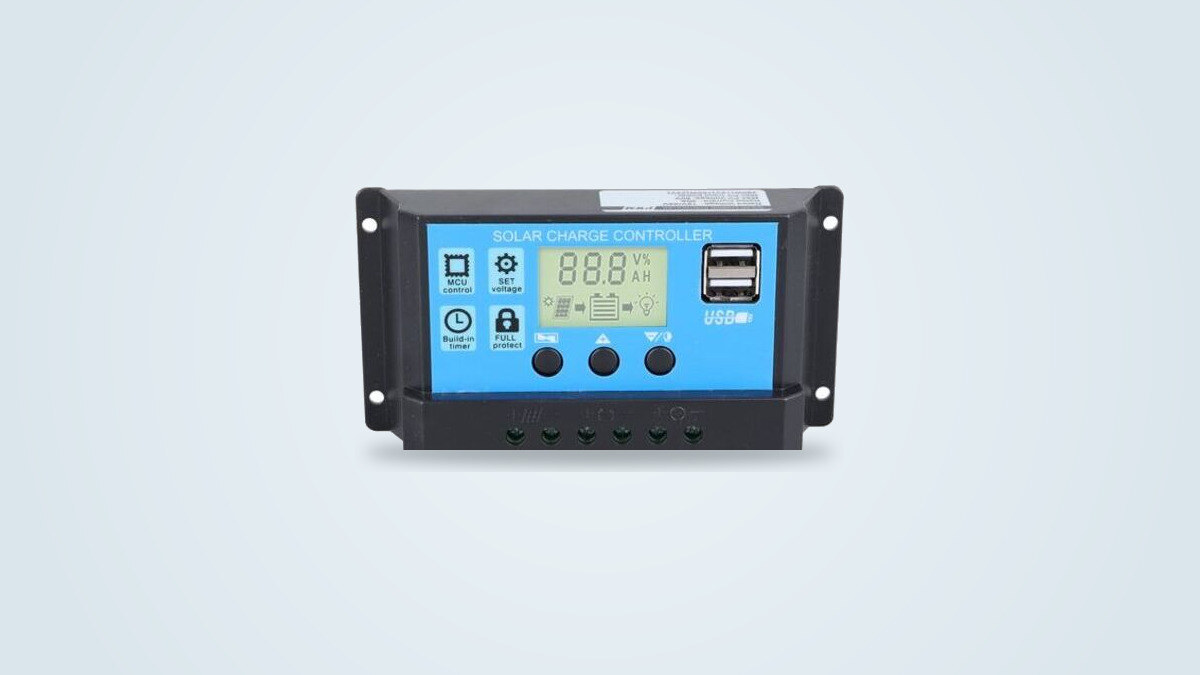
This closeness in naming is not unique to Thlevel: the entry-level solar charge controller segment sold on general marketplaces includes many nearly identical-looking references (same black casing, same blue LCD screen, same icons), rebadged under dozens of different brands. The most reliable marker remains the detailed technical listing, not the photo or the commercial name shown prominently.
The LCD screen and three buttons: fully local control
The Thlevel 30A PWM shows battery voltage, current and charge status in real time on an LCD screen, with distinct icons for the solar panel, the battery and the connected load. Two USB 5V/2A ports allow charging a phone or a small light directly, without drawing on the main battery, a modest output that will charge more slowly than a dedicated mains charger. Three buttons let you navigate the settings: charge thresholds, a light-control mode (turning on an output at nightfall, with an adjustable delay), and a timer mode for a scheduled charge.
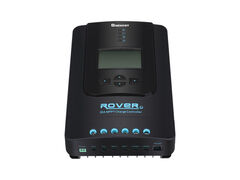
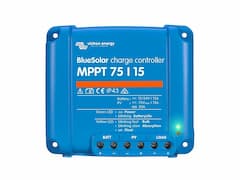
No app, no Bluetooth, no Wi-Fi: all configuration happens on the unit itself. That is a real difference from Victron's BlueSolar 75/15, which has no screen or Bluetooth as standard and requires a paid VE.Direct dongle for the slightest remote setting. The Renogy Rover 20A, already reviewed on the site, follows a similar philosophy (built-in LCD screen, Bluetooth optional rather than mandatory), with a display presented as more complete (voltage, current and solar output at the same time) than what the Thlevel's technical listing details, which centres on battery voltage and charge status.
The trade-off for this simplicity: with no app, no output history is available to check, and a missed initial setup step (thresholds left wrong for the actual battery type) can go unnoticed for longer than on a system with remote monitoring.
Sizing a panel: a safety margin to respect under 50V
With 30A of charging current, the Thlevel accepts, in theory, up to 360W of panels on a 12V battery and 720W on a 24V battery, provided the panel voltage stays aligned with the system's. The solar input voltage ceiling, set at 50V, is narrower than that of the three MPPT controllers already reviewed on the site.
This narrower margin deserves particular attention: a solar panel's open-circuit voltage (Voc) rises in cold weather, a behaviour inherent to any photovoltaic cell and not specific to this product. A panel rated at 22V open-circuit voltage under standard conditions can exceed 25V in severe cold; wiring two such panels in series would therefore push close to, or past, the Thlevel's 50V ceiling as soon as the first frosts arrive. Staying with a single 12V nominal panel, or several panels wired in parallel rather than in series, is the safest setup for this controller.
Safety and protections: a complete list, but not independently verified
The manufacturer advertises a full set of protections for the category: short circuit, open circuit, reverse polarity, overload, with dual MOS protection against overnight reverse current, which stops the battery discharging back into the panel once night falls. The advertised operating range, from -35 °C to +60 °C, is wide, wider than the range listed on the spec sheets of the Victron units and the Renogy Rover already reviewed on the site.
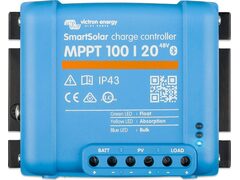
These protections remain manufacturer-declared characteristics: no independent verification of their robustness, for example their behaviour after repeated reverse-polarity mistakes or a prolonged short circuit, has been found for this specific model. The casing is also advertised with no IP protection rating at all, unlike the Renogy Rover 20A (IP32) or the Victron SmartSolar 100/20 (IP43): an installation sheltered from moisture and dust, inside an electrical box or an enclosed cabin, remains advisable rather than direct exposure to the weather.
No product recall was found for this model in the American and European safety databases consulted.
Build, format and a brand with a still modest profile
Compact (133 x 70 x 35 mm) and light (132g), the Thlevel 30A PWM fits easily into the electrical box of a van, a shed or a boat, with four screw-mounting tabs built into the casing. The format and presentation (black casing, blue front panel, central LCD screen, same icons) are found identically on many other entry-level PWM controllers sold under dozens of different brands on the same marketplaces, a sign of manufacturing outsourced to a generic supplier rather than a design of its own.
No clearly advertised manufacturer warranty length was found for this model, nor any independent teardown or technical verification of its circuit board. The cumulative volume of customer reviews on general marketplaces remains high, with no recurring problem found on the matter, but that signal alone does not replace a multi-year reliability track record such as the one Victron or Renogy benefit from.
What this controller makes sense for, and what it does not cover
The Thlevel 30A PWM fits a modest installation already running on lead-acid: a garden shed, outdoor lighting, an older-generation caravan or motorhome, a boat with a lead service battery, or a backup system for a secondary home. In that setting, with a correctly sized 12V or 24V nominal panel, it runs the whole system with no surprises, at a price few MPPT controllers can match.
It is not suited, however, to anyone who already owns a lithium battery, LiFePO4 chief among them (the chemistry most recommended today for a new standalone system), nor to anyone planning a high-voltage panel (60 cells or more) to limit line losses on an extended installation. Both of these use cases are better served by an MPPT controller compatible with lithium, including from Thlevel itself under its separate MPPT reference.
Against the direct competition: Renogy Rover 20A and the Victron units
| Model | Technology | Current / max voltage | Compatible chemistries | Control |
|---|---|---|---|---|
| Thlevel 30A PWM | PWM | 30A / 50V | Lead-acid only | LCD screen, 3 buttons |
| Renogy Rover 20A | MPPT | 20A / 100V | Lead-acid and LiFePO4 lithium | LCD screen, optional Bluetooth |
| Victron BlueSolar 75/15 | MPPT | 15A / 75V | Lead-acid and lithium | None as standard, optional Bluetooth dongle |
| Victron SmartSolar 100/20 | MPPT | 20A / 100V | Lead-acid and lithium | Built-in Bluetooth |
The Renogy Rover 20A, already reviewed on the site, remains the most relevant point of comparison: the same local LCD-screen approach with no dependence on an app, but with genuine MPPT tracking (up to 99% tracking efficiency advertised) and full LiFePO4 lithium compatibility, at a price that stays moderate. The two Victron references target buyers willing to pay more for a reputation for reliability established over a long time in the off-grid sector and, for the SmartSolar, built-in Bluetooth remote monitoring.
The Thlevel positions itself well below all three on price, at the cost of giving up MPPT tracking and any lithium compatibility entirely: an honest trade-off, but one that limits its audience to a lead-acid installation already in place or deliberately chosen for its low entry cost.
Price and availability
The price observed sits around £19 for the bare controller, noticeably lower than all three MPPT controllers already reviewed on the site, the Renogy Rover 20A included, despite it being positioned as the affordable option of the MPPT range. The cumulative volume of reviews on general marketplaces is high, and the average rating that emerges from it sits above the one given here: a gap consistent with a product that correctly delivers on its promise for a buyer who knows exactly what they are buying, a simple lead-acid controller and not a rival to MPPT tracking, but less telling for anyone unaware of the structural limitations detailed above, largely invisible to anyone who never measures their own charging efficiency and has no need for lithium compatibility.