
Sony NP-FZ100: our full review

2280 mAh claimed, a real capacity that reaches 99% of the rated figure and even outpaces newer compatible rivals advertising a higher number: the official NP-FZ100 remains the benchmark for Sony's high-end mirrorless cameras.

Our rating
4.5/5
Actual delivered capacity: 4.6 out of 5 (weighting 25%)Capacity4.6Compatibility and camera recognition: 4.8 out of 5 (weighting 30%)Compatibility4.8Reliability and cycle count: 4.0 out of 5 (weighting 20%)Reliability4.0Cell build and safety: 4.4 out of 5 (weighting 25%)Build4.4

How is this rating calculated?

Official Sony NP-FZ100 battery for Alpha cameras

The essentials

The NP-FZ100 succeeded the NP-FW50 in 2017 with a sharp jump in capacity, and it still keeps that promise years on. Its real capacity reaches up to 99% of its 2280 mAh rated value in a comparison covering thirteen batteries, a result that puts it ahead of several newer compatible rivals that advertise a higher rated figure (2400 mAh) yet actually deliver less than the original Sony cell. As the official battery, it is recognised without reservation by every compatible body, a wide line-up that covers nearly the whole of Sony's current high-end Alpha range: a9, a9 II, a7R III, a7 III, a7R IV, a7 IV, a7S III, a7C, a7C II, a1, a6600, a6700 and the FX3 video body. Battery life in number of shots varies hugely by body, from 430 to over 800 shots under the CIPA standard. Sony does not publish an official cycle-count figure, but the available user feedback suggests a useful lifespan of at least several hundred cycles, in line with intensive photography use spread over several years. For any recent Alpha body, the official NP-FZ100 remains the safest choice.

Strengths

  • Real capacity that reaches up to 99% of its 2280 mAh rated value
  • Outpaces newer compatible batteries that advertise a higher rated capacity
  • Recognised perfectly by every compatible body, with no warning message
  • Compatible with nearly the entire current high-end Alpha range and the FX3
  • Useful lifespan suggested to reach at least several hundred cycles over several years

Limitations

  • No official cycle-count figure published by Sony
  • CIPA battery life varies hugely by body, worth checking for your specific model before buying
  • Price markedly higher than a compatible third-party battery
  • Not compatible with bodies from before 2017, which use the NP-FW50 format
  • The warning message some bodies display for any battery not recognised as genuine can be confusing, including, in rare cases, with an authentic Sony battery
Sony NP-FZ100 battery: see the full details and price →

The benchmark battery for high-end Alpha cameras

Since 2017, the NP-FZ100 has equipped nearly all of Sony's high-end mirrorless cameras, with a sharp jump in capacity over the previous format. It remains today's benchmark for anyone with one of these recent bodies.

2280 mAh
Rated capacity
16.4 Wh
Rated energy
99 %
Maximum real capacity

A real capacity that outpaces newer rivals

The NP-FZ100's real capacity reaches up to 99% of its 2280 mAh rated value, the best performance in a comparison covering thirteen batteries of this format. Notably, it outpaces newer-generation compatible batteries that advertise a higher rated capacity (2400 mAh) yet actually deliver a little less than the original Sony cell once compared under the same conditions. It is a result that clearly sets this battery apart from many compatible batteries, where the advertised capacity far exceeds what is actually available.

A wide range of Alpha bodies, total recognition

Being a genuine battery, the NP-FZ100 is recognised without reservation by every compatible body: an accurate charge-level display, no warning message, no disabled function. Its compatibility spans nearly the entire current high-end Alpha range: a9, a9 II, a7R III, a7 III, a7R IV, a7 IV, a7S III, a7C, a7C II, a1, a6600, a6700, plus the FX3 video body. Battery life in shots per charge (CIPA standard) varies hugely from one body to another, from around 430 shots in electronic-viewfinder mode on the most power-hungry models up to over 800 shots on the least demanding APS-C mirrorless cameras; it is worth checking the exact figure quoted for your own model before buying rather than relying on a general average. One detail is worth knowing: the warning message some Sony bodies display for any battery not recognised as genuine is not a reliable indicator on its own, since the same message has already shown up on a recent body paired with a battery that was nonetheless authentic, probably for another reason (a contact issue or a one-off glitch).

No official figure, a useful lifespan of several years suggested

Sony publishes no official data on the number of charge cycles the NP-FZ100 can take before its capacity drops noticeably. The available user feedback suggests a useful lifespan of at least several hundred cycles, with a gradual decline setting in after several hundred full cycles, in line with intensive photography use spread over several years. This estimate remains indicative, with no official validation from the manufacturer.

The protections of a genuine battery

The NP-FZ100 includes the standard protections of a genuine manufacturer lithium-ion battery: overcharge, overheating and short-circuit protection. Nothing points to any particular safety issue with this battery.

Against the NP-FW50, the format it replaced

How does the NP-FZ100 differ from the format that equipped Alpha cameras before 2017?

Technical comparison: Sony NP-FZ100 against the Sony NP-FW50 (prices seen on the market, for guidance only)
CriterionSony NP-FZ100Sony NP-FW50
Rated capacity2280 mAh1020 mAh
Compatible bodiesSince 2017 (a9, a7 III and later)Before 2017 (a6000, a7 II and earlier)
Measured real capacityUp to 99% of rated≈ 95% of rated
Price seen on the market£55 to £57£59.86

The two formats are not interchangeable: the body you own directly determines the choice. For a recent body (2017 onwards), the NP-FZ100 is the only option, with no genuine alternative. Its more-than-doubled capacity over the NP-FW50 reflects the greater demands of the sensors and video modes on Sony's most recent Alpha bodies.

The rating in detail

Our rating
4.5/5
Actual delivered capacity 4.6
Compatibility and ecosystem breadth not measured
Reliability and long-term endurance not measured
Charge time and tool runtime not measured
Build and interface not measured
Compatibility and camera recognition 4.8
Reliability and cycle count 4.0
Cell build and safety 4.4
Sony NP-FZ100 battery: see the full details and price →

The product and its alternatives

Sony NP-FZ100 battery

Sony NP-FZ100 battery

See price (20)

Replacement battery for Sony Alpha A7 IV, A7 III, A7R V, A9 II, ZV-E1 and FX3. Restore your device's original runtime when the battery gets tired.

View product
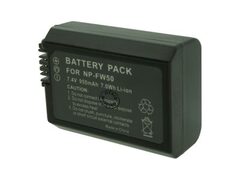
Sony NP-FW50

Sony NP-FW50

See price (49)

Uncompromised runtime for your Sony mirrorless: the genuine NP-FW50 powers the Alpha A6000, A7 and RX10 with the brand's reliability.

View product
Otech NP-FW50 battery

Otech NP-FW50 battery

£21.29 (15)

Replacement battery for the Sony Alpha A6000, A6400, A6100, A7 II and RX10. Restore your device's original runtime when the battery gets tired.

View product

Frequently asked questions

Only if your body dates from 2017 or later (a9, a7R III, a7 III and later generations). Earlier bodies use the NP-FW50 format, which is not compatible with the NP-FZ100.

It varies hugely by body, from around 430 shots in electronic-viewfinder mode on the most demanding models up to over 800 shots on the least power-hungry APS-C mirrorless cameras. It is worth checking the exact CIPA figure for your own model before buying.

In a direct comparison, yes: the official NP-FZ100 delivered a higher real capacity than compatible batteries advertising 2400 mAh against its own 2280 mAh rated figure. A higher advertised number does not guarantee a higher real capacity.

Sony publishes no official figure. The available user feedback suggests a useful lifespan of at least several hundred cycles, in line with several years of intensive photography use.

Not necessarily. This message appears for any battery not recognised as genuine, but it has also shown up in rare cases with authentic Sony batteries, probably for another reason (a contact issue or a one-off glitch).