
What the advertised 200W actually delivers
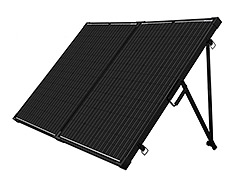
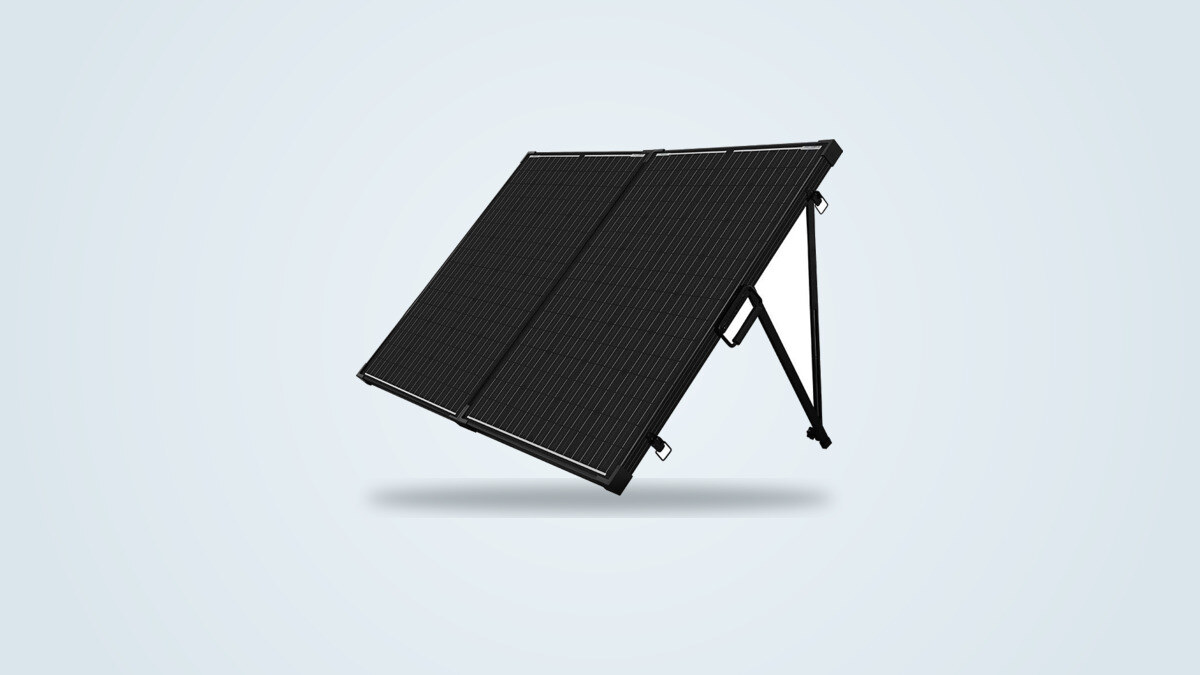
The Renogy Solar Suitcase 200W pairs two Renogy RNG-100D-SS monocrystalline panels of 100W each, wired in parallel. Their combined electrical figures, open-circuit voltage (Voc) of 24.3V, optimal voltage (Vmp) of 20.4V, short-circuit current (Isc) of 10.42A, and optimal current (Imp) of 9.82A, match exactly double the figures of a single RNG-100D-SS panel according to its own datasheet. That's the first useful confirmation before judging anything else: this is the brand's classic monocrystalline generation, rated at 22% cell efficiency, not the newer N-Type line Renogy now sells with up to 25% rated efficiency and an improved temperature coefficient.
This 200W figure corresponds to peak power measured under the industry's standardized test conditions (1000 W/m² of irradiance, 25 °C cell temperature, AM1.5 spectrum), a convention shared across the whole sector that allows comparing panels against each other, but one that is never quite met outdoors. Sun angle, cloud cover, and the panel heating up in full sun always pull real-world output below this figure.
The built-in Voyager 20A controller on this suitcase is a PWM (Pulse Width Modulation) controller, not an MPPT (Maximum Power Point Tracking) one. A PWM controller connects the panel straight to the battery and simply pulls the output voltage down toward the battery's own voltage: it never hunts for the panel's maximum power point. These panels reach their optimal power at 20.4V, well above a 12V battery's voltage while charging. An MPPT controller would convert that voltage gap into extra current; a PWM controller leaves a good share of it untapped. This is a deliberate architecture trade-off, not a fault or a manufacturing defect: it lets the Voyager stay more compact, cheaper, and simpler to use than an equivalent MPPT unit, at the cost of structurally lower charging efficiency against a 12V battery.
No independent measurement of the power actually delivered to a battery through this specific controller was found for this kit. That's a gap in the data rather than a figure to invent: the mechanism described above holds regardless of its exact value, and it alone explains why swapping the Voyager for an external MPPT controller noticeably changes the yield harvested from the same panels.
Like any classic crystalline cell, these panels lose efficiency as their temperature climbs in full summer sun, a physical trait inherent to crystalline silicon rather than a defect specific to this product. The built-in bypass diodes limit, without fully cancelling, the output drop as soon as one of the two panels falls into shade: it's best to avoid even partial shade on either panel to preserve the whole unit's output.
16.3 kg: the real trade-off of this suitcase
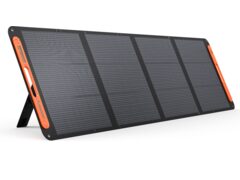
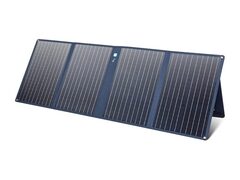
At 16.3 kg, the Renogy Solar Suitcase 200W is by far the heaviest 200W nomad solar panel already reviewed on this site. It weighs up to 3.4 times more than the Anker Solix PS200 (4.8 kg) for identical power, and 2.6 times more than the Jackery SolarSaga 200W (6.2 kg). Folded, it measures roughly 90 x 66 x 8 cm and packs into a semi-rigid carrying case with a handle.
Set against the power it delivers, this suitcase reaches about 12.3 watts per kilogram carried, a simple calculation (rated power divided by total weight) that lets panels of different power levels be compared on a common basis. That figure puts it clearly last among nomad panels of comparable power already reviewed on this site, and even behind panels twice as powerful.
The Anker Solix PS400, twice as powerful (400W) for almost identical weight (15.9 kg), reaches 25.2 W/kg, more than double this suitcase's ratio. The gap comes down to architecture: a steel-and-aluminum frame, a full electronic controller built in, and a semi-rigid case with hinges and metal latches, against a fabric or thin-laminate build for most rival folding panels in this segment.
Precise IP ratings per component, not one figure for the whole unit
The manufacturer documents several distinct protection ratings on this suitcase rather than a single global certification: the panels' junction box is rated IP65, the MC4 connectors IP67, and the built-in Voyager 20A controller housing also carries an official IP67 rating. That last figure allows for resistance to dust and brief accidental immersion, well beyond simple exposure to rain.
Documenting protection component by component rather than displaying a single figure for the folded whole is less catchy on a marketing sheet, but it is also more precise information than one rating that would blur the real differences between the junction box, the connectors, and the controller. No single IP rating covering the entire folded suitcase, hinges and case included, turned up in the manufacturer's documentation: a nuance worth knowing rather than a figure to extrapolate.
The frame is built from black anodized aluminum, two riveted hinges, and a built-in handle; the adjustable kickstands lock in place with two thumbscrews, no tools needed. The manufacturer states the rear panel backing is weather resistant for a targeted lifespan of 25 years, a figure drawn from its official documentation and consistent with the equally long power warranty covered later in this review.
As with any panel of this type, letting the case dry out before extended storage and avoiding folding the panels closed before moisture has had time to evaporate helps preserve the hinges and the case fabric over the years.
MC4 and a battery cable included: built for 12V, not for USB
On the output side, the two panels feed the Voyager controller exclusively through MC4 connectors, the most widespread standard in the solar industry. The two halves of the suitcase connect to each other through a set of detachable connectors, presented by the manufacturer as a way to expand the system with additional panels. The controller then delivers current to the battery through an included alligator-clip cable, ready to connect directly to a 12V battery's terminals, with no setup beyond selecting the battery type on the controller itself.
This simplicity has a downside for anyone aiming at a nomad power station instead, Jackery, EcoFlow, Bluetti, or Anker alike: no USB output exists anywhere on the product, a trait it shares, to be fair, with nearly every nomad panel of this power already reviewed on this site. No adapter cable to a station's proprietary port is included in the box, though. Connecting this suitcase to a station that doesn't accept native MC4 means sourcing the matching adapter for that station's solar input separately, and checking beforehand that the station's input voltage range accepts the suitcase's 24.3V open-circuit voltage.
For a direct hookup to a 12V battery, on the other hand, the connectivity is complete straight out of the box: no extra purchase or wiring is needed, a point covered in more detail in the next section on the built-in controller.
The built-in Voyager 20A controller: the central argument for this suitcase
The Renogy Voyager 20A controller automatically recognizes and charges flooded lead-acid, AGM, gel, and lithium batteries, with automatic detection of a 12V or 24V system voltage and a solar input range of 15 to 55V, well above this suitcase's 24.3V open-circuit voltage. A backlit LCD screen displays battery voltage, charging current, charged capacity in amp-hours, and temperature through an included sensor; two buttons cycle through this information and let you select the battery type. The controller also builds in protection against reverse polarity, overvoltage, overheating, and reverse night-time current.
This integration carries real practical value: on a typical nomad panel sold without a controller, you have to add its purchase and its wiring before anything can be connected to a battery at all. This suitcase removes that step and that cost, an argument that matters little for anyone aiming at a power station that already has its own MPPT controller built in, but that counts for real on a standalone 12V setup.
The controller is mounted on the back of one of the two panels, a practical spot for packing into a suitcase but a thermally unfavorable one: sitting in direct contact with a panel exposed to the sun, it runs hotter than a remote-mounted, separately cabled unit would, which can slightly reduce its efficiency on the hottest days. That's an integration trade-off inherent to the suitcase format, not a flaw isolated to this particular product.
Who it's really built for: the 12V battery, not the power station
This review judges the suitcase on the criteria of a versatile nomad solar panel: portability, weather resistance, and universal connectivity to a power station or a USB device. Another use case exists, just as real and documented by the manufacturer itself: near-permanent installation on the roof, in the hold, or in the trunk of an RV, a converted van, a boat, or an off-grid site, to maintain a single 12V lead-acid, AGM, gel, or lithium battery.
On that exact use case, weight matters far less: the suitcase stays stowed or fixed in place, it isn't carried around daily like a backpacking panel. The lack of a USB output isn't a shortcoming there either, since that was never its job. Judged on that ground, the built-in controller, the automatic battery-chemistry detection, and the monitoring screen make it a complete, self-sufficient solution, with no extra cost or wiring beyond the included clip cable.
Against direct rivals in the catalog
Against folding panels of comparable power already reviewed on this site, the Renogy suitcase stands out through two advantages none of the others share: a complete charge controller already built in, and a manufacturer warranty on the panels themselves that runs far longer.
| Criterion | Renogy Suitcase 200W | EcoFlow 220W | Anker Solix PS200 | Jackery SolarSaga 200W |
|---|---|---|---|---|
| Power | 200W | 220W | 200W | 200W |
| Weight | 16.3 kg | 5.1 kg | 4.8 kg | 6.2 kg |
| Power to weight | 12.3 W/kg | 43.1 W/kg | 41.7 W/kg | 32.3 W/kg |
| Built-in controller | Yes (PWM 20A) | No | No | No |
| Output | MC4 + battery cable | Built-in XT60 | MC4 + XT60i adapter | MC4 only |
| Weatherproofing | IP65/IP67 per component | IP68 | IP68 | IP67 |
| Warranty | 10 years / 25 years (80%) | 5 years | 5 years | 3 years |
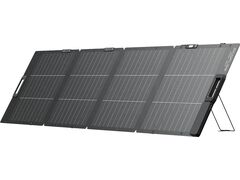
Against the EcoFlow 220W solar panel or the Anker Solix PS200, the Renogy suitcase concedes three to three and a half times the weight and lacks a single IP rating for the whole unit, but it's the only one of the four with a full charge controller built in and the only one with a double-digit warranty on its panels. Against the Jackery SolarSaga 200W, the only other native MC4-output model in this lineup, the comparison is more clear-cut: the Jackery stays 2.6 times lighter, without offering a built-in controller or a longer warranty in exchange.
Renogy also sells a newer suitcase line built on N-Type cells, rated for up to 25% efficiency and under 0.4% annual degradation, against 22% efficiency for the classic monocrystalline generation used in this model. The suitcase covered in this review is still built on that earlier generation, which Renogy continues to sell alongside the newer one.
Build quality and warranty: the product's real strong point
This suitcase's RNG-100D-SS panels carry a manufacturer warranty of 10 years on parts and labor, and 25 years on power output with an 80% guaranteed threshold at that point. That's one of the longest warranties in the entire nomad solar panel segment already reviewed on this site, where most rivals sit between 24 months and 5 years.
The anodized aluminum frame, riveted hinges, and metal latches are built for repeated outdoor use. No recurring manufacturing defect or recall has been identified for this product to date. No independent teardown was found for this exact model either, a research gap worth flagging rather than a flaw in the product itself: manufacturers of nomad power gear get uneven coverage from the sites specializing in this kind of analysis.
The Japanese market does not carry this suitcase in this form: Renogy sells newer lines there instead, N-Type cells or folding panels with a USB output, a fact of regional distribution rather than a quality signal.
Pricing on the manufacturer's own online store for this exact kit (two panels plus the Voyager 20A controller) varies noticeably with promotional periods, sometimes sitting well below the price listed higher up on this product page: it's worth comparing purchase channels before ordering.
Who this suitcase suits, and who it doesn't
The Renogy Solar Suitcase 200W suits, first and foremost, anyone looking to equip a 12V battery on an RV, a van, a boat, or an off-grid setup without buying or wiring a separate controller, and who values a long panel warranty over a feather-light build. On that exact use case, it remains a complete, proven solution.
By contrast, anyone after a light panel to carry to a backpacking site, to charge over USB, or to connect straight to a nomad power station without an adapter will find a better fit in the Anker Solix PS200 or the EcoFlow 220W solar panel, both noticeably lighter and already fitted with connectivity built for that use. And anyone chasing maximum charging efficiency on a 12V battery would do better pairing this suitcase's panels with an external MPPT controller rather than sticking with the original PWM Voyager.