
What the advertised 3000 lumens are actually worth
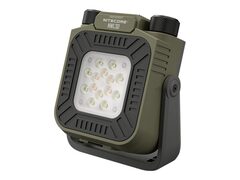
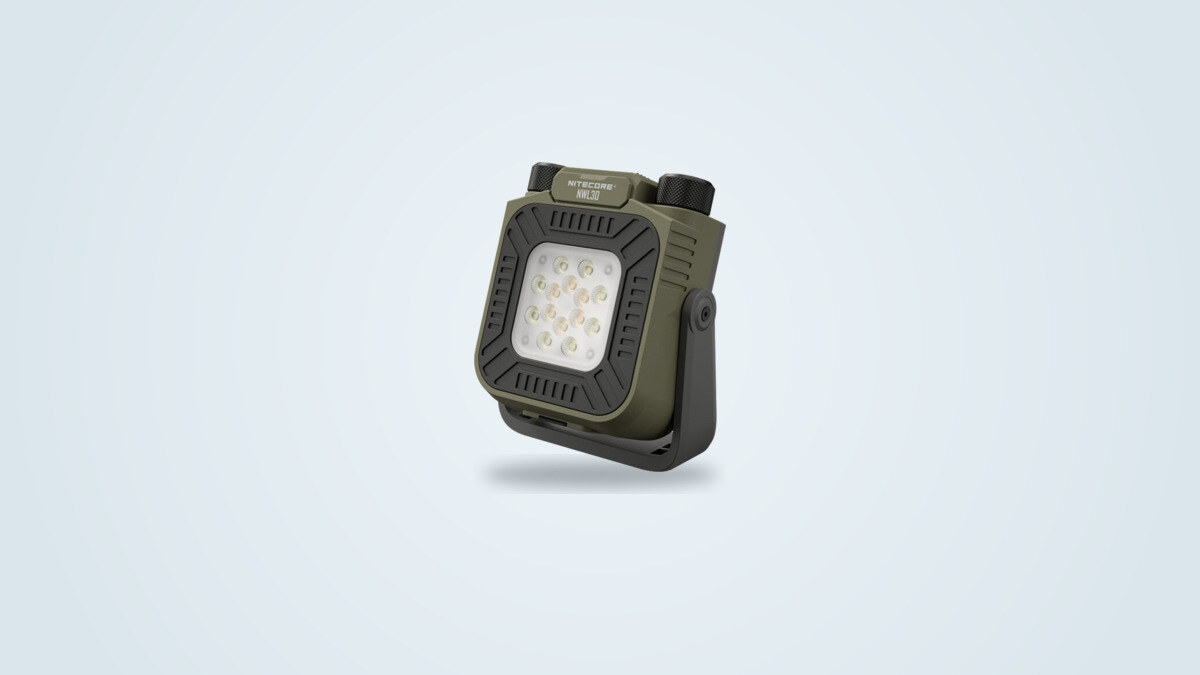
The number that sells the Nitecore NWL30 is the 3000 printed on the box. It is real, but it deserves a closer look before anyone plans a use case around it. First, that ceiling is only reached by combining both available colour-temperature channels: on its own, the cool-white channel tops out near 1740 lumens, and the warm-white channel near 1370. The advertised 3000 is the sum of both channels pushed together, not the output of a single colour of light.
Second, that peak does not hold for hours. On the brightest setting, output drops within the first few minutes: the figure falls to around 500 lumens after two minutes, then settles near 700 lumens for the rest of the session. A quick calculation backs this up: sustaining 3000 lumens continuously over the advertised 7.5-hour runtime on the brightest mode would require an average draw of barely 9 W, an efficiency no power LED reaches at this light output. Once read alongside a calculator, the spec sheet itself gives away a fast drop after the initial peak.
There is nothing unusual about this behaviour: most high-output lights work this way, a short peak for the headline figure followed by a sustainable plateau that keeps the electronics from overheating. The issue lies elsewhere: nothing on the product page spells out that real plateau, and anyone expecting a full 3000-lumen blast for an entire evening will be disappointed. For a quick job-site task (finding a tool, lighting a short task), the peak is more than enough. For lighting a campsite over time, the 700-lumen plateau is what actually counts, and it remains quite good for the category.
The wide 100° beam throws up to 120 m, for a centre-beam intensity of roughly 3577 candela. Plenty to flood an entire campsite, less suited to picking out a single point at long range: the NWL30 is built to flood an area, not to throw a narrow spot far away. No colour rendering index (CRI) is published for this floodlight, a figure often missing from this kind of outdoor product but worth flagging for anyone planning to use it for detailed DIY or mechanical work where colour accuracy matters.
Real runtime by lighting mode
The 18,000 mAh battery carries, per the shell's own label, 3.6 V and 64.8 Wh, which lines up exactly with the expected arithmetic (18 Ah times 3.6 V): nothing to question about this figure, it is not inflated relative to the cells' actual chemistry. What is left to work out is how those 65 Wh translate into usable hours, and the answer depends heavily on the mode selected.
On the most economical setting, 50 lumens, runtime climbs to 130 hours, comfortably enough for a full week of bivouac backup lighting without going near an outlet. On the brightest mode, given the plateau explained above, the advertised 7.5 hours are best read as a sustained-use duration rather than a promise of 3000 uninterrupted lumens. In between, the stepless brightness control allows fine-tuning consumption to whatever is happening at the time, a picnic table or a work zone.
The red signalling light, steady or flashing, runs on its own separate budget: 25 lumens for up to 80 hours, a comfortable reserve for a safety use case (marking a parked vehicle, finding a campsite at night) without ever touching the white-light reserve or the power-bank function.
All three functions draw from the same 65 Wh reserve: extended use of the white light reduces by that much what is left for topping up a phone or running the mosquito repeller. Nothing unusual for a combined device, but worth keeping in mind for a weekend with no chance to recharge. As a point of reference, those 65 Wh amount to roughly 3 to 4 full charges of a modern smartphone (whose battery typically runs between 15 and 20 Wh), after accounting for USB conversion losses.
The power bank function: 20 W, a modest ceiling
The NWL30 turns into an external battery through a bidirectional USB-C port (input and output) and an output-only USB-A port. Advertised maximum output is 20 W, and both ports come close to it in practice: around 20 W over USB-C, up to 18 W over USB-A, enough for a phone on a moderate fast charge, a smartwatch or earbuds.
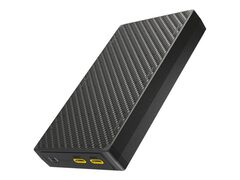
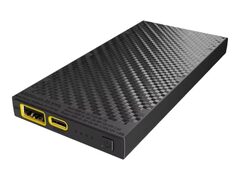
The real limit is the protocol rather than raw wattage: the NWL30 only recognises Quick Charge (QC), with no USB PD or PPS. Many recent smartphones (most flagship Android models, and every iPhone charged over USB-C) expect PD to trigger their fast-charge mode: plugged into the NWL30, they will still charge, but not necessarily at their top speed. That is a real difference from Nitecore's other power banks in the catalogue: the NB10000, NB20000 and Pocket 10000 all pair USB PD with QC. On the NWL30, that piece was left out, likely to make room for the optics block and the mosquito-repelling heating element that take up most of the shell.
| Spec | NWL30 | NB10000 | NB20000 | Pocket 10000 |
|---|---|---|---|---|
| Capacity | 65 Wh | 38.5 Wh | 72 Wh | 38.5 Wh |
| Max output | 20 W | 20 W | 22.5 W | 22.5 W |
| Protocols | QC only | USB PD, QC | USB PD, QC | USB PD, QC |
| Screen | None | LED | None | None |
| Pass-through | No | Yes | Yes | Yes |
Another restriction: no screen or even a simple charge-level light, no pass-through charging (no way to recharge the unit itself while also charging a phone plugged into it), and no wireless charging. There is also no information confirming whether both ports can deliver their full power at the same time, or whether total output is shared between them once two devices are plugged in together.
As for recharging the NWL30 itself, a full charge takes about 3 hours 40 minutes over USB-C, on a rated input of 9 V and 2.22 A (about 20 W) that in practice caps a bit lower, closer to 17 to 18 W (near 8.8 V and 1.98 A): a minor gap that does not stop it from reaching the advertised time within a few minutes.
The mosquito repeller: a third function that needs pads
The NWL30's third function is not some invisible ultrasonic gimmick: it is a genuine heating element, built into the back of the shell, designed to hold an off-the-shelf mosquito-repelling pad soaked in an active ingredient that is released by heat. The mechanism is the same one used by standalone electric repeller units sold for indoor or outdoor use, simply built into the light.
Two operating modes adjust the range: the low mode covers about 3.5 m and makes a full pad last around 17.5 hours, the high mode extends coverage to about 5 m but uses up the pad in around 12.5 hours. Enough for a full evening of camping or fishing on a single pad, even on the high setting.
As for how well it actually keeps mosquitoes away, the function relies on well-established chemistry (heated repellent pads have existed for decades) rather than on any Nitecore-specific technology: it will only be as good as the pad used, and like any repeller of this kind, its range holds up better in still air than against a steady breeze that scatters the active ingredient.
Build quality, ruggedness and handling
The NWL30's shell weighs 515 g for 106.4 x 121.8 x 52.7 mm, a size that fits in one hand but is noticeable in a bag compared with a simple flashlight. That is the price of packing a full optics block, power-bank electronics and a heating element into the same housing.
Protection sits at the level expected for outdoor use: IP66 rated (fully dust-tight, protected against water jets), with an advertised drop resistance of up to 1 m. The handle, mounted on a magnetic base, rotates a full 360° and packs a magnet rated at roughly 22 N of holding force, enough to clamp firmly onto a vehicle's metal frame or a job-site structure. A 1/4-inch screw thread and a tilting stand round out the mounting options, for placement on the ground, on a standard photo tripod, or hanging from the handle inside a tent.
Measured per gram, the on-board capacity is nonetheless less efficient than on a dedicated power bank: the NWL30 delivers about 0.13 Wh per gram, against roughly 0.25 Wh per gram on the same brand's NB20000. A logical gap given everything else the NWL30 packs into its shell, but a genuine point of comparison for anyone torn between the two use cases.
Against the Nitecore lineup and direct rivals
Within Nitecore's work-light lineup, the NWL30 is not a standalone model: it sits alongside the NWL20, a smaller, cheaper sibling. The NWL20 tops out at 600 lumens for an advertised throw of 93 m, runs on a removable 5000 mAh battery (so replaceable, unlike the NWL30's), but offers neither a power-bank function nor a mosquito repeller. Choosing between the two comes down to use: the NWL20 suits occasional use where budget comes first, the NWL30 targets more frequent use where the added versatility justifies the extra cost.
| Spec | NWL30 | NWL20 | Olight Olantern Classic 2 Pro |
|---|---|---|---|
| Max brightness | 3000 lm | 600 lm | - |
| Weight | 515 g | - | 757 g |
| Capacity | 65 Wh | 18 Wh (removable) | 40.3 Wh |
| Power-bank output | 20 W | None | 18 W |
| Mosquito repeller | Yes (pads sold separately) | No | No |
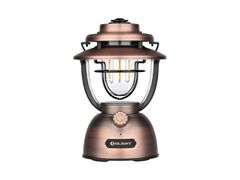
Against a versatile lantern such as the Olight Olantern Classic 2 Pro (already reviewed on this site), which also combines a light with a power bank but no mosquito repeller, the comparison tilts clearly in the NWL30's favour on paper: for a lower weight (515 g against 757 g) and a similar capacity, it packs more than double the energy per gram (0.13 Wh/g against roughly 0.05 Wh/g), comparable output power (20 W against 18 W), and one extra function. The Olantern leans more toward decorative lantern-style ambient light, a use case the NWL30 does not try to cover with its floodlight beam.
Three functions, one scoring trade-off
Scoring the NWL30 on the same grid as a plain power bank raises a genuine fairness question. Output power and connectivity, both relevant for judging a pure external battery, only cover part of what this device is: nobody buys a 3000-lumen work light purely to get 20 W out of its USB-C port. Conversely, real brightness and lighting runtime, which drive most of this review's first two sections, do not appear in the formal power-bank scoring grid at all, since that is not its primary purpose.
This editorial choice is worth spelling out: this review's final score follows the site's standard power-bank grid (capacity and runtime, output power, size, connectivity, recharging, build quality), to stay comparable with other external batteries in the catalogue. But anyone choosing mainly between a work light and a camping lantern should weigh things differently: light quality and power management on the brightest mode, covered above, matter far more to that decision than the USB charging protocol.
The NWL30's real strength is not excelling at any single one of these three roles, but making each one solid enough to replace, on its own, three separate items in a bivouac bag: a work light, a backup external battery, and an electric mosquito repeller.
Brand reliability and warranty
Nitecore has specialised in portable lighting since the mid-2000s, and is generally well regarded within the flashlight enthusiast community for the overall ruggedness of its products and the reliability of its after-sales support. The NWL30 carries a 2-year manufacturer warranty, standard both for the brand and for the power-bank category in this catalogue.
The overall design (reinforced shell, IP66 rating, strong magnet) inspires confidence over time, and the brightness plateau on the top mode, covered above, actually works in favour of the electronics' longevity: a light that limits its own output avoids the prolonged heat build-up that would otherwise prematurely wear down its LEDs and battery. The manual and wear parts (cable, mosquito-repelling pads) remain available independently through Nitecore's retailer network, which limits the risk of having to replace the whole unit over a missing accessory.
Other Nitecore power banks already reviewed on this site (NB10000, NB20000, Pocket 10000, Carbon 6K) all land within a similar overall score range, between 3.8 and 4.0 out of 5: a sign of consistency across the brand's lineup in this segment, rather than an isolated result.
Who the NWL30 is for, and who should look elsewhere
The Nitecore NWL30 is aimed first at anyone wanting to cut down the number of items carried while camping, bivouacking, fishing or on an occasional outdoor job site: a single light covers area lighting, a phone battery top-up, and mosquito protection in the evening. Van life and RV trips, where every item counts twice over in limited storage space, are natural territory for this kind of combined device.
It suits less well anyone chasing the best possible external battery for the money: with no USB PD, a 20 W ceiling and no screen, the NWL30 is comfortably outclassed on that front alone by dedicated power banks, Nitecore's own included. It will also not suit anyone expecting the mosquito-repelling function to be ready to go straight out of the box: without a pad bought separately, that function stays inactive. Finally, 515 g is a lot for anyone counting every gram on an ultralight hike, a use case where a dedicated headlamp or flashlight will always make more sense.
For everyone else, campers, anglers, DIYers and van-lifers who value versatility and accept the trade-offs that come with it, the NWL30 remains a rare proposition in its segment: no direct competitor identified at this price point combines all three functions with a comparable level of execution.