
What the announced 280 lumens are actually worth
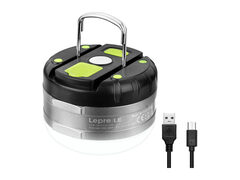
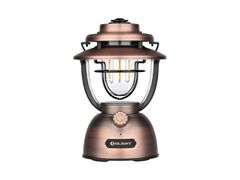
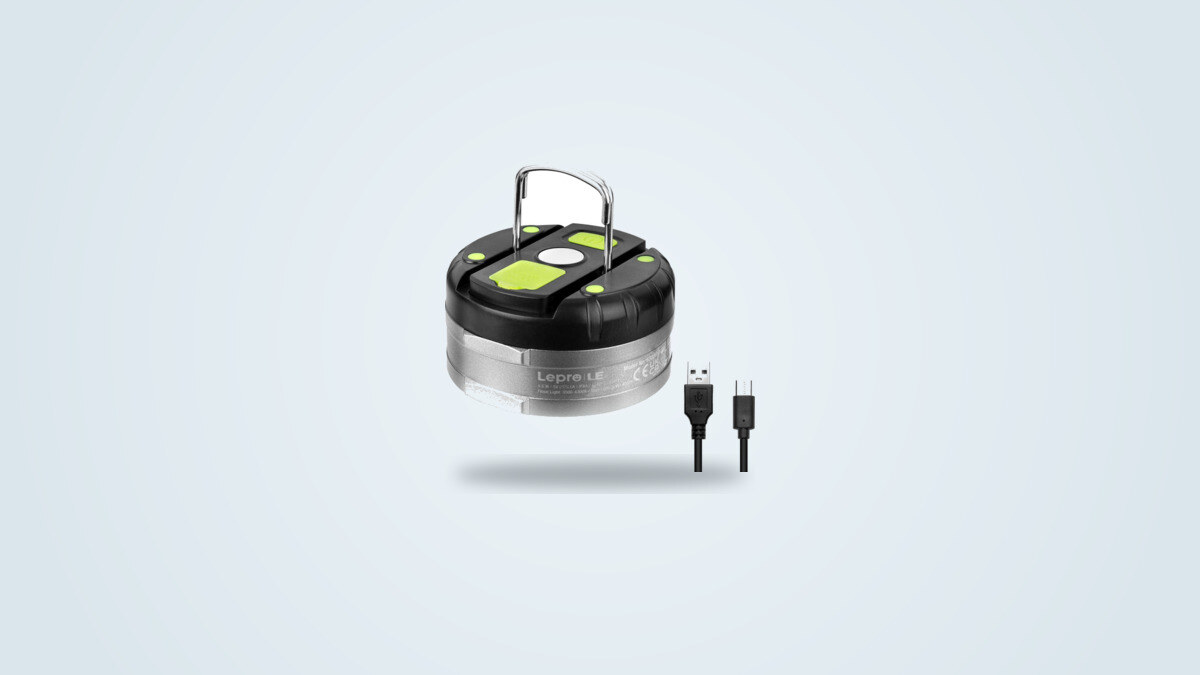
On the box, the Lepro claims 280 lumens spread across 360° from a cylindrical diffuser 70 mm across. Unlike a torch that concentrates its beam along one axis, this circular spread avoids harsh shadows inside a tent or around a camping table. The light comes from 12 diodes rated at 3 W, with an announced colour temperature of 3800 to 4400 K: a fairly neutral white, closer to daylight, unlike the warm tones (1850 K and 3000 K) chosen by the Olight Olantern Classic 2 Pro for a look closer to an oil lamp.
Three modes share that output: 280 lm at full power, 140 lm on the medium setting, and a flashing signal mode around 260 lm. These figures come from the manufacturer's spec sheet, repeated identically by several independent retailers with no divergence from one site to another: a sign of consistency, though not an independent measurement.
| Device | Lepro 280 lm | Olight Olantern Classic 2 Pro | Nitecore LR70 (lantern) | Nitecore NWL30 |
|---|---|---|---|---|
| Announced maximum | 280 lm | 300 lm (up to 318 lm per the dedicated review) | 400 lm | 3000 lm (700 lm sustained) |
| Spread | 360° | 360° | 360°, 3 of 4 faces | directional spotlight |
| Colour temperature | 3800-4400 K | 1850 K and 3000 K | 4000 K | 2700-6500 K adjustable |
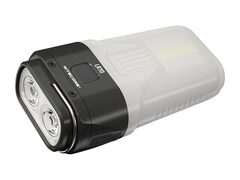
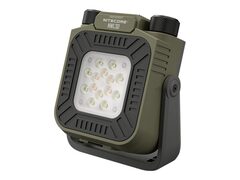
Against the three other multi-function lanterns already reviewed on this site, the Lepro is by far the dimmest: the Nitecore LR70 and NWL30 both pass 3000 lm in spotlight mode, and even the LR70's pure lantern mode (400 lm) beats the Lepro's maximum. That figure alone doesn't tell the whole story: both Nitecores are primarily long-range torches with a secondary lantern mode, while the Lepro is built as a pure ambient lantern with no pretence of throwing light far. On that specific job, even lighting at short to medium range, 280 lm across 360° is plenty for a two-person tent, a camping table, or a hallway during a power cut.
Announced runtime: 5 to 11 hours depending on the mode
The three modes translate into very different runtimes, a figure the manufacturer states separately for each. The medium setting (140 lm) does most of the work on a camping trip: it lasts close to eleven hours, enough for two to three full evenings without a recharge. Full power (280 lm) drops to about five hours, a logical result since the electrical draw nearly doubles. The flashing signal mode, around 260 lm, lasts about ten hours: close to full power in instant brightness, but with a lower average draw since the diode isn't lit continuously.
These durations remain far behind the Nitecore LR70 and NWL30, which run for tens or even hundreds of hours on their most economical settings. The gap comes down mainly to the size of the energy reserve: 11.1 Wh for the Lepro against 37 to 65 Wh for the two Nitecores, a reserve three to six times larger. Relative to its own capacity, though, the Lepro's runtime remains in line with its rivals.
The power bank function: a 5 W stopgap
The Lepro isn't just a lantern: its 3000 mAh battery (around 11.1 Wh at the nominal voltage of a lithium-ion cell) also feeds a single USB-A port, pitched as able to rescue a smartphone with a dead battery or during a power cut. The idea genuinely works, but output caps at 5 W, the level of an entry-level USB charger from about a decade ago.
A recent smartphone typically packs a 15 to 20 Wh battery. Once the usual conversion losses of a USB charge are factored in, the Lepro's 11.1 Wh roughly covers half a charge, never a full charge from empty: that's about what the manufacturer's own spec sheet claims, no more. At 5 W, that half-charge also takes longer than with a recent charger or power bank: expect well over an hour for a useful partial top-up, against 15 to 30 minutes on a current USB-C charger.
| Device | Lepro 280 lm | Olight Olantern Classic 2 Pro | Nitecore NWL30 | Nitecore LR70 |
|---|---|---|---|---|
| Capacity | 11.1 Wh | 40.32 Wh | 65 Wh | 37 Wh |
| Maximum output | 5 W | 18 W | 20 W | 18 W |
| Ports | 1 x USB-A | USB-C and USB-A | USB-C and USB-A | USB-C only |
| Fast-charge protocol | None | Fixed steps 5/9/12 V | Quick Charge | Quick Charge |
That weakness should still be read against what the device actually promises: nowhere does the Lepro present itself as a capable power bank, only as a stopgap. Seen that way, it delivers on its promise, even if it lags well behind current standards for a dedicated power bank.
The mounting system: two magnets and two loops
This lantern's most concrete strength doesn't show up on any rival spec sheet at the same price: two magnets sit in the base, strong enough to clamp the unit onto the sheet metal of a campervan, the metal frame of a garden shed, or a car bonnet. Once in place, the unit frees up both hands, avoiding the need to hold a torch or hunt for an improvised hook.
Two folding metal loops round out the system. Folded flat against the housing, they don't get in the way of handling; unfolded, they let the lantern hang, notably upside down from the highest point of a tent. That's the most effective position for even lighting, since the light falls from the ceiling rather than being blocked by the ground or the tent walls. This dual mounting, magnetic and hanging, has no direct equivalent in the comparison: the Olantern and both Nitecores each rely on a single mounting method, a handle or a single loop, with no built-in magnet.
Charging: a micro-USB port that shows its age
The Lepro charges over a micro-USB port, rated at 5 V and 1 A (5 W), with the cable included in the box. That's a slow charge, but consistent with a battery holding only 11.1 Wh: in theory, a full charge from empty would take a little over two hours at constant power, though no full-charge duration is stated for this specific model, and the usual conversion losses always stretch that theoretical figure in practice. Take this point as indicative rather than established.
Choosing micro-USB over the now near-universal USB-C is the clearest sign of this lantern's age; it launched in 2016. Back then, micro-USB was still the standard on almost every small electronic device; by 2026, a large share of users no longer carry that cable day to day, which can turn an emergency recharge into a hunt for a specific cable at the worst possible moment. All three rival lanterns in this comparison have since moved to USB-C.
Build and resistance: IPX4, aluminium and plastic
The housing pairs an aluminium ring with a translucent plastic diffuser, for a unit weighing 176 g and measuring 70 mm across by 63 mm tall. Against the three other multi-function lanterns already reviewed, each built around a sturdier shell, steel for the Olantern, reinforced polycarbonate for both Nitecores, the Lepro's construction stays simpler and lighter, with a finish that shows its age next to those newer models.
The IPX4 rating protects against splashing water from any direction, enough for a shower under an awning or a damp night while camping, but below the NWL30's IP66 or the LR70's IP67, both of which also guard against dust and, for the LR70, temporary submersion. No manufacturer warranty length is stated for this specific model, where the Olantern and both Nitecores each announce two years.
The clearest signal about this lantern's reliability is an indirect one: the 280 lm/3000 mAh model, launched in January 2016, is still listed by European retailers in 2026, a decade of continuous sales. Few entry-level electronic accessories stay on the shelf that long if a wave of failures had pushed the manufacturer to pull the product. That isn't proof of reliability for any single unit, but it is a confidence signal for the product as a whole.
A rating built on a grid designed for power banks
This lantern sits in the "Multi-function devices" sub-category of the site's power banks section, alongside the Olight Olantern Classic 2 Pro, the Nitecore NWL30, and the Nitecore LR70, all already reviewed. To stay comparable with every power bank in the catalogue, this review is scored on the same standard six-axis grid: capacity and runtime, output power, size, ports, charging, and build.
That grid says little about what actually makes the Lepro worth considering: the quality of its 360° spread, the cleverness of its dual magnet-and-loop mounting, or how even its light is inside a tent. Conversely, it mechanically penalises a device whose power bank function was only ever secondary, with a 5 W output that carries little weight against the 18 to 20 W of its three comparables. This editorial choice deserves to be explicit, as with the three other devices in the same aisle: the rating that follows reflects a grid built to compare batteries against each other, not the quality of a camping light.
Anyone choosing primarily between this lantern and a dedicated power bank should read this rating for what it is: a signal that counts against the Lepro on a use case it barely claims. Anyone looking instead for a camping lantern that can rescue a phone occasionally should weight the sections on lighting and mounting, earlier in this review, far more heavily than the USB charging figures alone.
Against the direct competition
At a price around £23, the Lepro sits well below the three other multi-function lanterns already reviewed on this site, all sold between roughly £81 and £145 depending on the model. This isn't quite the same kind of purchase: the Lepro targets a stopgap budget, while the other three represent a considered investment in an object meant to last and replace several accessories at once.
| Criterion | Lepro 280 lm | Olight Olantern Classic 2 Pro | Nitecore NWL30 | Nitecore LR70 |
|---|---|---|---|---|
| Weight | 176 g | 750 g | 515 g | 271 g |
| Capacity | 3000 mAh (11.1 Wh) | 11,200 mAh (40.32 Wh) | 18,000 mAh (65 Wh) | 10,000 mAh (37 Wh) |
| Max brightness | 280 lm | 300 lm | 3000 lm | 3000 lm (torch), 400 lm (lantern) |
| Water resistance | IPX4 | not stated | IP66 | IP67 |
| Review rating | 3.7 / 5 | 3.8 / 5 | 3.8 / 5 | 3.9 / 5 |
| Observed price | ≈ £23 | ≈ £145 | ≈ £81 | ≈ £90 |
The balance between price and equipment tips mechanically in favour of the three more complete rivals: for three-and-a-half to six times less money, the Lepro gives up USB-C, fast charging, tougher water resistance, and most of the energy reserve. It keeps two arguments none of the other three matches at the same level: the most compact and lightest build of the group, and a dual magnet-plus-loop mounting system none of the others offer. For a stopgap role, in a vehicle, an emergency drawer, or an already-full bag, that price gap remains easy to justify.
Still sold in Europe, replaced in the United States
A fact rarely visible on a product page is worth flagging here: this exact model, 280 lm and 3000 mAh, appears to have vanished from the US market. The product page that once carried these specs stateside now shows a different version, 410 lm and 3600 mAh, under a near-identical commercial name. No US retailer seems to still carry this exact 280 lm model.
In Europe, the picture differs: the 280 lm model remains listed by retailers in France, Germany, Italy, and Spain, at the same price as its last pricing update. This kind of gap between markets isn't unusual for a long-running entry-level product: a manufacturer often evolves its range market by market rather than in one global move, and a listing that disappears on one side can stay active on the other for years longer.
Who it suits, who it doesn't
The Lepro 280 lm suits, first of all, anyone who wants simple camping light, with no app or complex settings, plus the ability to rescue a phone if genuinely needed. Its compact size and dual mounting system also make it a solid pick for an emergency kit at home, in a vehicle, or in a garden shed, left in a drawer and forgotten about until a power cut makes it useful.
It also suits anyone on a tight budget, or simply looking to round out an existing camping kit without investing in a premium object: under £25, it remains the cheapest option in this direct comparison for anyone wanting both a 360° lantern and a backup charge for a smartphone.
It suits less well anyone after a genuine power bank for daily use: 5 W and 11.1 Wh place it well behind dedicated batteries, including the three other multi-function lanterns in this comparison. It won't suit anyone needing a powerful, long-throw light either, a role neither its design nor its 280 lm aim for, nor anyone who'd rather not rely on a specific micro-USB cable. Finally, the lack of a clearly stated manufacturer warranty length may matter to buyers who favour products with an explicit after-sales commitment from the point of purchase.