
What it gives back depends on what you charge
The pack claims 99.54 Wh, and the figure holds up to the decimal: seven 3,950 mAh cells wired in series, so 25.2 V, which comes to exactly 99.54 Wh. What remains to be known is how many of those watt-hours actually reach the device plugged in. The answer is not a number, it is a curve.
On a small 10 W charge, typically a phone connected at 5 V, it gives back only 75.1 Wh, or 75 %. Efficiency then climbs with the power drawn: 85.6 Wh at 27 W, then a maximum of 87.5 Wh at 60 W, or 88 %. Beyond that it settles around 86 %, with 85.5 Wh at 140 W. Twelve watt-hours separate the worst case from the best, on the same product and the same full charge.
The explanation lies in what the device consumes for itself. The colour screen, the management chip, Bluetooth and Wi-Fi draw current permanently, whatever the power being delivered. At 10 W, that fixed draw accounts for a huge share of the total; at 60 W it dilutes and becomes negligible. Above that, conduction losses take over and pull the curve slightly back down. On top of that comes the step-down ratio: going from 25.2 V to 5 V costs more in conversion than dropping to 20 or 28 V.
A word in the manufacturer's favour, because it is deserved. The case carries the wording "Rated Capacity: 15.9 Ah (5 V DC 3 A)", that is 79.5 Wh of usable capacity on the 5 V output. Publishing that particular figure, the least flattering one, is rare: most brands stick to the milliamp-hours of the pack and leave efficiency in the dark. The EcoFlow figure is not bad because it is low, it is simply visible where others say nothing.
Across the range that really counts, that of a laptop, those 86 to 88 % put this battery above the average for its format. That is its real quality, and it is genuine.
300 W, but not split the way you would imagine
The 300 W exist. How they are split across the four outputs, on the other hand, is engraved in small print under the product, and it changes a lot of things.
The label is explicit: 280 W at most across two ports (140 W + 140 W), 300 W across three (140 + 95 + 65), and 300 W across four split as 140 + 140 + 10 + 10. In other words, the two ports sold as 65 W get only 10 W each as soon as all four outputs are working together.
Ten watts is less than an entry-level phone charger. A recent phone plugged in there will charge, but slowly, and a tablet will barely gain enough to offset its own consumption. The promise of four simultaneous devices is therefore kept on paper and empty in practice for the last two.
Another consequence, less visible: the 300 W advertised are never reachable with two devices. It takes three. Someone buying this battery to power two demanding laptops will top out at 280 W, which is still excellent, but does not match the figure on the box.
Two laptops at full speed, without faltering
This is where it excels, and that deserves to be said as plainly as the reservations. The two main outputs deliver 140 W each at the same time, or 280 W combined, over USB Power Delivery 3.1 with a 28 V level. Few batteries of this format can do it.
Those 140 W are sustained power, not a peak advertised for a few seconds. The battery holds them until its internal temperature reaches 40 °C, then falls back to 100 W. The step-down is clean, gradual, and never interrupts the charge.
One technical limit deserves flagging for anyone who mainly charges phones: on the two main outputs, the PPS protocol is capped at 11 V. Some recent smartphones negotiate levels above that and will fall back to a slower mode. The two small outputs do climb to 20 V in PPS, but with the 65 W that are quickly cut back to 10 W.
A full recharge in under an hour, by cable alone
This is the other genuine success of the product, and it calls for no accessory. The built-in cable accepts 140 W as an input. Starting from a cold battery, a complete fill takes about 53 minutes, and 80 % is reached in around forty minutes.
For a reserve of nearly 100 Wh, that is fast. Many batteries of this capacity take two to three hours. In practice it means a lunch break is enough to set off again with a full charge, which changes the way it is used over several days.
Since the two main outputs are bidirectional, the battery can also be fed through both at once and climb to 280 W of input, which brings 80 % down to about 26 minutes. That takes two chargers, and the box supplies none.
The 20 minutes claimed, and what they really cost
The argument pushed hardest is a charge to 80 % in 20 minutes. It is accurate, but it rests on a condition that the marketing mentions without drawing the consequences: the Rapid Pro 320 W charging dock is required.
That dock is sold separately, at a reference price of €159.99. On a battery that trades around €110, the accessory carrying the headline argument therefore costs more than the product itself. And the link does not go through USB-C: it uses eight proprietary spring contacts under the case, which accept 17 to 32 V.
Even with the dock, the same 80 % takes closer to 27 minutes than 20. The explanation is thermal and has nothing to do with the battery: it is the dock that climbs to nearly 70 °C and throttles itself. The weak link in the system is not the one you would expect.
Without the dock, by cable, count on around forty minutes for 80 %. The real gap between the €159.99 accessory and a plain cable therefore comes down to about a quarter of an hour.
The built-in cable, best argument and breaking point
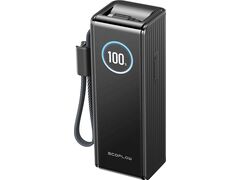
The 60 cm retractable USB-C cable housed in the case is what really sets this product apart. It takes 140 W, works in both directions, and saves carrying one more accessory. In day-to-day use, it is the argument that convinces.
It also carries the main risk of the product. The manual is unambiguous: the device contains no user-replaceable parts, and the battery is not replaceable. The cable is no exception. And it is the cable that serves the priority 140 W output.
The risk is not theoretical. The retraction mechanism has already shown its limits, and cables have broken after a few months of use, with long waits for a replacement. On a product covered by a two-year warranty, this is the point to watch.
The comparison with the Rapid Pro X in the same range is telling: on that model the cable sits in a removable magnetic block, and is therefore replaceable. The manufacturer has clearly identified the weakness and fixed it on the following model.
300 cycles, the real Achilles heel
This is the figure that should weigh most in a buying decision, and it is the least advertised. EcoFlow claims 300 cycles before dropping to 80 % of the initial capacity. The standard for this segment sits around 500, and several competitors claim double that.
Translated into real use: a full charge every two days burns through that budget in a little under two years. A rhythm of one charge a week pushes it beyond five years, which is comfortable. Everything therefore depends on how intensively it is used, and this product is sold precisely to people who travel often.
The problem is not the figure on its own, it is its combination with the rest: battery not replaceable, cable not replaceable, no spare parts in the catalogue. When the pack reaches its limit, the whole object has to go. The app does at least offer to cap the charge to spare the cells, which is the right reflex on this model.
Heat under control, throttling stated up front
Pushing 300 W through a case this size gives off heat, and it is handled rather well here. After 45 minutes of charging at full power, the surface of the case stays under 40 °C, which is very respectable for that power level.
The protection behaviour comes in three stages. At 40 °C of internal temperature, the output falls back from 140 to 100 W. Charging continues, simply more slowly. At 48 °C, the protection cuts out. Between the two, the device arbitrates between its ports rather than slowing everything down uniformly.
How long it takes to reach that first threshold is not published anywhere, and it depends in any case on the ambient temperature and on the device plugged in. What can be said is that the step-down exists, that it is predictable, and that it does not cut the charge off midway.
A screen that tells you everything, an app you can skip
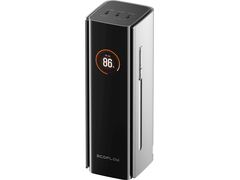
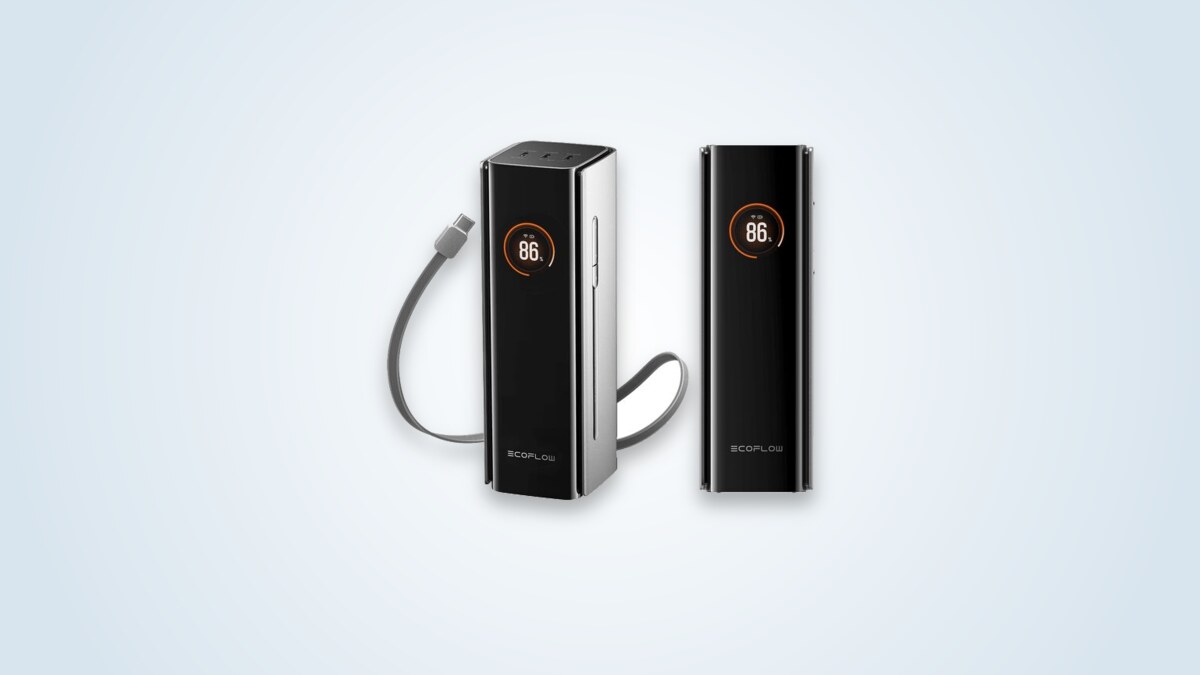
The 1.54 inch screen shows far more than the remaining percentage: watts per port, voltage, amperage, temperature and a cycle counter. For anyone who wants to understand what is going on, in particular the split across the four outputs, it is a genuine tool.
The app adds remote monitoring, firmware updates, customisation of the standby screen and control of the charging strategy. It requires creating an account, which will put off a share of buyers.
It does come with a hidden cost: the battery carries Bluetooth and Wi-Fi, and leaving those radios active causes self-discharge on the order of 0.5 to 1 % per day. On a battery kept full in a bag between two trips, that means a pack that empties itself in a few months. Switching them off when they are not in use is the right reflex.
Under the 100 Wh bar, and clearly marked
At 99.54 Wh, it passes under the 100 Wh threshold set by civil aviation for cabin boarding without prior authorisation. The margin is 0.46 Wh, which is to say nothing at all, and it rests entirely on the voltage used for the calculation: 3.6 V per cell. The same pack counted at 3.7 V would show 102.3 Wh and fall outside the rule.
The reassuring part is the marking. The case carries the figure in milliamp-hours and in watt-hours, with an aircraft pictogram. That is exactly what an agent looks at during a check, and many batteries print only the milliamp-hours, which leaves the conversion to their judgement.
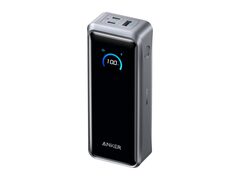
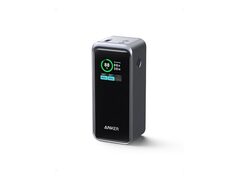
One amusing detail shows how far this limit shapes products. The Anker Prime 26,250 mAh, its direct competitor, claims 99.75 Wh, a margin of 0.25 Wh under the bar. It gets there by counting its cells at 3.8 V, where EcoFlow counts its own at 3.6 V. Two different conventions, two different declared capacities, and two products parked to the millimetre under the same threshold. That is obviously no accident.
The subject goes well beyond this one product, and the rules changed recently. Our article on the end of the exemption above 100 Wh spells out what it means for travellers.
Do not confuse it with the Rapid Pro X
EcoFlow sells two batteries built on a strictly identical pack, under neighbouring names and €85 apart. Not a single watt-hour, not a single watt separates them: the same 99.54 Wh, the same 300 W, the same charging dock, the same claimed lifespan.
| Criterion | Rapid Pro 27K | Rapid Pro X |
|---|---|---|
| Capacity | 99.54 Wh | 99.54 Wh, identical |
| Total output | 300 W | 300 W, identical |
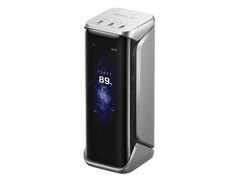
| Screen | 1.54 inch | 3.9 inches, customisable |
| Built-in cable | fixed to the case | removable magnetic block |
| If the cable breaks | output lost | block replaceable |
| Price seen | ≈€110 | ≈€195 |
The price gap therefore buys a large screen, an ecosystem of interchangeable modules, and above all a cable that can be replaced. Nothing more. For anyone who wants neither the screen nor the modules, the 27K offers exactly the same energy and the same power for considerably less.
One nuance in favour of the 27K, incidentally: its four outputs are built into the case, whereas the Pro X carries only three and owes its fourth port to the magnetic block. Without that block fitted, it tops out at 270 W.
Who it suits, and who it does not
It suits anyone charging one or two laptops on the move, anyone who wants a reserve close to the cabin limit without going through an accessory, and anyone who appreciates seeing exactly what their battery is doing on a detailed screen.
It does not suit anyone planning to power four devices at a decent speed: the last two ports make do with 10 W. Nor anyone who mainly charges phones, the case where efficiency is at its worst and where a lighter battery would do better. Nor intensive daily use, since the 300 cycles claimed come round quickly on a battery that cannot be replaced.