
Weight: the real signature of this panel
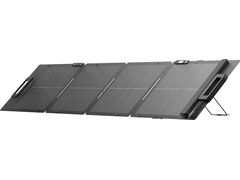
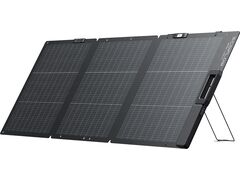
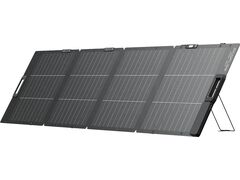
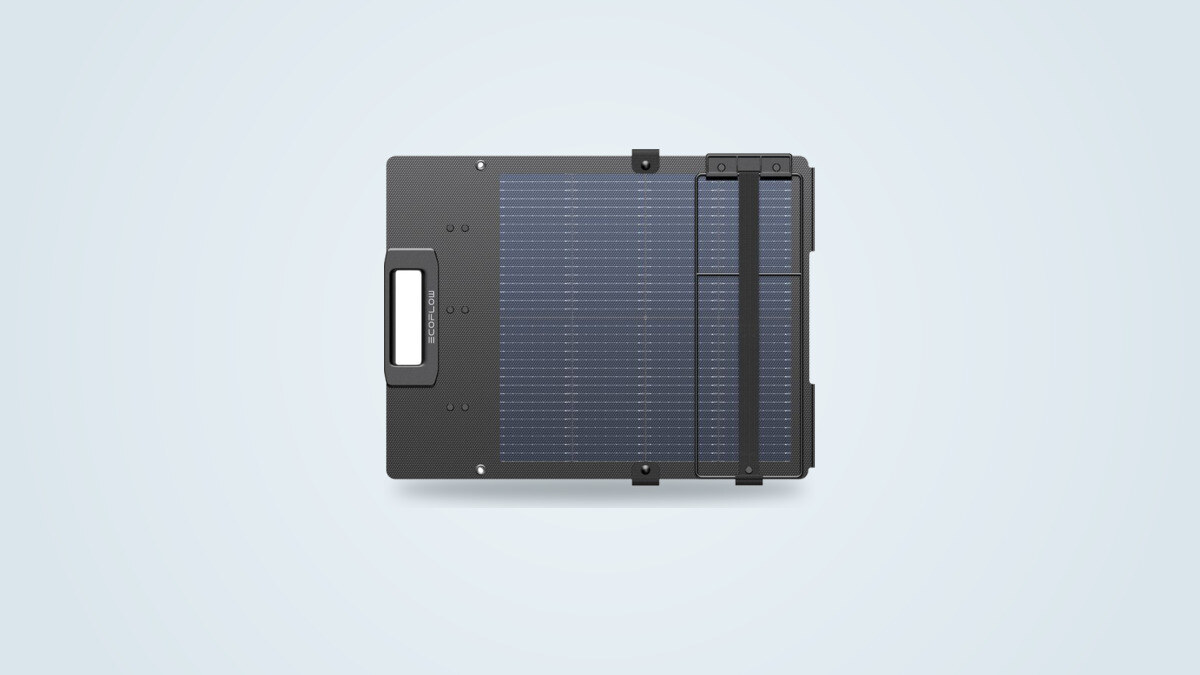
The EcoFlow 110W solar panel weighs 3.3 kg, for an unfolded size of 194.4 x 41.3 cm and a thickness of 2.6 cm. Folded, it packs down to 54.4 x 41.3 x 3.6 cm, roughly the size of a large attaché case. It is the lightest panel in EcoFlow's entire folding bifacial line: the 160W weighs 3.8 kg, the 220W 5.1 kg and the 400W 10.2 kg, a roughly linear progression with rated output.
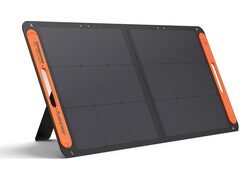
Against nomad panels of similar power already reviewed on this site, the 110W stands out clearly: the Jackery SolarSaga 100W weighs 3.6 kg for a slightly lower rated output (100W), and the Goal Zero Nomad 100 climbs to 4.6 kg for the same power. EcoFlow's 110W is, to date, the lightest nomad panel in this power class compared on this site.
That lightness has a flip side, though: once deployed on its built-in stand, the panel handles sustained wind poorly with no ballast option. Nothing in its design weighs it down or anchors it to the ground, and its very lightness, a clear asset for carrying it around, works against it as soon as the wind picks up.
A product name that covers two very different generations
Before comparing this panel with other reviews found online, one thing is worth knowing: the "EcoFlow 110W solar panel" name has been used for two products with noticeably different specs. An older, monofacial version weighs around 4 kg, claims a cell efficiency of 22 to 23% and has no built-in adjustable stand, using its carry case as a fixed kickstand instead. The current version, the one this review covers and the one this site's product page references, is bifacial, weighs 3.3 kg and includes a kickstand adjustable from 30 to 60°.
| Feature | Previous version | Current bifacial version |
|---|---|---|
| Design | Monofacial | Bifacial |
| Cells | Standard monocrystalline | N-type TOPCon monocrystalline |
| Rated output | 110W (front face only) | 110W (STC), up to 122W declared under bifacial conditions |
| Stand | Carry case used as a fixed kickstand | Built-in kickstand adjustable from 30 to 60° |
| Rated weight | Around 4 kg | 3.3 kg |
This mix-up isn't unique to the 110W: reviews already published on this site for the EcoFlow 160W and 220W panels flag the same pattern, with each size in the current bifacial line having likewise replaced an older, heavier, non-bifacial version.
110W or 122W: what the bifacial figure actually means
EcoFlow rates this panel at 110W under the industry's standard test conditions (STC: 1000 W/m², 77 °F/25 °C cell temperature, AM1.5 spectrum), built with N-type TOPCon monocrystalline cells. Under its own bifacial test protocol, the manufacturer declares an output that climbs to 122W, a figure that folds in the rear face's contribution. That bifacial test protocol is the manufacturer's own: no independent outdoor measurement was found to confirm this figure for the current generation of the product.
As with the other bifacial sizes in the range, this extra output depends mainly on the albedo, the reflectivity, of the ground beneath the panel: it generally stays limited on grass or dark soil, the most common camping surface, and can get closer to the declared ceiling on very light ground (sand, snow, concrete). This isn't a limitation specific to this panel: it's a physical constraint common to bifacial technology as a whole, rarely explained on the box.
On the electrical side, the spec sheet lists an open-circuit voltage (Voc) of 23.5V, a short-circuit current (Isc) of 6.1A, a maximum-power voltage (Vmp) of 19.5V and a maximum-power current (Imp) of 5.9A. These are standardized figures under test conditions that are never met as such outdoors: the sun's angle of incidence, cloud cover and the panel heating up in direct sun all pull the available output down. This lack of independent cross-checking, true across EcoFlow's whole recent bifacial line, rules out stating a precise gap between the rated 110W and what this current generation actually delivers in the field.
IP68: weatherproofing on par with the best in class
The panel is IP68 rated, the best protection against water and dust in this comparison, tying the Jackery SolarSaga 100W and EcoFlow's other bifacial panels (160W, 220W). This rating means the panel can be left outside in a downpour without rushing to bring it in.
N-type TOPCon cells generally have a more stable thermal behaviour in direct sun than the P-type cells common on entry-level nomad panels, which in theory limits output loss on the hottest days. This current generation shows no known hinge or connector failure to date, though the track record available is by nature more limited than for a product sold for several years, an honest caveat to keep in mind rather than a proven flaw.
Output ports: built-in XT60, but no USB
The XT60 cable comes already built into the panel, a genuine convenience: nothing to look for or plug in separately to connect the panel to a River or Delta series EcoFlow station. It's the native connector of the EcoFlow ecosystem, directly compatible with almost every generator the brand makes, no adapter needed.
The trade-off is a genuine limitation: the panel offers no USB-A or USB-C output at all. Charging a phone or a small power bank directly, without going through a station or a charge controller, isn't possible, unlike the Jackery SolarSaga 100W, which adds USB-A and USB-C ports alongside its main output. To plug this panel into a generator or controller from another brand, an XT60 adapter cable to the expected connector (MC4, Anderson, or another proprietary standard) is needed: XT60 is common across the portable power station ecosystem but lacks the universality of MC4, more widespread on fixed solar installations and on some rival nomad panels.
Build and warranty: an established brand, 5 years of cover
EcoFlow was founded in 2017 in Shenzhen, China, and has since become one of the reference names in the portable power station market, with a broad ecosystem of panels, batteries and accessories that work together. The 110W solar panel carries a 5 year manufacturer warranty, matching EcoFlow's other bifacial panels (160W, 220W), and no recall has been identified for this product to date.
The move from the previous version (around 4 kg, monofacial, no built-in stand) to this 3.3 kg panel with an adjustable stand amounts to a full design overhaul rather than a cosmetic change, spanning several years of production between the two versions. This same kind of generational shift shows up on the 160W and 220W in the same range too, which points to a consistent renewal strategy across the brand's whole folding bifacial panel line rather than an isolated case.
Against other nomad panels of similar power
Compared with nomad panels already reviewed on this site, EcoFlow's 110W holds an unusual spot: slightly more powerful than a classic 100W panel, yet also the lightest in its class, with a connector geared toward its own ecosystem.
| Criterion | EcoFlow 110W | Jackery SolarSaga 100W | Goal Zero Nomad 100 |
|---|---|---|---|
| Rated output | 110W | 100W | 100W |
| Rated weight | 3.3 kg | 3.6 kg | 4.6 kg |
| Design | Bifacial | Monofacial | Monofacial |
| USB output | No | Yes (USB-A and USB-C) | No |
| Rating | IP68 | IP68 | Not specified |
| Warranty | 5 years | 3 years | Not specified |
The Jackery SolarSaga 100W, despite a slightly lower rated output (100W), weighs 300 g more (3.6 kg) and doesn't match the EcoFlow's 5 year warranty, but it keeps one clear practical edge: two built-in USB ports that let you charge a phone or a small power bank directly without going through a station, something no bifacial EcoFlow panel offers. The Goal Zero Nomad 100 leans on the Yeti ecosystem but climbs to 4.6 kg for the same rated 100W, and its real-world available output usually sits between 50 and 80W out of the rated 100W, a gap Goal Zero doesn't state at the point of sale. EcoFlow's 110W stands out for its already built-in cable, its light weight and its 5 year warranty, at the cost of a more closed connector setup and no USB output at all.
Price and where it sits in the EcoFlow range
In the UK, the EcoFlow 110W solar panel is priced at around £149 at the time of writing, direct from the manufacturer. It sits at the entry point of EcoFlow's bifacial range, below the 160W (around £199) and the 220W, a coherent range that lets buyers match power output to the station they own without switching cable ecosystems.
| Model | Power | Rated weight |
|---|---|---|
| EcoFlow 110W | 110W | 3.3 kg |
| EcoFlow 160W | 160W | 3.8 kg |
| EcoFlow 220W | 220W | 5.1 kg |
Worth noting for buyers: the older, heavier, non-bifacial version of this panel sells through some retailers at a price close to, or even above, the current version, despite falling short on nearly every spec (weight, stand, bifacial design). Checking the product page for a built-in adjustable kickstand and the rated weight (3.3 kg) helps avoid paying the same amount, or more, for a less capable product than the one covered in this review.
Who this panel suits, and who it doesn't
EcoFlow's 110W suits, first and foremost, anyone who already owns, or is considering, a compact station from the brand (River series) and wants the lightest, easiest-to-carry solar top-up in the whole range: the built-in XT60 cable removes any need to hunt for an adapter, and the folded size slips easily into a bag or a small boot.
On the other hand, anyone wanting to charge a phone or a small power bank directly, without carrying a station, should look at a panel with USB ports, such as the Jackery SolarSaga 100W. Anyone with a medium to large station who wants to recharge it faster should look instead at the 160W or 220W in the same range. Anyone camping regularly on a wind-exposed site will need something to weigh this very light panel down. And anyone using a station from another brand will need an adapter cable, since XT60 isn't the most widespread standard outside the EcoFlow ecosystem.