EcoFlow 100W Flexible Solar Panel: Our Full Review

The EcoFlow 100W flexible solar panel keeps a promise rarely stated this clearly: its official documentation states 70 to 80W of actual output in clear weather, not the 100W nominal rating, and most of the values found in real-world use sit within this range or above it. Its light weight and quick installation are genuine strengths, but two caveats are worth knowing: the advertised 258° curve looks overstated against real-world flexibility, and the need for an air gap under the panel to avoid overheating, though specified in the technical documentation, does not appear on the product page.

Our rating
4.1/5
Efficiency: 4.3 out of 5 (weighting 25%)Efficiency4.3Portability and size: 4.0 out of 5 (weighting 25%)Portability4.0Weather resistance: 3.9 out of 5 (weighting 20%)Weatherproofing3.9Output ports: 4.2 out of 5 (weighting 20%)Output4.2Build and endurance: 3.7 out of 5 (weighting 10%)Build3.7

How is this rating calculated?

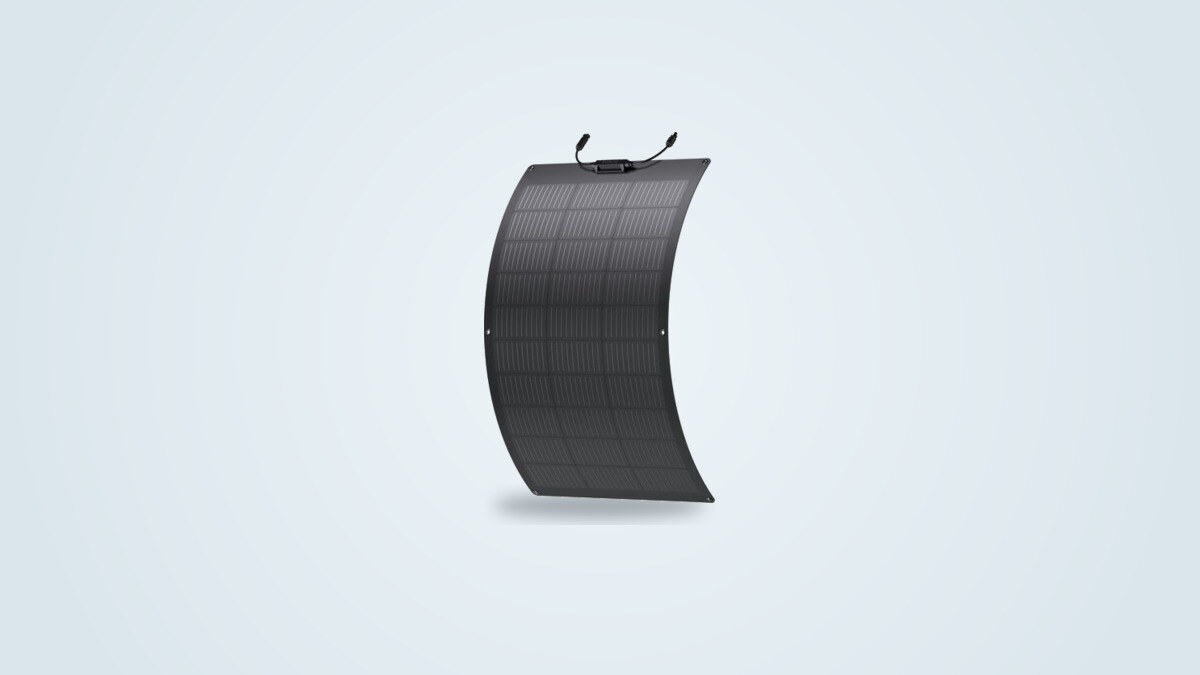
EcoFlow 100W flexible solar panel on a light background

The essentials

The EcoFlow 100W flexible solar panel stands out for rare transparency: its official documentation itself states 70 to 80W of actual output in clear conditions, not the 100W nominal rating, and most of the values found in real-world use meet or exceed it. Light (2.3kg) and quick to install, it remains an excellent choice for durably equipping a van, a boat or a cabin. Two caveats to know before buying: the advertised 258° curve looks overstated against the flexibility actually found in use, and the technical documentation recommends an air gap under the panel to avoid a heat-related loss of output, a detail missing from the product page. A gradual power decline over two and a half years is also reported in one isolated but noteworthy case, tracked with precision. For a fixed installation on a curved surface, it is a solid choice, honest about its own limits.

Strengths

  • Actual output (70 to 110W depending on conditions) matching what EcoFlow itself states as the normal range, a rare degree of transparency for this type of product
  • Light (2.3kg) and quick to install, around 10 minutes mentioned repeatedly, including with adhesive-only mounting
  • Standard MC4 connector, compatibility confirmed with a Victron MPPT controller in a real installation
  • IP68 certification, no water-tightness incident reported
  • Build quality that comes across as better than generic flexible panels, notably on the quick-release connectors

Limitations

  • The advertised 258° curve looks overstated against the flexibility actually found in use
  • The need for an air gap under the panel to avoid overheating, specified in the technical documentation, does not appear on the product page
  • A gradual power decline on one unit tracked with precision (100W down to 60W over two and a half years), with after-sales support reportedly refusing coverage beyond 2 years
  • The advertised warranty period ranges between 24 and 36 months, worth checking before buying
  • No confirmation found of compatibility with Renogy or Redarc controllers, only Victron being confirmed compatible in real-world use
EcoFlow 100W flexible solar panel: see the full details and price →

Actual output, matching what EcoFlow itself states

EcoFlow's official documentation states that, for a clear day with the panel angled at 90° to the sun (800 to 900 W/m², panel at 50 °C), output typically falls between 70 and 80W out of the 100W nominal rating. The user manual and the manufacturer's own blog explain this directly: heat (a 10 to 15% loss above 25 °C) and a non-optimal installation angle (a further 5 to 10%) account for most of this gap.

100 W
Nominal power
70 to 80 W
Normal range (EcoFlow)
2.3 kg
Weight
IP68
Waterproofing

Real-world output falls, in most of the cases found, within this range or above it: between 75 and 110W in full sun depending on orientation, up to 85W in June at an optimal angle. The low readings reported (20 to 60W) consistently correspond to overcast skies or a non-optimal angle, two factors the manufacturer already anticipates, not a fault with the panel.

The 258° curve, a claim to qualify

EcoFlow highlights a possible curve of up to 258°, the most visible argument on the product page. The minimum bend radius stated in the technical documentation is 200mm, a real limit worth knowing before considering a very tightly curved surface. In use, the actual flexibility allows the panel to follow a moderate curve, without appearing to reach the extreme of this advertised figure: the marketing argument looks slightly overstated.

Installation itself remains a genuine strength, quick (around ten minutes, mentioned repeatedly) thanks to the panel's light weight (2.3kg), which lets it go on structures that would not support a rigid framed panel.

Mounting it flat without overheating: a caveat missing from the product page

An important point, absent from the product page but clearly present in the technical documentation: mounting the panel flat, with no air gap underneath, encourages a heat buildup that reduces output and, over time, service life. The user manual is explicit on this point and recommends leaving a gap between the panel and the mounting surface, whichever fixing method is chosen (adhesive or drilled).

The built-in bypass diode protects against hot spots caused by partial shading of a section of the panel, a mechanism distinct from overall heat buildup due to poor ventilation: the two should not be confused, contrary to what some product descriptions might suggest.

The IP68 certification protects effectively against water and dust, with no contrary incident reported on this specific point.

MC4 connector and compatibility

The MC4 connector, a solar industry standard, ensures broad compatibility well beyond the EcoFlow ecosystem alone. Stable operation with a Victron SmartSolar MPPT controller is confirmed on two separate occasions, with consistent charging voltages backing it up. No equivalent confirmation has been found with other controller brands such as Renogy or Redarc, which does not signal incompatibility, simply an absence of available feedback.

One point deserves clarification before buying: the presence of an MC4-to-XT60 adapter cable in the box is not consistently confirmed. It is worth checking this detail directly before ordering if this compatibility is needed for the planned installation.

Build quality, lifespan and after-sales support

Perceived build quality is generally good, with a preference expressed repeatedly over cheaper generic flexible panels, notably regarding the quality of the quick-release MC4 connectors. The manufacturer itself acknowledges, in its documentation for the Japanese market, that a flexible panel degrades more easily and has a shorter useful lifespan than an equivalent rigid panel, with limited hindsight so far on this technology's long-term durability.

A gradual power decline appears on this specific unit, tracked precisely over time: 100W at the start, 90W at 6 months, 80W at 1 year, 70W at 2 years, 60W at two and a half years, with after-sales support reportedly refusing coverage beyond 2 years. This case remains isolated and does not support a general degradation rate, but the precision of the tracking gives it real weight. A complete failure after one month of occasional use makes up a second, separate case, handled quickly by after-sales support this time. The advertised warranty period itself ranges between 24 and 36 months: worth checking directly before buying.

Price and availability

The price in the UK is £109, against a catalogue price of £139 outside promotions. EcoFlow's official UK site occasionally shows this model as out of stock while the Amazon store run by the same company lists it in stock at the same price, a gap worth checking at the time of purchase rather than a general unavailability. No product recall was found for this panel in the US safety databases consulted.
The product and its alternatives

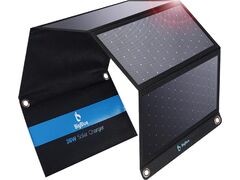
BigBlue 28W

BigBlue 28W

See price (22)

A panel that fits in your pack and charges three devices in the sun: the BigBlue 28W combines high-efficiency SunPower cells, three USB ports and weather resistance.

View product

Frequently asked questions

Rarely on a continuous basis. EcoFlow itself states a normal range of 70 to 80W in clear conditions, and most of the values found in real-world use sit within this range or above it.

Actual flexibility allows the panel to follow a moderate curve, but it does not appear to reach the extreme of this advertised figure in use. The minimum bend radius stated by the manufacturer is 200mm.

Yes. The manufacturer's technical documentation explicitly recommends it to avoid a heat buildup that reduces output and service life, even though the product page does not mention it.

The MC4 connector is an industry standard. Stable operation with a Victron MPPT controller is confirmed in real-world use; no equivalent confirmation has been found for other brands.

The rating in detail

Our rating
4.1/5
Efficiency 4.3
Portability and size 4.0
Weather resistance 3.9
Output ports 4.2
Capacity and expansion not measured
Solar input and MPPT not measured
Control and smart features not measured
Installation and compliance not measured
Build and endurance 3.7
EcoFlow 100W flexible solar panel: see the full details and price →