
Solar and expansion: what the new generation takes away
The Delta 3 Max succeeds the Delta 2 Max, and EcoFlow's own published comparison between the two generations holds a surprise: the newer version does not do better on every point. Solar input drops from 1000 W split across two independent MPPT trackers to 500 W on a single MPPT. In practice, the same panel kit that charged the older generation at full power is now capped at half its potential on this one.
| Feature | Delta 2 Max (previous generation) | Delta 3 Max |
|---|---|---|
| Solar input | 1000 W, 2 independent MPPT | 500 W, 1 MPPT only |
| Expansion | Up to 6 kWh with additional battery | None |
| Mains charge 0-80 % | 53 min | 51 min |
| Weight | 23 kg | 20.3 kg |
This step back is not a technical oversight: it is a deliberate range segmentation. The two features removed, generous solar input and expansion, are now the exclusive preserve of the Delta 3 Max Plus, sold for around 200 euros more, which keeps 1000 W of dual-MPPT solar and accepts up to 10 kWh of additional batteries. Anyone buying a new generation on the assumption of across-the-board progress deserves to know this nuance before buying rather than after.
For home backup use on a station that is not recharged from solar day to day, this step back matters little. It becomes decisive, on the other hand, for anyone aiming at sustained solar self-consumption or planning to grow their storage capacity over time: in both cases, the Max Plus or another expandable station on the market answers the need better.
51 minutes for 80 %: charging speed remains a genuine strength
On this point, the Delta 3 Max gives up nothing to its bigger sibling: mains charging from 0 to 80 % in 51 minutes is identical, or nearly so, to the previous generation (53 minutes), and ranks among the best times on the market for a 2048 Wh capacity. The maximum input power of 2300 W, however, depends on the mains voltage available: the stated figure holds for a standard 230 V European electrical installation.
The automatic backup switchover in under 10 milliseconds is also strictly identical between the two versions in the range: EcoFlow does not differentiate this critical function by tier, unlike per-circuit output priority or X-Fusion, both reserved for the Max Plus. For home backup use, this is the most useful function day to day, and it is not trimmed on the cheaper version.
Five charging methods are available in total: mains, solar, alternator charger, generator, and a solar-plus-alternator combination. On generator, the maximum stated recharge power reaches 2400 W, a figure common to both versions in the range.
Delta 3 Max or Max Plus: a very real risk of confusion
The Delta 3 Max and the Delta 3 Max Plus share the same product page at EcoFlow, the same displayed capacity of 2048 Wh, and a good part of the marketing content that presents them. The specifications table does list the two versions separately, but the page's general presentation blocks do not consistently make that distinction, and can keep showing the Max Plus's specifications even when the Max version is explicitly selected from the dropdown menu.
This ambiguity explains why a good share of the content available online about the “Delta 3 Max” actually concerns the Max Plus: the two products are easily mixed up in search results as well as in poorly copied comparison tables. A figure found for one of the two versions never automatically carries over to the other, even when the product name looks almost identical.
A third product deserves to be ruled out of any confusion: the plain “Delta 3” (without “Max”), a much smaller station of around 1024 Wh that shares nothing with this one beyond the range prefix.
2400, 4800, 3200 W: three power figures, three different uses
The spec sheet lists three AC power values, each answering a distinct situation, and they are best not confused when sizing your needs. The 2400 W figure is the power the station delivers continuously, with no time limit as long as capacity allows. The 4800 W peak covers only transient spikes, typically the inrush current when a motor, compressor or pump starts up, which lasts a few fractions of a second before dropping back under the 2400 W mark.
The 3200 W in X-Boost mode answers a third case: powering an appliance whose rated power slightly exceeds the 2400 W continuous limit, provided it is a tolerant resistive load, a portable heater or a kettle for example, and not electronics sensitive to waveform quality. This mode does not conjure up extra power: it widens the tolerance margin for appliances that accept a slightly degraded supply, which does not suit every use.
For reliable sizing, it is therefore best to treat the 2400 W continuous figure as the reference ceiling for sustained use, and to keep X-Boost for occasional fixes on appliances confirmed to be compatible.
20.3 kg: easy to move, not built for daily carrying
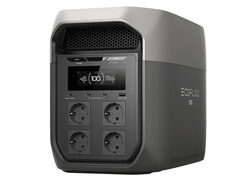
At 494 × 239 × 305 mm for 20.3 kg, the Delta 3 Max moves from room to room or loads into a car boot without major difficulty, but remains too heavy for frequent hand-carrying over long distances. Its size is closer to a small cabin bag than a portable cooler.
The weight cut compared with the Delta 2 Max, around 13 % less for the same capacity, is noticeable in use without changing the nature of the object: no wheels are fitted, unlike bulkier stations from the same brand, and moving it relies entirely on the two side handles. For a fixed home installation, home backup, or use in a converted vehicle, this limit does not matter. For nomadic use with frequent back-and-forth trips, it is worth planning for.
Efficiency and the capacity actually available
The claimed capacity of 2048 Wh rests on LiFePO4 chemistry, known to be stable but never delivered at 100 % once conversion losses are accounted for. One isolated data point puts the capacity actually delivered at around 1900 Wh, or about 93 % of the claimed value: a common and reasonable gap for this type of product, though without a detailed measurement protocol on record to verify it point by point.
Round-trip efficiency, meaning the energy actually recoverable at the output relative to the energy put in over one full charge-discharge cycle, comes out at around 79 % on the only data point available to date. This figure remains isolated and still needs corroborating with other numbers before being treated as firmly established, but it sits within a range consistent with what comparable LiFePO4 stations generally show, neither suspiciously perfect nor a poor result.
Standby draw, estimated at around 27 W on this same isolated data point, is worth knowing before relying on the unit for permanent backup: left on float charge continuously over a long period with no outage, a station uses up a non-negligible share of its own reserve just to hold its level. No reliable figure was found for actual runtime on standby over an extended period without mains power, so this point remains open.
Quiet running, but only at moderate load
The noise level stated by the manufacturer is 25 dB for a 600 W load, a value measured close to the unit under the manufacturer's own lab conditions. No independent decibel-metre measurement was found to confirm or qualify this figure, nor to track how it changes at higher power levels, which means this specific aspect cannot be rated on anything beyond a stated value.
The cooling on a station of this power inevitably ramps up as the load drawn increases, a general trait of this type of device rather than a quirk of this particular model. In typical home backup use, where the station rarely runs at full power continuously, everyday noise likely stays close to the stated value at moderate load rather than its theoretical maximum.
Not expandable: what this actually changes depending on use
The total absence of an additional-battery port fixes the Delta 3 Max's capacity at 2048 Wh for its entire service life, with no possibility of growing it later. For occasional backup of a few hours during an ordinary power cut, this limit is practically never felt: 2048 Wh already comfortably covers a household's essential needs for a good part of a day.
The picture changes for anyone planning sustained year-round solar self-consumption, or extended runtime over several days off-grid: in both cases, being unable to add a battery later means having to buy the right capacity outright, or turning to the Max Plus, another expandable model in the Delta 3 range, or a second, separate station.
This segmentation choice is not unique to EcoFlow: it shows up at several competitors who reserve expansion for their higher-end ranges. It simply deserves to be identified before buying rather than discovered the moment the need to expand arises.
Ports and app control: complete, without the Max Plus refinements
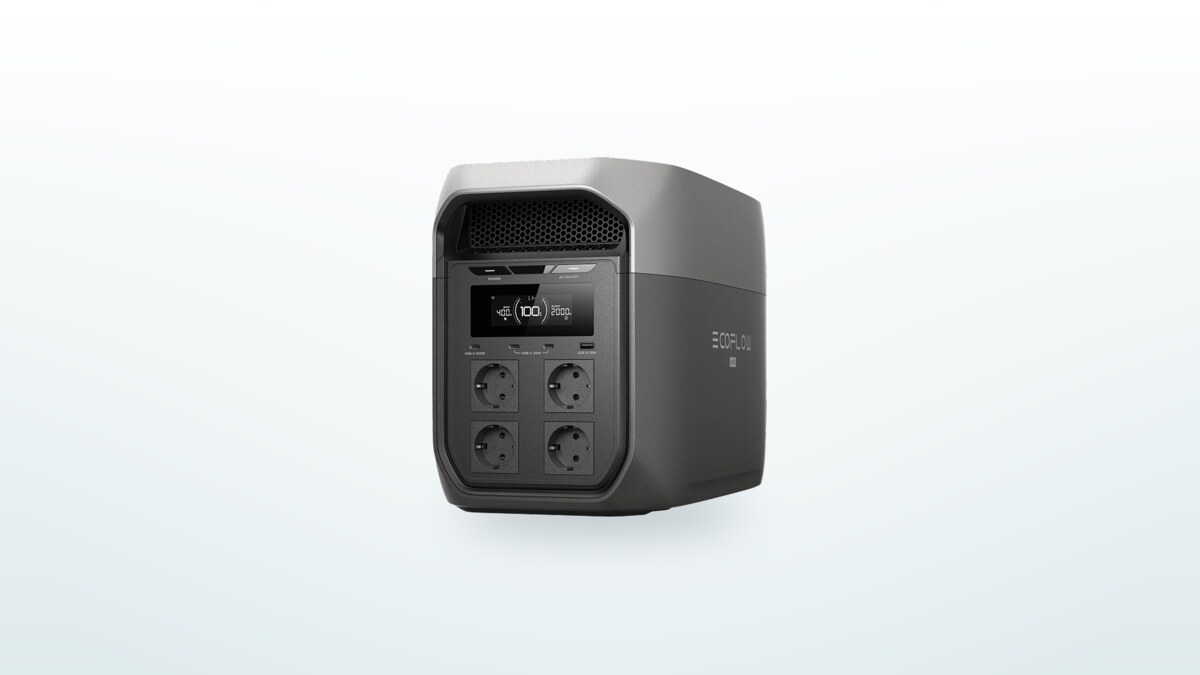
The Delta 3 Max offers nine output ports in total: four mains sockets, one USB-C port at 100 W maximum, two additional USB-C ports capped together at 30 W, one USB-A port at 18 W, and a 12 V DC output up to 126 W. Enough to power several devices at once without juggling a power strip.
| Feature | Delta 3 Max | Delta 3 Max Plus |
|---|---|---|
| 12 V DC output | 126 W max. | 378 W max., additional Anderson output |
| Main USB-C | 100 W max. | 140 W max. |
| Per-circuit output priority | No | Yes |
| Wi-Fi/Bluetooth/app control | Yes | Yes |
Remote control through the app, with consumption tracking and scheduled charging windows, stays identical between the two versions. Only the per-circuit output priority function, which lets you choose from the app which devices stay powered during an extended outage, is reserved for the Max Plus. For standard home use without a fuse board segmented into priority circuits, this absence is barely felt day to day.
Warranty and reliability: a promise that needs qualifying
The officially stated warranty breaks down into 3 years of standard cover, plus 2 years of extra cover accessible after registering the product in the EcoFlow app. The 5-year total, often advertised as a flat figure, therefore depends on an active step from the buyer: without that registration, real cover stops at 3 years.
The new-generation LiFePO4 cells, presented by the manufacturer as free of internal connectors (“tabless”), aim for better thermal behaviour and a longer lifespan than the previous generation. The stated cycle count, 4000 cycles before dropping to 80 % of original capacity, is consistent with another independent figure found for this specific model, which is reassuring about the accuracy of this particular number.
As the product was only recently launched, no history of failures or recurring defects has been found to date, but the absence of negative signals is not proof of long-term reliability for a model with only a few months of track record so far. No complete lab protocol, with detailed figures and published measurement conditions, was found for this specific version, unlike earlier generations in the Delta lineup, which have already been extensively tested.
Against the Anker SOLIX C2000 and the Bluetti Elite 200 V2
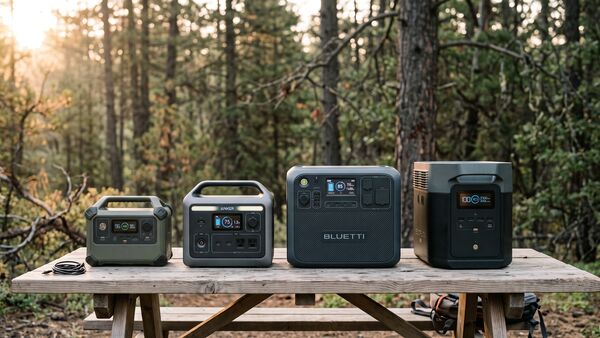
In the 2 kWh station segment, around 1300 euros, two direct alternatives stand out: the Anker SOLIX C2000 and the Bluetti Elite 200 V2.
| Criterion | EcoFlow Delta 3 Max | Anker SOLIX C2000 | Bluetti Elite 200 V2 |
|---|---|---|---|
| Capacity | 2048 Wh | 2048 Wh | 2073 Wh |
| AC output | 2400 W (4800 W peak) | 2400 W | 2600 W |
| Recharge 0-80 % | 51 min | 60 min | 76 min |
| Expandable | No | Yes, up to 12 kWh | No |
Against the Anker SOLIX C2000, the Delta 3 Max recharges faster and switches to backup more quickly, but gives up the advantage on expansion: up to 12 kWh for the Anker, against none here. For anyone planning to grow capacity over time, that gap weighs heavily on the decision. Against the Bluetti Elite 200 V2, the charging-speed gap is even clearer, 51 against 76 minutes, a concrete argument for anyone who recharges their station frequently between uses.
What remains is the most direct comparison of all, the one against its own bigger sibling. Against the Delta 3 Max Plus, the Delta 3 Max keeps the same capacity and an almost identical charging speed, for around 200 euros less. The whole gap comes down to three points: 600 W less continuous power, solar input cut in half, and expansion disappearing entirely. For anyone who needs none of the three, the Max version remains the most rational choice in the range.
Who it suits, and who it does not
It suits anyone looking for a responsive home backup station, with a near-instant switchover and fast recharging between outages, without needing to grow storage capacity later on. It also suits occasional nomadic use, motorhome or job site, where 2048 Wh and 2400 W cover the large majority of everyday needs.
It does not suit anyone aiming at sustained year-round solar self-consumption, where the input limited to 500 W on a single MPPT quickly becomes a constraint, nor anyone planning to grow their storage capacity progressively: in both cases, the Delta 3 Max Plus or another expandable model in the range will answer the need better, for an extra cost to weigh against the peace of mind gained.