
About 80 % efficiency, but two ways to calculate it
Round-trip efficiency (the energy that comes back out relative to what went in to recharge it, full cycle) sits around 80 %, with figures ranging from 76 to 81 % depending on the load drawn. That's a common order of magnitude for a station with dual AC-DC/DC-AC conversion on LiFePO4 cells, neither exceptional nor disappointing.
A different metric, usable capacity on a single discharge (the energy that comes out of the battery once full, not counting the recharge), gives a different and higher figure, one that depends on the load drawn: the station returns 1830 Wh under a 500 W load and 1940 Wh under 990 W, out of the claimed 2048 Wh, or 89 % then 95 % of rated capacity. These two figures don't quantify the same thing and shouldn't be compared directly: the first includes both charging AND discharging losses, the second only discharging losses.
25 dB stated, but only up to 600 W
The spec sheet states a noise level of 25 dB at 0.5 m, a value precisely capped to a charging or discharging power of 600 W. This detail almost systematically disappears from commercial reuses of the figure, which suggest a value that holds under any circumstance.
Beyond that threshold, the fan speeds up: around 28 dB at 1 m for a moderate load close to 2200 W, then 30 to 32 dB at 1 m at full power close to 3000 W, with the fan running at full speed. That's not an excessive noise level in absolute terms, but the gap with the headline figure stays clear and is worth knowing before buying for use in a lived-in room at sustained full load.
X-Boost 3900 W: solid on resistive loads, unverified on inductive ones
X-Boost mode allows the unit to exceed the 3000 W continuous rating, up to 3900 W, by tolerating a drop in output voltage, a purely software mechanism reserved for resistive loads (heaters, kettles, cooktops), including a 3500 W induction hob load.
On a more demanding inductive load in terms of inrush current (motor, compressor, air conditioner), the manufacturer's own documentation stays clear of any promise: no independent test of this type of appliance pushed beyond the continuous rating was found. So this is neither confirmed nor ruled out for this specific use case, to be distinguished from the transient 6000 W peak, which only serves to absorb the very brief inrush current when a motor starts, without sustaining continuous-use power.
"Full-tab" cells: a technical first not yet independently verified
This generation introduces LiFePO4 cells described as "full-tab", a change aimed at reducing internal resistance compared with the small-tab cells of previous generations. The manufacturer states a resistance of 1.5 mΩ against 2 mΩ for the previous in-house cell, a 25 % reduction.
That's a precise technical figure, more credible than a vague marketing claim, but it comes solely from the manufacturer: no comparative cycling or thermal-endurance test between the two cell generations was found to verify it independently. The temperature near the fan outlet reaches around 40 °C during charging, but without a comparison against the previous cell generation, that figure alone doesn't allow judging the real benefit of the full-tab design.
Capacity extension: a proprietary connector, not the broad compatibility implied
The Delta 3 Max Plus accepts a dedicated additional battery to go from 2048 to 4096 Wh, through a proprietary 12-pin connector distinct from the XT150 connector used by the rest of the EcoFlow range (Delta 2, Delta 2 Max, Delta 3, Delta 3 Plus). The official spec sheet for this additional battery confirms native compatibility only with the Delta 3 Max Plus itself and the Delta 3 Ultra Plus.
Expansion using batteries from the Delta 3, Delta 3 Plus, Delta Pro 3 or Delta 2 Max does not work natively as of now, despite compatibility sometimes wrongly advertised: the physical connector differs, and the manufacturer mentions an upcoming firmware update for the Delta 3 and Delta 3 Plus, with no confirmed date. A separate accessory, the expansion adapter needed to plug in several batteries at once, has faced repeated availability delays since launch. It's best to check directly with the manufacturer before buying a battery from another model expecting to pair it with this station.
The physical connector itself confirms this limit: several connection cables sold separately for third-party equipment on the Delta 2, Delta 2 Max, Delta 3 and Delta 3 Plus models explicitly state they are not compatible with the Delta 3 Max Plus (nor with the Delta Pro 3, a separate range), proof that this is not just a software restriction but a genuine hardware difference.
Three USB-C ports at 140 W, a 12 V output on an Anderson connector
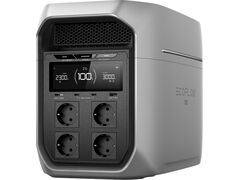
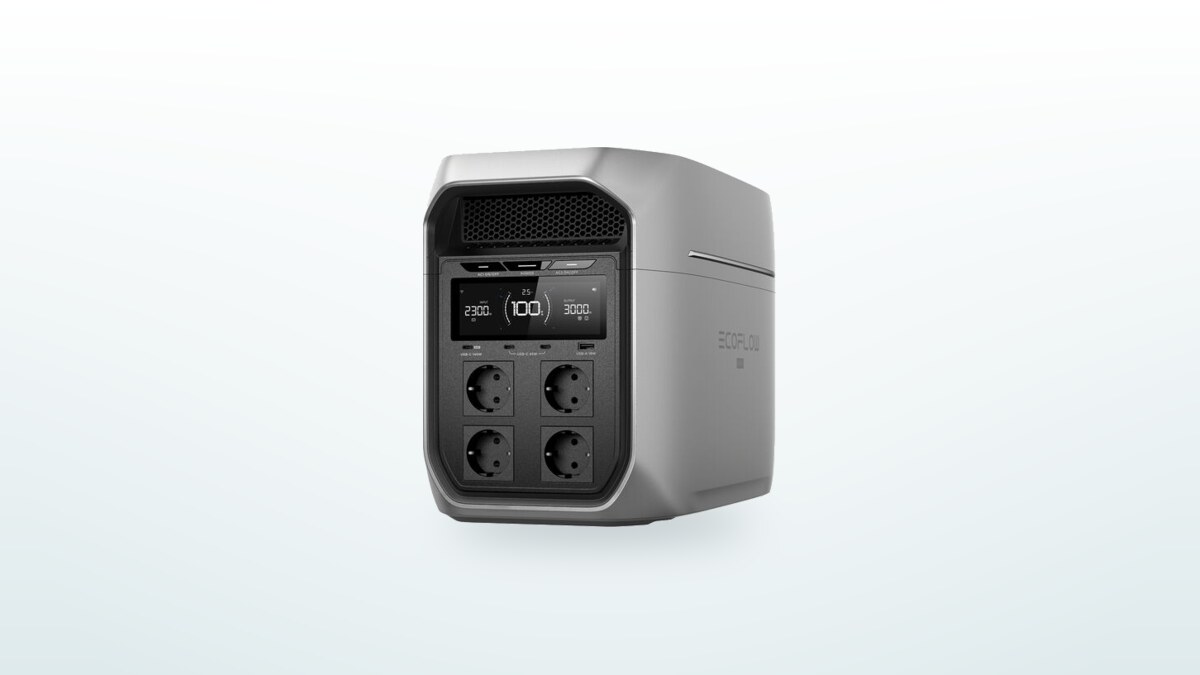
On the output side, the station offers four mains sockets, three USB-C ports each delivering up to 140 W (enough to quickly charge a demanding laptop), one USB-A port at 18 W, and a 126 W 12 V DC output on an Anderson connector, more common on professional equipment or converted vans than on consumer electronics.
The stated operating range spans from -10 °C to 45 °C on discharge, and from 0 °C to 45 °C on charge, typical limits for this type of station, worth keeping in mind for outdoor use in cold weather.
UPS function at 8 ms, faster than advertised
In the event of a mains outage, the station switches over to its own power. The manufacturer states under 10 ms; the switchover time comes in at 8 ms, a better result than the official rating.
That figure applies to a light load, however. No test of switchover time under heavy load, close to the 3000 W continuous rating, was found. Nothing points to a problem at that power level, but this specific case remains a blind spot in this review's coverage.
47 minutes for 80 %: a figure that largely holds up
The 47-minute recharge time from 0 to 80 % assumes an input power close to the 2300 W maximum. At that same input level, the equivalent figure comes out very close, at 49 minutes. At a lower input power (1800 W), the time comes out to 64 minutes, a gap consistent with the available power rather than a contradiction of the stated figure.
On an installation that can only supply 1800 W instead of 2300 W, charging time therefore stretches out proportionally, without this being a flaw in the product.
Standby draw worth watching for permanent use
Left plugged in continuously, the typical case for home backup use, the station draws around 19 W at rest, a loss on the order of 450 Wh per day from standby alone. That's a relatively high figure for this type of device.
For nomadic or occasional use, this matters little. For home backup use, where the unit stays plugged in permanently for months at a time, it's a real cumulative energy cost worth factoring in, even though it stays minor next to a household's overall electricity consumption.
Home backup, job site, motorhome: power over pure runtime
For home backup, the 3000 W continuous rating (6000 W peak) is enough to cover nearly every appliance in a household running at once, including a cooktop or a pump, which sets this station apart from lower-power models built around runtime alone.
On an off-grid job site, that same power lets demanding tools run (angle grinder, circular saw) without the continuous-power limitations that hold back less powerful stations. In a motorhome, the 2048 Wh capacity stays average for the category, but the charging speed means the reserve can be topped back up during a single stop rather than an entire leg of the trip.
Limited track record, and a mix-up not to repeat
Launched in late 2025, the Delta 3 Max Plus doesn't yet have the track record of older models. No major failure or defect has turned up for this product so far.
One terminology mix-up is worth flagging: an EcoFlow safety recall was indeed announced in late 2025, but it concerns exclusively a completely different product, the Delta Max 2000 (sold between 2022 and 2025), not the Delta 3 Max Plus. The similarity in names can lead to confusion; no official recall procedure targets this product to date.
No dedicated after-sales service in France, support centralized at the European level
EcoFlow support operates at the European level (email, contact form, weekday hours), with no phone line or after-sales service identified as physically based in France. One French retailer offers a paid plan with priority assistance and loaner equipment, a third-party service distinct from the manufacturer's own native support.
Return shipping costs are stated as relatively high, a point worth knowing before a bulky purchase like this one.
1499 € confirmed, occasional retailer stockouts
The 1499 € tax-inclusive price for the unit alone is confirmed stable across major French stores as of publication, with no tax-exclusive pricing trap or disguised bundle found.
Availability, on the other hand, is mixed: while the official store lists the product as available, several specialised French retailers show a temporary stockout with restocking announced in the coming weeks. Buyers in a hurry are better off checking stock at the time of purchase rather than relying on a single site.
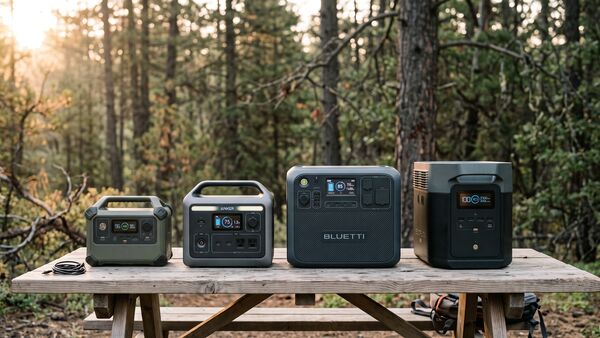
Against the Anker SOLIX C2000, the Bluetti Elite 200 V2 and the EcoFlow Delta 2 Max
Around 1300 to 1500 €, three direct alternatives stand up against the Delta 3 Max Plus: the Anker SOLIX C2000, the Bluetti Elite 200 V2 and the EcoFlow Delta 2 Max.
| Criterion | EcoFlow Delta 3 Max Plus | Anker SOLIX C2000 | Bluetti Elite 200 V2 | EcoFlow Delta 2 Max |
|---|---|---|---|---|
| Capacity | 2048 Wh | 2048 Wh | 2073 Wh | 2048 Wh |
| AC output | 3000 W (6000 W peak) | 2400 W | 2600 W | 2400 W |
| Recharge 0-80 % | 47 min | 60 min | 76 min | 60 min |
| Expandable | Yes (dedicated battery only) | Yes (up to 12 kWh) | No | Yes (up to 6 kWh) |
| Market price | ≈ 1499 € | ≈ 1299 € | ≈ 1299 € | ≈ 1299 € |
The Delta 3 Max Plus stands out with the most powerful continuous output and the fastest recharge in the group. The Anker SOLIX C2000 goes further on maximum expansion, the Bluetti Elite 200 V2 isn't expandable at all, and the Delta 2 Max remains the most affordable option in the group for a comparable capacity.
Who it suits, and who it doesn't
It suits anyone looking for a powerful station that recharges quickly, for home backup or demanding nomadic use, without needing to extend capacity beyond 4096 Wh with the single dedicated battery.
It doesn't suit anyone who already owns an additional battery from another EcoFlow model hoping to reuse it, nor anyone seeking absolute silence at full power, nor anyone who needs field-tested proof of X-Boost mode on a motor load.