Efficiency: more a cell story than a whole-panel one
Callsun quotes 25% efficiency for this panel, a figure worth clarifying before any comparison. It describes the cell itself, 182 mm monocrystalline N-Type silicon with sixteen busbars (16BB), not the finished panel once assembled with its frame, hinges and connector pouch. N-Type technology relies on a newer architecture than the PERC cells fitted to most nomad panels: it limits the performance loss as the cell heats up, which happens systematically in full sun, and it slows degradation from one year to the next. The sixteen busbars also shorten the distance current has to travel before being collected, which cuts resistive losses and improves tolerance to micro-cracks.
Measured against the panel's total unfolded area (122.5 x 58.4 cm, or 0.715 m²), the 110 W rating works out to a density of about 154 watts per square metre, or 15.4% efficiency at the whole-panel level, well below the 25% quoted for the cell alone. This gap is not specific to Callsun: the same calculation, applied to the official dimensions and power ratings of the other three panels in this comparison, gives 149 W/m² for the Jackery SolarSaga 100W, 137 W/m² for the EcoFlow 110W and 130 W/m² for the Allpowers SP029 140W. The percentage printed on the box therefore says nothing about real efficiency per square metre, a figure that matters more for anyone who has to fit the panel into a limited space, such as a van roof or a motorhome awning.
On this measure, the Callsun tops the comparison, even ahead of the EcoFlow 110W's most favourable figure (up to about 152 W/m² under optimal bifacial conditions, a measurement taken under different conditions and not directly comparable to the calculation above). The real advantage of N-Type technology is therefore not found in the quoted percentage, close to that of several rivals, but in this power density and in the better temperature behaviour the technology promises. No independent outside measurement was found, however, to put a figure on the degradation gap over time for this particular model.
A format built to actually be carried
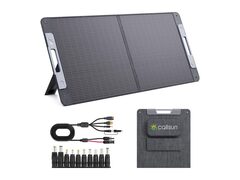
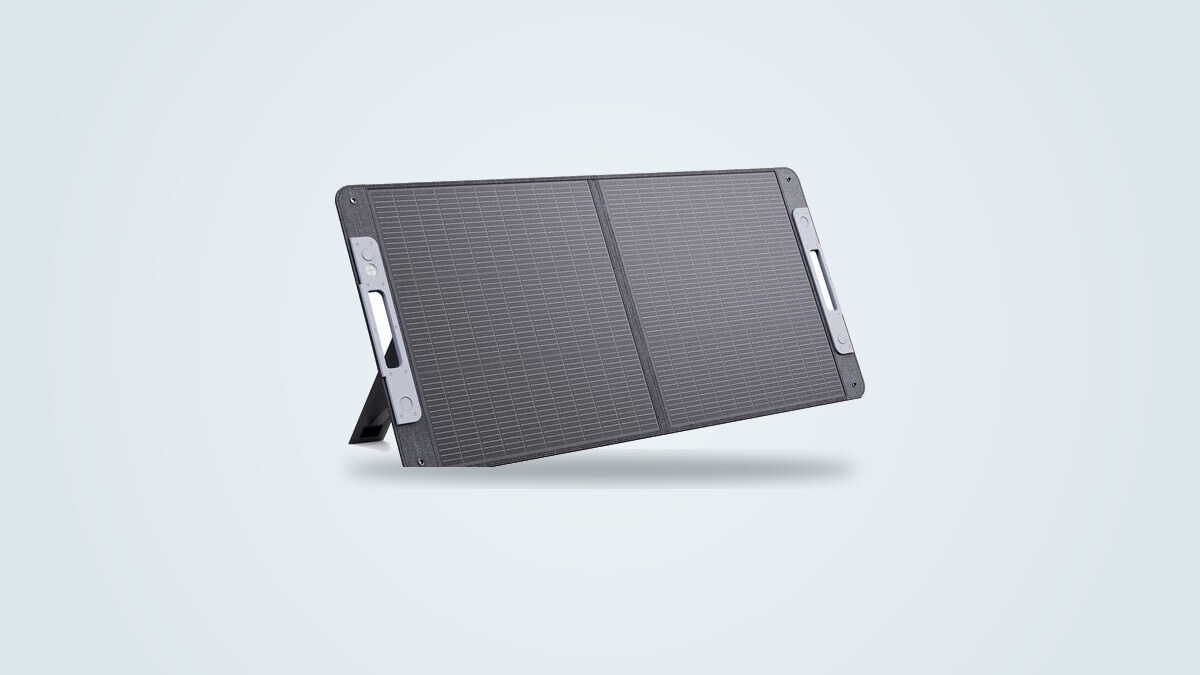
The Callsun 110W weighs 3.64 kg for an unfolded format of 122.5 x 58.4 cm and a thickness of 3 cm. Folded in two around a central hinge and a built-in handle, it packs down to 62.1 x 58.4 x 4 cm, roughly the size of a large, slightly thick laptop. The manufacturer claims a quick open-and-close system, in 5 seconds, that avoids untangling straps at every setup.
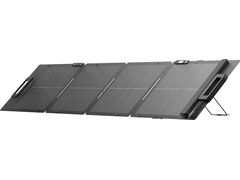
At 3.64 kg for 110 W, the Callsun sits practically level with the Jackery SolarSaga 100W (3.6 kg for 100 W), and clearly ahead of the Allpowers SP029 140W (4.49 kg). Only the EcoFlow 110W does better (3.3 kg), thanks to a slimmer bifacial design, but at the cost of closed connectivity with no direct USB port at all. Relative to output, that works out to about 30 W per kilogram for the Callsun, against 33 for the EcoFlow, 31 for the Allpowers and 28 for the Jackery.
Two adjustable kickstands unfold without tools to aim the panel at the sun, a feature also claimed by the EcoFlow and the Allpowers in this comparison. There is little track record on this specific point, such as hinge and kickstand durability after dozens of repeated folding cycles: the model is too recent on the European market for years-long use to have been documented yet.
IP67, with a caveat the manufacturer states itself
The panel is rated IP67: full dust-tightness and tolerance of temporary immersion, an official, stated figure where many rivals settle for a vague "splash resistant". The ETFE surface coating, more resistant to UV and abrasion than the PET used on entry-level models, adds to that protection, as does the waterproof Oxford-fabric backing.
One important caveat, documented by the manufacturer itself rather than a simple communication gap: the connector box that houses the USB outputs and the solar cables is not covered by that certification. The official documentation is explicit on this point and recommends keeping the box dry, with a dedicated zippered pouch supplied for that purpose. The IP67 rating therefore protects the panel's fabric, not the electronics that go with it, a nuance rarely highlighted on this type of product.
On this axis, the Callsun stays one notch below the two same-power panels already reviewed on this site: the Jackery SolarSaga 100W and the EcoFlow 110W both carry an IP68 rating, superior on paper since it tolerates prolonged rather than temporary immersion. In camping or van use, where neither panel is ever actually submerged, the gap remains largely theoretical, but it exists and is worth flagging before buying.
Five connectors and three direct ports: the best-equipped of the comparison
The Callsun ships with a 2-metre five-in-one solar cable (XT60, Anderson, DC5521, DC7909) rounded out by a ten-in-one adapter kit, which in practice covers almost every power station on the market. The manufacturer explicitly states compatibility with the EcoFlow (Delta and River), Anker Solix (from the C300 up to the F3800) and Bluetti (Elite, AC and Apex) ranges, provided the station's solar input accepts more than 18.8 V, which almost every recent station does.
The connector box packs three direct ports: a standard USB-A (5 V/3 A), a second fast-charge USB-A (5 V/3 A, 9 V/2 A or 12 V/1.5 A) and a USB-C with Power Delivery up to 15 V/3 A, or 45 W. That is three times the power of the Jackery SolarSaga 100W's USB-C port, capped at 15 W, and above all two more ports than the EcoFlow 110W, which offers no USB output at all and forces you through a station even to charge a simple phone.
| Panel | Solar connectors | Direct ports | USB-C max |
|---|---|---|---|
| Callsun 110W | XT60, Anderson, DC5521, DC7909 | 2x USB-A + USB-C | 45 W |
| Jackery SolarSaga 100W | Proprietary Jackery output | USB-A + USB-C | 15 W |
| EcoFlow 110W | XT60 | None | Not applicable |
| Allpowers SP029 140W | Native MC4 | 2x USB-A + 18 V output | Not applicable (USB-A only) |
Against the Allpowers SP029 140W, which relies on a native MC4 output rather than a stack of adapters, the Callsun matches it for plug-in versatility while offering a markedly more powerful direct charging port (45 W over USB-C against a non-standard 18 V/3 A output on the Allpowers). On this specific axis, the Callsun comes out as the best-equipped of the four panels compared here.
A warranty that stands out sharply from the rest of the market
Callsun is a brand with real industrial reach: the manufacturer claims four production sites spread across China, Vietnam, Indonesia and Saudi Arabia, totalling over 100,000 m² of combined production floor, a structure well beyond that of a simple reseller slapping its logo on a generic product.
Warranty length, however, is the weakest point on this axis. The manufacturer's own warranty table places its foldable portable solar panels of the same range, the 100 W and 200 W N-Type versions, at just one year, well short of the ten to twelve years claimed on its rigid panels and the five years on its flexible ones. The 110W is not named there specifically, but no longer warranty is stated anywhere else for this exact model, either on its product pages or on the retailer listings checked for this review across France, Germany and the United States.
Against the three other panels in this comparison, the gap is clear: the Jackery SolarSaga 100W is covered for 3 years, the Allpowers SP029 140W for 2 years, and the EcoFlow 110W for 5 years, the best cover in the category. Barring a manufacturer update, the Callsun therefore carries the shortest warranty of the four, a point to weigh against its lower purchase price.
Against the EcoFlow 110W, its closest direct rival
Same rated power (110 W), same price bracket: the bifacial EcoFlow 110W is the most natural comparison point for the Callsun. The two technology bets, though, point in opposite directions. EcoFlow bets on bifacial design, a rear face that captures light reflected off the ground to reach up to 122 W claimed under the manufacturer's own test conditions, and on an ultra-slim 3.3 kg build. Callsun bets on a high-efficiency monofacial N-Type cell and on connectivity that is directly usable without going through a station.
| Criterion | Callsun 110W | EcoFlow 110W |
|---|---|---|
| Cell technology | N-Type 16BB, monofacial | TOPCon N-Type, bifacial |
| Calculated real density | 154 W/m² | 137 to 152 W/m² depending on protocol |
| Claimed weight | 3.64 kg | 3.3 kg |
| Weatherproofing | IP67 (box excluded) | IP68 |
| Direct USB outputs | 2x USB-A + USB-C 45 W | None |
| Warranty | 1 year | 5 years |
| Price observed | £128.27 | £149.00 |
The result is a clean split of strengths. EcoFlow wins on weatherproofing, on weight and above all on warranty, five times longer. The Callsun wins on the real power density calculated above and by a wide margin on direct connectivity, with three charging ports including one at 45 W against none at all for EcoFlow, which forces you through a station even to charge a simple phone. At a near-identical price, the choice really comes down to intended use: plugging in small devices directly day to day, or betting everything on longevity and weatherproofing at the cost of closed connectivity tied to the EcoFlow ecosystem.
Against the Jackery SolarSaga 100W and the Allpowers SP029 140W
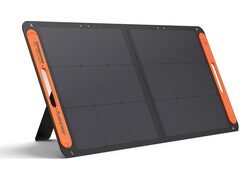
The Jackery SolarSaga 100W, one of the market's established names, nearly matches the Callsun on weight (3.6 kg against 3.64 kg) and carries the same IP68 rating as the EcoFlow, with a 3-year warranty. It still trails on two specific points: its USB-C port is capped at 15 W against 45 W on the Callsun, and its real power density calculated above, 149 W/m², stays slightly below the Callsun's 154 W/m². The "SolarSaga" name also covers several generations and variants (Air, Prime, Light) not to be confused with one another when buying, a trap the Callsun, a newer name on this specific segment, does not yet present.
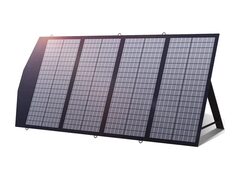
The Allpowers SP029 140W plays a different card: 30 W more than the Callsun, for 850 g more (4.49 kg) and £1.99 more (£130.26 against £128.27), a gap now razor-thin. Its native MC4 output and its two USB-A ports make it a serious rival on connectivity, but its cell efficiency is quoted inconsistently from one manufacturer page to another, between 21 and 24% depending on the source, and its weatherproof rating also varies by source, between IP65 and IP67. The Callsun's own specifications, by contrast, stay identical and consistent across the three markets checked for this review (France, Germany, United States), no small advantage in a segment where contradictory spec sheets remain common.
The cheapest of the four, by a wafer-thin margin
At £128.27 at the time of writing, checked directly on the product page and the retailer listing, the Callsun 110W remains the cheapest of the four panels compared here, but only just: the Allpowers SP029 140W now sits at £130.26, less than £2 above it. The EcoFlow 110W follows at £149.00 and the Jackery SolarSaga 100W at £159.00, both themselves marked down since launch.
| Panel | Power | Price observed |
|---|---|---|
| Callsun 110W | 110 W | £128.27 |
| Allpowers SP029 140W | 140 W | £130.26 |
| EcoFlow 110W | 110 W | £149.00 |
| Jackery SolarSaga 100W | 100 W | £159.00 |
Price also swings noticeably from one European market to another for a strictly identical reference: at the time of writing, the same panel was around 13% cheaper on the German marketplace than on the French one. Checking the day's price before buying remains worthwhile, even between two countries sharing the same currency.
Who this panel suits, and who it does not
The Callsun 110W suits first and foremost anyone who wants to charge small devices directly, a phone, a tablet or a head torch, without necessarily owning a station, thanks to its three direct ports and 45 W USB-C, while still keeping the option of plugging in a station via the supplied five-in-one cable. It is also a rational choice for anyone comparing mainly the starting budget among panels of similar power, since it remains the cheapest of the four compared here.
Conversely, anyone chasing the best possible weatherproofing or the longest warranty should look instead at the EcoFlow 110W, with its IP68 rating and 5-year warranty, or the Jackery SolarSaga 100W, also IP68, 3 years of warranty and a longer-established brand. Anyone who needs extra watts without much concern for weight should look at the Allpowers SP029 140W instead. And anyone camping in frequently damp conditions should keep in mind that the Callsun's connector box, unlike the panel fabric itself, is not waterproof according to the manufacturer.