
Solid efficiency, but highly dependent on power draw
Discharge efficiency on the Elite 200 V2 varies sharply with the power drawn. On a USB-C output limited to 60 W, it does not exceed 76.8 %: the inverter draws a roughly fixed amount of power, which weighs proportionally much more heavily on a small load. At 200 W, it climbs to 90.5 %, and reaches its best point around 1000 W with 96.7 % returned.
On the mains-charging side, a full recharge requires roughly 83 to 85 % efficiency, with about 15 to 18 % extra energy needed to restore the claimed 2073.6 Wh capacity. These figures sit in the segment's upper-middle range, with a real sensitivity to the power drawn that is worth knowing before running small appliances continuously for long periods.
A claimed 16 dB: a figure found nowhere but the spec sheet
The claimed 16 dB at low load, rising to under 50 dB at full load, is the exact wording repeated word for word across almost every site that lists this product. No serious measurement with a named sound metre and a described protocol is available: it is manufacturer data, with no third-party verification identified.
The manufacturer states that the fan cycling on and off at low load remains normal. Without a verifiable figure, it is best to take away a qualitative impression of quietness rather than to trust an uncorroborated dB figure.
Power Lifting 3900 W: resistive loads only
Power Lifting mode allows the continuous 2600 W output to be exceeded, up to 3900 W. The manufacturer's manual is explicit about its limit: this mode is reserved for purely resistive loads, with a kettle, an electric heater or a hairdryer given as examples. It is disabled by default and must be turned on deliberately in the app.
For a motor- or compressor-driven appliance, the official warning is different: this type of load can start at two to four times its rated power, with a risk of overloading the unit, and the manufacturer recommends staying under 2600 W in that case rather than relying on Power Lifting. No independent test was found on a motor or compressor pushed beyond 2600 W in Power Lifting mode: this is therefore neither confirmed nor ruled out for this specific type of load, and the manufacturer's own precautionary principle applies.
Two AC outlets, two 100 W USB-C ports, a single solar input
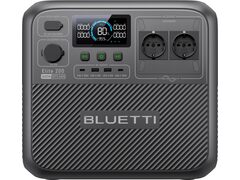
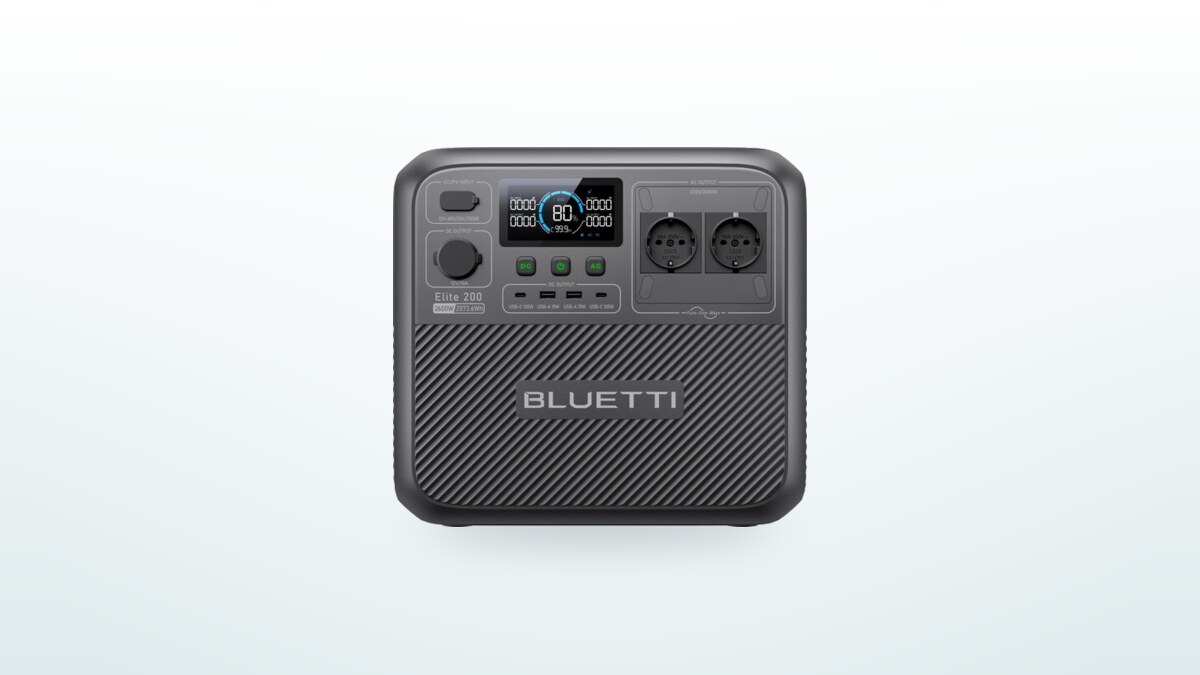
On the output side, the Elite 200 V2 offers two mains sockets, two USB-C ports delivering up to 100 W each (enough to charge a laptop without a dedicated mains adapter), two USB-A ports at 15 W, and a 12 V DC output rated at 120 W for automotive or camping equipment. On the European market, those two Schuko sockets share the inverter's 2600 W: the available power stays comfortable, but a power strip becomes necessary as soon as more than two mains appliances have to run at the same time.
The weak point sits on the input side: a single MPPT controller handles all solar charging, where some rival stations offer two to split panels facing different directions. Combined with the voltage ceiling already mentioned, this choice limits solar installation flexibility compared with models that are more permissive on this point.
There is no earlier "Elite 200": the real comparison is the AC200L
The "V2" name is misleading: no trace of an "Elite 200" model without a suffix exists at Bluetti. The manufacturer itself presents the Elite 200 V2 as the direct successor to the AC200P (2020), and readily compares this new generation to the more recent AC200L. "V2" therefore denotes a technological step within the range, not a sequel to a product of the same name.
Compared with the AC200L, the Elite 200 V2 gains in compactness and lightness (24.2 kg against a noticeably bulkier unit), and doubles its claimed cycle count (6000 versus around 3000). But it steps back on two concrete points: its solar input caps out at 1000 W and, more importantly, at 60 V, versus 1200 W and 145 V on the AC200L, which requires more current (and so more cabling run in parallel) to reach its full solar potential in practice. And it is no longer expandable with an additional battery, a function the AC200L offered.
A real weak point on the solar input, but not one to overgeneralize
The same fault shows up more than once, across different usage profiles: the solar input's MPPT controller can lock up at high voltage and very low power (for example 37 V displayed for barely 1 W of actual charging), requiring a manual unplug-replug to restart. One case was fixed by a firmware update after contacting technical support.
A more severe case, involving several successive replacement units for the same solar input failure, remains an isolated case: but the installation involved did not use standard solar panels, rather a reconditioned power feed from an external charge controller and a separate battery bank, a use case outside the intended scope that limits how far this particular case can be generalized. Outside of this point, no elevated failure volume stands out on the solar input.
UPS function at 15 ms: no cutoff found on sensitive equipment
If mains power is lost, the Elite 200 V2 switches to its own power supply with a claimed delay of 15 ms. No independent measurement with a stopwatch or an oscilloscope was found to verify this figure down to a tenth of a millisecond.
No perceptible disruption has been found on sensitive IT or network equipment, which is consistent with such a short switchover delay.
24.2 kg with no wheels: the trade-off of a compact format
The manufacturer claims a format 40 % more compact than the AC200P it replaces, a claim widely repeated but never independently re-measured side by side with the old model. The weight saving, though, is real: the Elite 200 V2 weighs 24.2 kg, noticeably less than the AC200P.
That weight is nonetheless carried entirely by hand: unlike other stations of this capacity, the Elite 200 V2 has neither wheels nor a telescopic handle. For a fixed installation (home backup, a converted van), this is not a problem once the unit is in place. For frequent moves, especially on a job site or a boat, planning to carry it with two people quickly becomes advisable given its mass concentrated in a relatively compact format.
Two other concrete limits to know before outdoor use: the unit has no resistance to water splashes, and its claimed operating range stays between -20 °C and 40 °C. Nothing unusual for this type of station, but a point to plan for when using it outdoors unsheltered or in high heat.
Van, boat, home backup: runtime that lasts several days
In a converted van, the runtime provided by the 2073.6 Wh capacity is counted in days rather than hours for measured use: roughly two to three days for full use (fridge, lighting, charging devices), and five to seven days for the fridge alone. A complementary solar panel extends that runtime further on a multi-day trip.
For home backup, the station easily covers a household's essential needs during an outage: fridge, freezer, internet box, lighting, and even a portable heater for a limited time. On board a boat, its format stays compact for the tight storage of a cabin, with solar charging that usefully tops up runtime at anchor. In both cases, the product's fixed installation largely offsets the lack of wheels already mentioned.
Mobile app has room for improvement, manual not translated into French
The Elite 200 V2's build quality is often highlighted, but the mobile control app proves heavier and less intuitive, a weak point compared with the rest of the product.
Another concrete point: the manual included is not translated into French, which forces users to look elsewhere (third-party videos, forums) for the finer settings. Neither of these points calls the unit's operation into question, but they weigh on day-to-day comfort of use, especially during the first setup.
Limited track record, but no alarming reliability signal
Launched in early 2025, the Elite 200 V2 does not yet have the track record of older models. That track record is nonetheless substantial already, with a very large majority of positive feedback and a small proportion of negative feedback, with no recurring failure pattern standing out beyond the solar input weakness already mentioned.
French after-sales support has a dedicated contact (email and phone), with a stated response time under 48 hours. No dated feedback specific to this model regarding a repair handled in France could be found so far: this is a point still short on data rather than a negative signal.
The manufacturer's 5-year warranty comfortably covers the period during which the solar controller instability mentioned above is likely to appear, and this type of case has indeed been resolved through a warranty replacement. This is a genuine safety net, provided you push back with support if needed to escalate a case beyond first-line assistance.
1299€ confirmed, and a mix-up risk with the "Premium 200 V2"
The 1299 € selling price matches the tax-inclusive price seen on official stores in France at the time of publication. Occasionally lower offers exist at other retailers, with variations of around 150 €, within the usual range for this type of promotion.
The price has actually trended upward since launch rather than downward: listed around 1099 € at launch in early 2025, it then went through a promotional dip close to 999 € in the autumn of the same year, before stabilising around 1299 € since. This is the reverse of what is often seen with this type of product, where the price falls toward the end of its commercial life.
One thing to watch when buying: there is another model, the "Premium 200 V2", more powerful (2700 W continuous) and more expensive, sometimes labelled confusingly by certain retailers under a name very close to the Elite 200 V2. Checking the exact name and the stated continuous power before buying avoids this confusion.
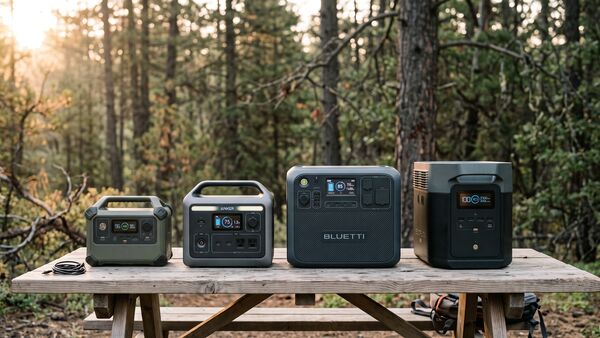
Up against the EcoFlow Delta 3 Plus and the Anker Solix C1000
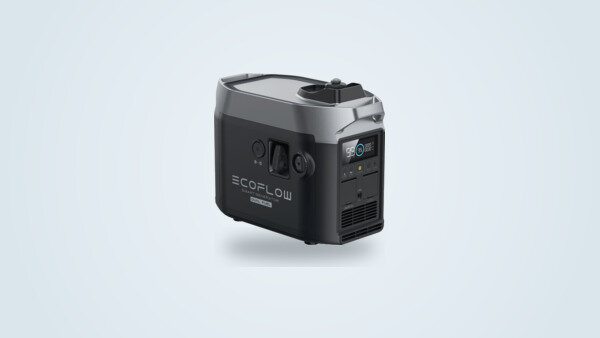
Around 1000 to 1300 €, two direct alternatives stand out against the Elite 200 V2: the EcoFlow Delta 3 Plus and the Anker Solix C1000, both with noticeably lower capacity.
| Metric | Bluetti Elite 200 V2 | EcoFlow Delta 3 Plus | Anker Solix C1000 |
|---|---|---|---|
| Capacity | 2073.6 Wh | 1024 Wh | 1056 Wh |
| Power | 2600 W (3900 W) | 1800 W (2700 W) | 1800 W (2400 W) |
| Charging 0-80 % | ≈ 50 min | ≈ 50 min | ≈ 43 min |
| Battery cycles | 6000+ | 4000+ | 3000+ |
| Market price | ≈ 1299 € | ≈ 999 € | ≈ 699 € |
The Delta 3 Plus and the C1000 play the price and compactness card at lower capacity. The Elite 200 V2 stands out with almost double the capacity and a higher cycle count, at the cost of a bigger budget and a format that still remains the bulkiest of the three.
Who it suits, who it does not suit
It suits anyone looking for a large, mostly stationary energy reserve (home backup, a converted van, a workshop), with fast mains charging and battery longevity among the best on the market.
It does not suit anyone planning to fully exploit a large solar installation (the input stays voltage-limited), anyone needing to expand capacity with additional batteries, or anyone who frequently moves their equipment over rough terrain without help, for lack of wheels.