
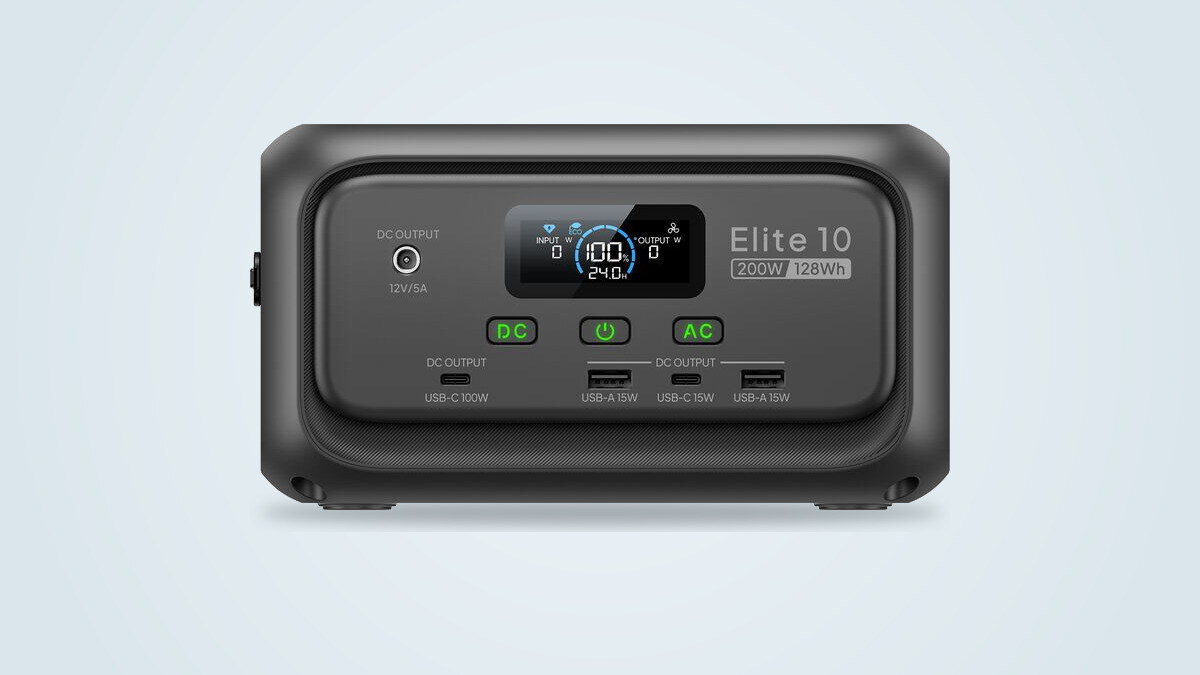
What the claimed 128Wh are really worth
The 128Wh printed on the Bluetti Elite 10 is a LiFePO4 cell capacity, measured upstream of the inverter. As with any inverter-based power station, the energy actually recoverable at the wall outlet is always lower than this nominal figure, due to the conversion losses inherent to power electronics.
On this model, real-world output sits around 105Wh, roughly 82% of the claimed 128Wh: a full discharge under a 100W resistive load (a fan at full speed) emptied the battery in just over an hour, consistent with this usable capacity. A second estimate, based on a laptop charged from 20% to 100%, lands in a similar ballpark, around three quarters of the rated capacity. That's a decent figure for this ultra-compact format, without being outstanding: the best stations in the catalogue climb above 90%, while the weakest sometimes fall below 80%.
This roughly 82% efficiency places the Elite 10 in the lower-middle of the catalogue for this kind of measurement, a logical trade-off given the extreme miniaturisation of the inverter inside a case barely bigger than a lunchbox.
A real wall outlet in a record-small body
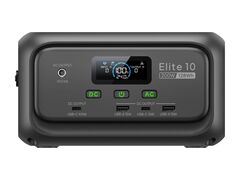
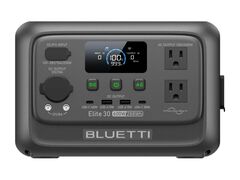
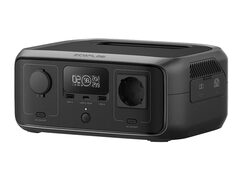
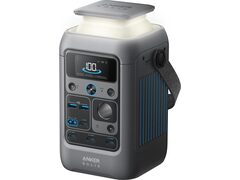
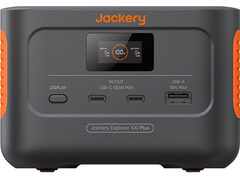
The Bluetti Elite 10's central selling point is its size: 200 x 146 x 110mm and 1.8kg on the scale, for a station that still packs a genuine wall outlet and a UPS function. Compared with other mini power stations in its class, it sits between two distinct profiles: DC-only stations, lighter or higher-capacity but with no wall outlet at all (Anker SOLIX C300X DC and Jackery Explorer 100 Plus), and slightly higher-capacity stations like the EcoFlow River 3, which offers more power and a slightly faster charge but weighs nearly twice as much.
The trade-off is simple to sum up: among stations in its class that keep a real wall outlet and a UPS function, the Elite 10 is the lightest. Against the Jackery Explorer 100 Plus, twice as light but with no wall outlet or UPS function at all, the choice comes down to the buyer's priority: weight alone, or the versatility of a real wall outlet.
The case fits in one hand, a built-in handle makes it easy to carry, and it includes an LED light strip on top (3 modes: cool, warm, flashing SOS) rated for up to 50 hours, handy for a campsite or a power cut without needing to bring a separate torch.
A 70-minute recharge: the headline promise, with an important catch
Bluetti advertises a full charge in 70 minutes over AC for the Elite 10, a strong selling point in this segment. That figure is real: in Turbo mode, which pushes charging power up to 150W, the battery reaches 80% in 45 minutes and 100% in 70 minutes, matching the claim.
What the spec sheet doesn't show is that this figure assumes Turbo mode is selected. The Elite 10 offers three AC charging modes, Turbo, Standard and Silent, each striking a different balance between speed and noise. In Standard mode, charging power is capped at 70W: the same full charge, from 0 to 100%, then takes roughly 22 hours, versus 70 minutes in Turbo. That's not a minor gap: a factor of more than 18 separates the two modes.
This tiered system has its logic: Silent mode caps power at 40W to cut fan noise, Standard mode offers a middle ground, and Turbo mode maximises speed at the cost of the highest noise level (see below). The solar input accepts up to 100W with a compatible panel, and car charging also reaches 100W through the cigarette lighter socket. Neither of these two cables is included in the box, though, worth planning for before buying.
Power output in practice: 200W held, one documented snag
The Bluetti Elite 10 claims 200W continuous, 300W surge, and up to 400W in boost ('lifting power') mode to absorb start-up spikes. The first figure holds up without reservation: a combined load of 100W (a fan at full power) and 100W (a light bulb), 200W in total, was handled without trouble by the inverter, which delivered exactly the power the manufacturer claims.
The 300W surge and 400W boost figures remain manufacturer claims, not independently verified to date. Nothing in the real-world usage reports contradicts them, but no source consulted has measured them precisely either: best treated as a safety margin rather than power to draw on continuously.
10ms UPS: the spec sheet's strongest argument
The UPS (uninterruptible power supply) function is arguably what sets the Bluetti Elite 10 apart most from the rest of its category. During a power cut, it switches to battery in 10ms maximum, with a bypass of up to 350W during the transition.
This figure didn't stay theoretical: a deliberate power cut triggered while a laptop and a Wi-Fi router stayed powered caused no noticeable interruption on either device, no dropped connection, and no restart. For anyone working on a sensitive document or relying on a continuous connection, this switchover delay avoids exactly the kind of incident a simple power strip cannot prevent.
The function remains limited by the capacity available upstream, though: once the roughly 105Wh of usable energy runs out, the protection stops. It's aimed at brief outages and cuts lasting a few tens of minutes, not an extended multi-hour blackout.
Noise: quiet at rest, clearly audible during fast charging
The Elite 10's noise behaviour varies significantly depending on the mode in use. In everyday use, powering a phone, a laptop or a small light, the fan stays largely unobtrusive. That changes during AC charging: in Turbo mode, which pushes charging to 150W to hit the advertised 70 minutes, the fan becomes clearly audible, around 45dB. Silent mode, which caps charging power at 40W, brings that down to around 30dB, close to inaudible in an occupied room.
The mechanism makes sense: the higher the charging power, the more the cells heat up, and the harder the fan has to work to dissipate that heat inside such a compact case. The three charging modes (Turbo, Standard, Silent) let you choose: maximum speed during the day, near-total silence at night, at the cost of a charge that then stretches over several hours.
Ports and controls: complete for its size
For a case the size of a lunchbox, the Elite 10 offers an unusually rich set of outputs: a 200W wall outlet, a USB-C port up to 100W (enough for a laptop), a second USB-C limited to 15W, two 15W USB-A ports, and a 60W DC5521 output. Six outputs in total, enough to power several devices at once without a power strip.
Against its closest rivals by weight, this port selection is a genuine strength: the Anker SOLIX C300X DC, despite being heavier (2.8kg), is DC-only with no wall outlet at all; the Jackery Explorer 100 Plus, lighter still, likewise offers no wall outlet and no UPS function.
Controls run through a front LCD screen (showing charge level, input and output power, and estimated remaining runtime in hours) and a Bluetooth mobile app. Two caveats worth knowing: only one of the two USB-C ports reaches 100W, the other being capped at 15W, and there's no wireless (Qi) charging pad, a feature some users would have appreciated on a device so geared toward charging phones.
What 128Wh really gets you day to day
With around 105Wh actually available, the Bluetti Elite 10 covers occasional needs rather than extended runtime. Over several months of real-world ownership, one full charge of the station delivered 4 to 5 full recharges of a recent smartphone, comfortably covering more than 24 hours of regular daily use. A laptop, being more power-hungry, only manages 1 to 2 full recharges from the same full charge of the station.
These figures place the device well: an excellent companion for light electronics (phone, camera, e-reader, headphones, a small light), fairer once a laptop enters the picture, and not the right tool for a fridge or a space heater, either of which would drain the usable 105Wh in barely a few tens of minutes. For a light camping weekend, a road trip, or a backup lasting a few hours, the capacity is enough; for several days off-grid without a recharge, it will need topping up with a solar panel or a second AC charge.
Build quality, warranty and reliability
The Bluetti Elite 10 is covered by a 5-year warranty, a duration that ranks among the longest in this mini power station segment, where many rivals cap out at 2 or 3 years. Its LiFePO4 battery is rated for more than 4000 cycles before dropping to 80% of its original capacity, a chemistry known for its longevity compared with the standard lithium cells used in most powerbanks. No safety recall or recurring build defect is documented for this model to date.
Two concrete caveats, tied more to the design than to build quality: the ports have no protective covers, and the spec sheet claims no IP rating, a logical gap for a device meant for indoor use and outdoor activities sheltered from the weather rather than fully exposed use. Another point worth knowing before buying: neither the solar-charging cable nor the car-charging cable ships in the box, despite both matching input ports appearing on the spec sheet; only an AC cable and a USB-C cable are included by default.
Against its direct rivals
In the mini power station segment with a wall outlet, the Bluetti Elite 10 faces a small handful of direct rivals.
| Criterion | Elite 10 | River 3 | SOLIX C300X DC | Explorer 100 Plus |
|---|---|---|---|---|
| Capacity | 128Wh | 245Wh | 288Wh | 99Wh |
| Wall outlet | 200W | 300W | None (DC only) | None (DC only) |
| UPS | Yes (10ms) | Yes | No | No |
| Weight | 1.8kg | 3.5kg | 2.8kg | 0.97kg |
| Full AC charge | 70 min (Turbo mode) | 60 min | Not specified | Not specified |
Against the EcoFlow River 3, the comparison on paper tilts clearly in its favour: more capacity (245Wh), more power (300W), and a slightly faster charge (60 minutes). The gap plays out on weight, where the Elite 10 holds a clear edge with nearly half the kilos on the scale. Against the Anker SOLIX C300X DC and the Jackery Explorer 100 Plus, the difference is more structural: neither offers a wall outlet or a UPS function, two features the Elite 10 rightly claims as its strengths. The Explorer 100 Plus stays significantly lighter (0.97kg) but gives up any wall outlet entirely; the SOLIX C300X DC offers more capacity (288Wh) in a slightly heavier body, also with no wall outlet.
Who it's for, and who should look elsewhere
The Bluetti Elite 10 is aimed first at light nomadic use and protection against brief power cuts: occasional remote work with a laptop and router to secure, camping or a campsite where a real wall outlet makes a real difference over a simple power bank, road trips charging multiple electronic devices, or a small emergency backup at home for essential devices during an outage. Its UPS function and its bag-friendly size make it a safe pick for anyone wanting to protect a workstation without investing in a bulkier station.
It's less suited to anyone looking for several days of runtime without recharging (the usable 105Wh gets used up quickly beyond light electronics), anyone needing to power a device with a high start-up surge like a compressor or a professional power tool, or anyone needing genuine weather resistance for fully exposed outdoor use. For those needs, a higher-capacity station or an IP-rated case will serve better.