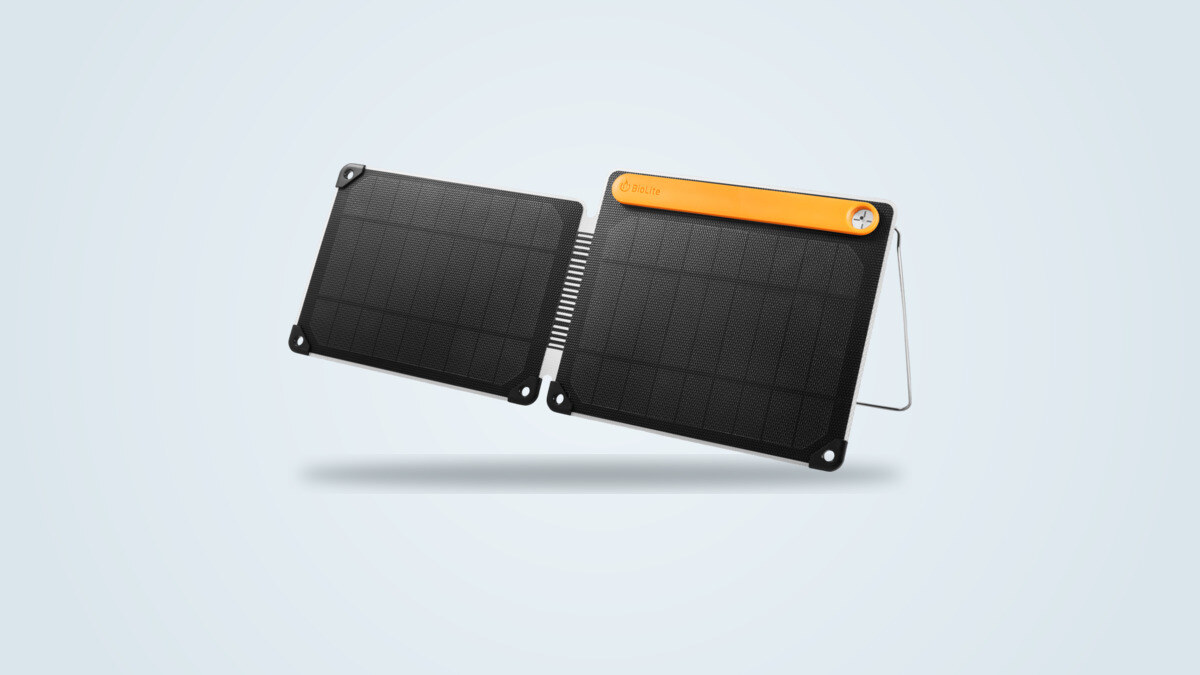
What the Built-In 3200 mAh Battery Is Really Worth
The BioLite SolarPanel 10+ stands out immediately for a choice rare among portable solar panels of this size: a built-in 3200 mAh lithium-ion battery, which the manufacturer rates at about 8 Wh. Almost all folding panels of comparable output simply pass captured energy straight through without storing it; this one can hold it in reserve to release later, including at night or in overcast weather.
In practice, that reserve gives roughly a 50% top-up to an average smartphone once full. That is enough for a phone that needs a boost at the end of the day, but well short of recharging a tablet or topping up a large power bank. The panel can also power a device directly without going through that battery, which skips a conversion step whenever the sun is already available at the time of charging. Exactly how it splits energy when both demands occur at once (a device plugged in directly while the internal battery is still incomplete) is not documented anywhere by the manufacturer; in practice, direct output appears to take priority over filling the battery.
Real-World Charge Time, Between the Promise and the Practice
BioLite states a full charge, from the panel to the internal battery or directly to a smartphone, in about one hour of midday full sun. On this same unit (panel and charging electronics unchanged since launch, only the internal cell grew from 3000 to 3200 mAh during the product's lifetime), real-world charging turns out to be notably slower:
| Stage | Claimed time | Real-world time |
|---|---|---|
| Internal battery, 50% to full charge | Full charge in about 1 hour | About 2 hours |
| Smartphone, 30 minutes of direct charging | Full charge in about 1 hour | About 21% charge added |
In overcast weather, the time stretches out considerably, sometimes well beyond these figures for an equivalent result. The thermal cutoff covered next adds another source of slowdown, one specific to this panel precisely because it carries a battery that needs protecting.
The Real Sticking Point: a Cutoff That Protects Its Own Battery
Having a battery on board is the SolarPanel 10+'s central selling point, but it is also what forces it to protect itself from itself. The compartment housing the lithium-ion cell is sealed and poorly ventilated: as soon as its internal temperature crosses the battery's safety threshold, the electronics cut both the solar input and the USB output at the same time. Four flashing LEDs signal the shutdown, and the panel then resumes normal operation once it has cooled, with no action needed and no consequence for the battery.
This mechanism trips more easily than you would expect: prolonged exposure to full sun on an ordinary summer day, not even a heatwave, is enough to trigger it, even when the panel sits on open lawn that should favour ventilation. The counterintuitive result: the panel can actually behave more consistently early in the morning or late in the afternoon, when sunlight is weaker but ambient temperature stays moderate, than at high noon in summer.
The Sundial and 360° Kickstand, a Real Aiming Aid
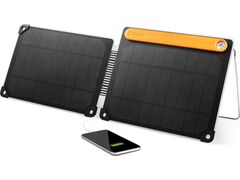
The SolarPanel 10+ has a small built-in sundial, which BioLite calls the "SunDial": a central marker whose shadow, once centred on the etched axis, shows that the panel is facing the sun optimally. Paired with the 360° adjustable metal kickstand, it lets you correct the aim in seconds, with no compass or app needed.
This adjustment is no gimmick. On a panel rated at just 10 W, a margin of that size represents a meaningful share of the energy available over a day, far more than a few seconds of aiming would suggest. The kickstand itself holds steady on almost any terrain, including uneven ground, gravel or rock, a genuine advantage when bivouacking where the ground is rarely flat.
Size and Portability: One of the Most Compact in Its Segment
Once folded, the SolarPanel 10+ measures 257 x 208 x 24 mm, roughly the size of a large book, for a total weight of 550 g. It is made of two rigid panels joined by a fabric hinge rather than a single monobloc plate, which lets it fold flat like a case. Four reinforced eyelets at the corners let you clip it to a backpack or a tent.
This light weight comes with a logical trade-off: at 10 W, the SolarPanel 10+ cannot compete with 60 to 100 W panels built to recharge a power station. It occupies a different niche, that of a solar top-up tucked into a hiking pack rather than a campsite's main charger.
Output Ports: a Single, Already Dated Port
The SolarPanel 10+ offers only a single output port, in USB-A, capable of delivering up to 2.4 A. There is no USB-C output, so no Power Delivery or Quick Charge negotiation: charging speed depends entirely on what the cable and the connected device accept over plain USB-A. The micro-USB input is only used to recharge the internal battery from the mains, never to power an external device.
That single port would have been enough a few years ago; today it shows its age next to newer entrants in the same segment (portable panel with a built-in battery) that combine USB-C with far greater storage, sometimes for a comparable budget. A recent smartphone that only charges over USB-C means keeping a USB-A to USB-C cable or adapter close at hand.
Up Against the Competition: an Increasingly Crowded Niche
The BioLite SolarPanel 10+ was long one of the few options to combine a compact portable panel with a built-in storage battery. That is no longer true today. More recent alternatives, such as the Sandberg Solar Charger 21W, use the same principle with a 10,000 mAh built-in battery (roughly three times the BioLite's capacity) and a USB-C output alongside USB-A.
| Criterion | BioLite SolarPanel 10+ | Sandberg Solar Charger 21W | Goal Zero Nomad 10 |
|---|---|---|---|
| Built-in battery | 3200 mAh | 10,000 mAh | None (separate power bank required) |
| Outputs | USB-A | USB-A + USB-C | USB-A |
The Goal Zero Nomad 10 deserves a special mention: with no built-in battery, it costs less to buy, but more importantly, Goal Zero has belonged to the same group as BioLite since the acquisition announced in April 2025. The two brands are still sold separately, but are no longer really independent competitors of one another.
Against this competition, the BioLite's advantage narrows to a single real argument: the integration and simplicity of one single object, with no extra cable or accessory to manage in order to store captured energy. For anyone who prioritises a more generous storage capacity and modern connectivity, the recent alternatives come out ahead on paper.
Weatherproofing and Build: What to Know Before You Head Out
The IPX4 rating protects against splashing water from any direction, not against sustained rain or immersion. The manufacturer explicitly advises against leaving the panel outside in the rain or submerging it in water. For typical camping or hiking use, that protection is enough against a brief shower; it is no substitute for shelter once bad weather sets in.
On build quality, the hinged folding case and the four reinforced corner eyelets give a generally sturdy impression. The metal kickstand, thinner than the rest of the structure, remains the most exposed point, though no single failure pattern stands out as recurring. The manufacturer's warranty remains limited to one year. A notable share of units arrive non-functional out of the box (LEDs that do not light up, a battery that will not charge), a fault resolved without difficulty under warranty but one that justifies checking the unit works as soon as you unbox it rather than once you are out in the field. The USB-A connector itself can weaken after several months of heavy use and repeated plugging, a wear point to keep an eye on over time rather than a widespread design flaw.
Price and Availability: a European Market Under Strain
The BioLite SolarPanel 10+'s official list price currently sits at around €150, both on the manufacturer's European store and in the United States in dollars. That figure contrasts with the notably lower price sometimes found at certain retailers, a gap that reflects a clearance of the last units in stock rather than a stable market price: at the time of writing, the manufacturer itself lists this panel as out of stock on its European store, and several major retailers no longer carry it.
This strain on European availability is not necessarily a sign the product is being discontinued: the SolarPanel 10+ remains actively sold in the United States and continues to appear in recent comparisons of portable panels. Still, it is worth knowing before basing a purchase on the lowest price found online.
Who the BioLite SolarPanel 10+ Is For
The BioLite SolarPanel 10+ is built for a specific use: recharging a smartphone independently over several days of hiking or light bivouacking, without carrying a separate power bank. Its built-in battery and compact format make it a logical companion for anyone travelling light who just needs a charged phone in the evening.
It suits vehicle camping, van life, or anyone needing to power a tablet, a laptop or a large power bank far less well: the output and storage capacity are too limited, and the lack of USB-C limits compatibility with recent devices. For those uses, a more powerful panel without a built-in battery, paired with a separately chosen power bank, remains more versatile.
One last buyer profile is worth mentioning: someone who already camps with a power station and wants a simple top-up for their phone, independent of the rest of the setup. On that specific point, the SolarPanel 10+'s simplicity (no cable to run to the main station) remains a genuine argument in its favour, even though its list price then puts it in direct competition with less specialised but more versatile solutions.