
Goal Zero Nomad 100
(8 reviews)
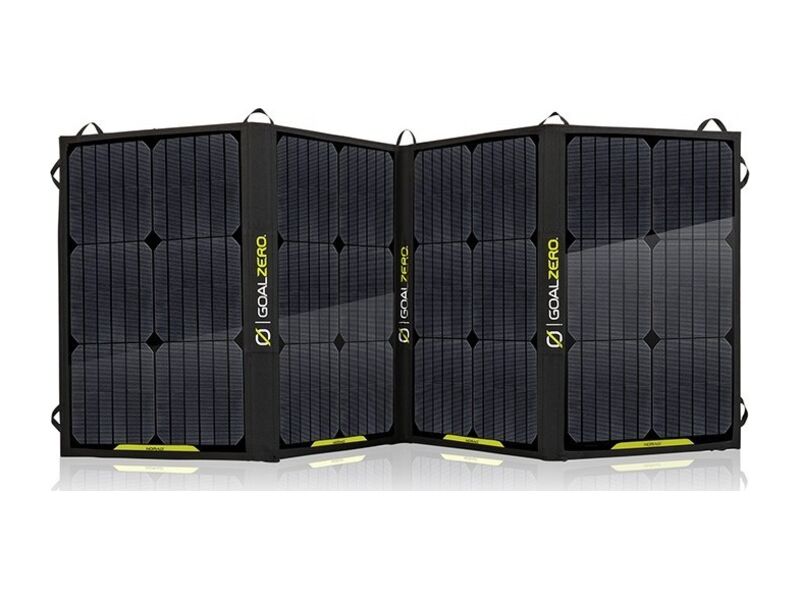
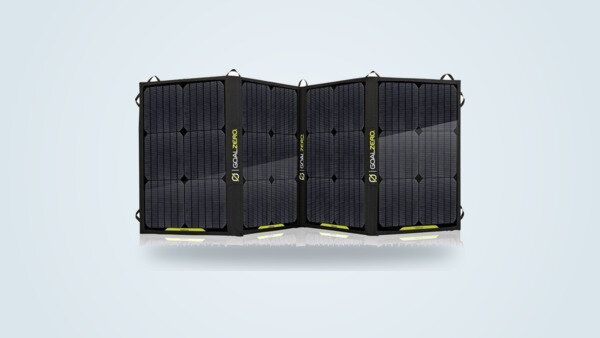
100W foldable, built-in Yeti-compatible cables and a fold-out kickstand: Goal Zero's nomad solar panel for van life, hiking or home backup.
Buy at AmazonAs an Amazon Associate I earn from qualifying purchases.
Characteristics
- Power: 100W
- Weight: 4.6kg
- Dimensions: 52x151cm unfolded, 52x39cm folded
- Compatibility: Yeti X range (8mm connector)
- Built-in Yeti-compatible cables, monocrystalline cells
Detailed overview: Goal Zero Nomad 100 solar panel
The Goal Zero Nomad 100 is a foldable 100W portable solar panel from a brand that pioneered nomadic power: Goal Zero has been selling these solutions since 2009. Sitting in the portable solar panels range, it mainly targets owners of a Yeti X station (500X, 1000X or 1500X) looking for a directly compatible solar add-on, with no adapter or extra cable to buy.
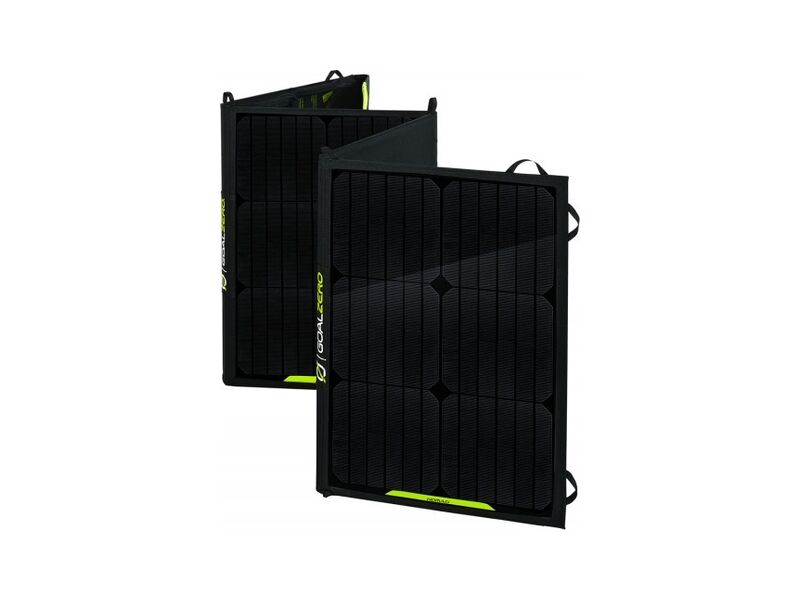
Its standout feature is how tightly it integrates with the Goal Zero ecosystem: the charging cable is built directly into the panel and ends in the brand's proprietary 8mm connector, the exact same one used by the Yeti 1000X also reviewed on this site. A fold-out kickstand built into the back of the panel lets you angle it toward the sun with no extra accessory, a detail often missing on rival panels sold flat.
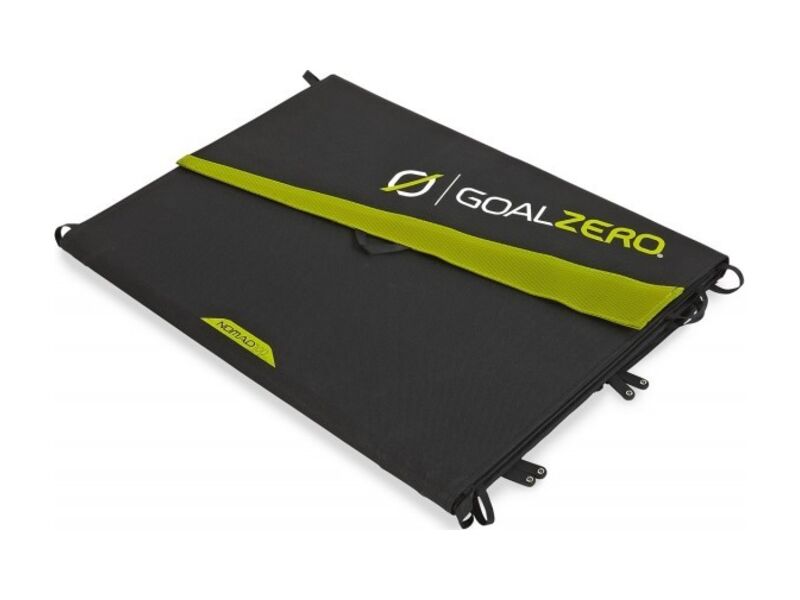
Its monocrystalline cells offer good conversion efficiency in direct sunlight. Unfolded, the panel measures 52x151cm for a generous capture area; folded to 52x39x5cm, it packs easily into a bag, a van or a car boot, at a weight of 4.6kg. One limitation worth knowing: unlike some rival nomad panels, the Nomad 100 has no direct USB output, it must always be connected to a power station to charge a device.
Paired with a Yeti 1000X, the Nomad 100 delivers a full recharge in 12 to 24 hours depending on sunlight, through the station's built-in MPPT controller. It carries a 2-year warranty and, in the UK, is best sourced through a marketplace such as Amazon, at a price that sits in the upper range for a 100W panel, justified by its direct Yeti compatibility and build quality.
Full specifications
Detailed characteristics (EAN: 0847974003794)
Panel
| Peak power?Rated panel power in full sun (STC conditions). | 100 W |
|---|---|
| Cell technology?Cell type; monocrystalline offers the best efficiency, flexible CIGS tolerates shading better. | Monocrystalline |
| Panel type?Foldable (portable), rigid framed (fixed install) or flexible (curved surfaces). | Foldable |
| Bifacial?Also captures reflected light on its rear side, for extra output. | No |
Outputs and connectors
| Output connectors?Output socket type(s) (MC4, XT60, Anderson, DC, USB…); determines compatibility with your station. | 8mm |
|---|
Durability and format
| Weight?Weight of the panel. | 4.6 kg |
|---|---|
| Unfolded dimensions (L × W × D)?Footprint when unfolded, in millimetres. | 1511 × 520 × 25 mm |
| Folded dimensions (L × W × D)?Footprint when folded for transport, in millimetres. | 520 × 394 × 51 mm |
☀ How fast does this panel recharge a power station?
The Goal Zero Nomad 100 panel (100 W) recharges a Jackery Explorer 1000 v2 (1070 Wh) in ~15h or an EcoFlow Delta 2 Max (2048 Wh) in ~29h, in full sun.
| Compact / mid | Recharge |
|---|---|
| Allpowers Volix P300 (256 Wh) | ~3h40 |
| EcoFlow River 3 Plus (286 Wh) | ~4h05 |
| Growatt Vita 550 (538 Wh) | ~7h40 |
| DJI Power 1000 (1024 Wh) | ~15h |
| High capacity | Recharge |
|---|---|
| Anker Solix C2000 Gen 2 (2048 Wh) | ~29h |
| Allpowers R4000 (3456 Wh) | ~49h |
| Fossibot F3600 Pro (3840 Wh) | ~55h |
| EcoFlow Delta Pro 3 (4096 Wh) | ~59h |
Estimate in full sun (ideal conditions). In practice, count on 3 to 5 hours of truly useful sunlight per day, so a full recharge may span several days depending on weather and orientation.
Comparison
How does the Goal Zero Nomad 100 compare with other foldable solar panels of similar power (roughly 100 to 120W)? Here's how it stacks up against three direct rivals.
| Criterion | Goal Zero Nomad 100 | Jackery SolarSaga 100W | Bluetti PV120 | EcoFlow 110W |
|---|---|---|---|---|
| Price | £340 | ≈ £239 | ≈ £189 | ≈ £165 |
| Power | 100W | 100W | 120W | 110W |
| Weight | 4.6kg | ≈ 5.5kg | ≈ 4.7kg | ≈ 4.5kg |
| Direct USB output | No | No | Yes | No |
| Built-in kickstand | Yes | Yes | No | No |
| Connector | Proprietary 8mm (Yeti) | Proprietary (Jackery) | MC4 | MC4 |
On price alone, the Nomad 100 is the most expensive of the four, and it lacks the direct USB output found on the Bluetti PV120. Its real advantage lies in the ecosystem: for anyone who already owns a Yeti X station, direct compatibility with no adapter, a well-designed built-in kickstand and Goal Zero's recognised build quality make it the simplest, most coherent choice, where MC4-connector panels often need an adapter cable to work with a Yeti.
Related video
Video: Goal Zero Nomad 100 vs. Boulder 100 Briefcase & PWM vs. MPPT Laderegler - Published on 10/07/2020
Our tester's review: Julien De Jurquet
The Nomad 100 wins you over with its simplicity: the cable is already built into the panel, and its 8mm connector plugs directly into the whole Yeti X range with no adapter to hunt down. Its fold-out kickstand is well designed for quickly angling the panel toward the sun, a real plus over panels you have to prop up with whatever's at hand. Unfolded (52x151cm), it captures light efficiently in good weather thanks to its monocrystalline cells. Folded to 52x39x5cm, it packs easily into a van or a backpack, though 4.6kg is noticeable on a lightweight trek. The real downside: no direct USB output, unlike some rivals that let you charge a phone without a station in between. As with any solar panel, the rated 100W is only reached in ideal sunlight conditions. For anyone who already owns a Yeti X, it's a straightforward, hassle-free choice; for more general use with direct USB charging, other panels are a better fit.
In-depth review Goal Zero Nomad 100: our full review 3.7/5 Read our full review → Efficiency 3.7 Portability and size 4.0 Weather resistance 3.8 Output ports 3.3 Capacity and expansion not measured Solar input and MPPT not measured Control and smart features not measured Installation and compliance not measured Build and endurance 3.9 Battery compatibility not measured Safety and protections not measured Storage battery compatibility not measured Control and smart features not measured Compliance and grid connection not measuredFrequently asked questions: Goal Zero Nomad 100 solar panel
Yes, it uses the proprietary 8mm connector shared across the entire Yeti X range (500X, 1000X, 1500X, 3000X), with the cable already built into the panel, no adapter needed.
No, unlike some rival panels such as the Bluetti PV120, the Nomad 100 has no direct USB output: it must be connected to a power station to charge a device.
Expect 12 to 24 hours depending on sunlight and angle, through the station's built-in MPPT controller. Chaining two Nomad 100 panels cuts that time, using a separately sold combiner accessory.
Folded down to 52x39x5cm, it packs easily into a van, a campsite bag or a car boot, though its 4.6kg weight is worth factoring in for lightweight hiking.
It is best sourced through a marketplace such as Amazon.co.uk, since Goal Zero's own UK store does not currently list this model.
Need help choosing?
Other products in the "Portable solar panels" category
Allpowers Solax SE200
See price (3)
Foldable, IP68 waterproof and up to 25% efficient, the 200 W Allpowers Solax SE200 solar panel recharges your power stations anywhere.
Allpowers Solax SE60
See price (2)
60W of light, foldable solar power: the portable panel that recharges phone, power bank and small station in the sun, with up to 25% efficiency.
Allpowers SP001 21W
£47.49 (3)
21W foldable and just 610g: the little USB solar panel that charges a phone, tablet or power bank in the sun, with no socket or bulk.
Allpowers SP012 100W
See price (3)
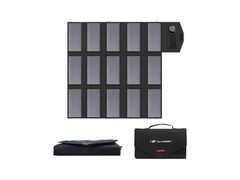
100W of foldable solar with a dual USB output: the nomadic panel that directly charges your devices AND your power station, camping or on the road.
Published on 04/09/2026