
BigBlue 28W: our full review

The BigBlue 28W delivers real-world power well below the advertised 28W, a gap more pronounced than among competing panels tested under the same conditions. Its compact size, a weight often lower than advertised, and its ability to keep producing under overcast skies are genuine strengths, but two points are worth knowing before buying: the USB ports are not covered by the panel's IP44 rating, and several generations with different port configurations are sold under the same commercial name.

Our rating
3.7/5
Efficiency: 3.1 out of 5 (weighting 25%)Efficiency3.1Portability and size: 4.3 out of 5 (weighting 25%)Portability4.3Weather resistance: 3.7 out of 5 (weighting 20%)Weatherproofing3.7Output ports: 3.6 out of 5 (weighting 20%)Output3.6Build and endurance: 3.9 out of 5 (weighting 10%)Build3.9

How is this rating calculated?

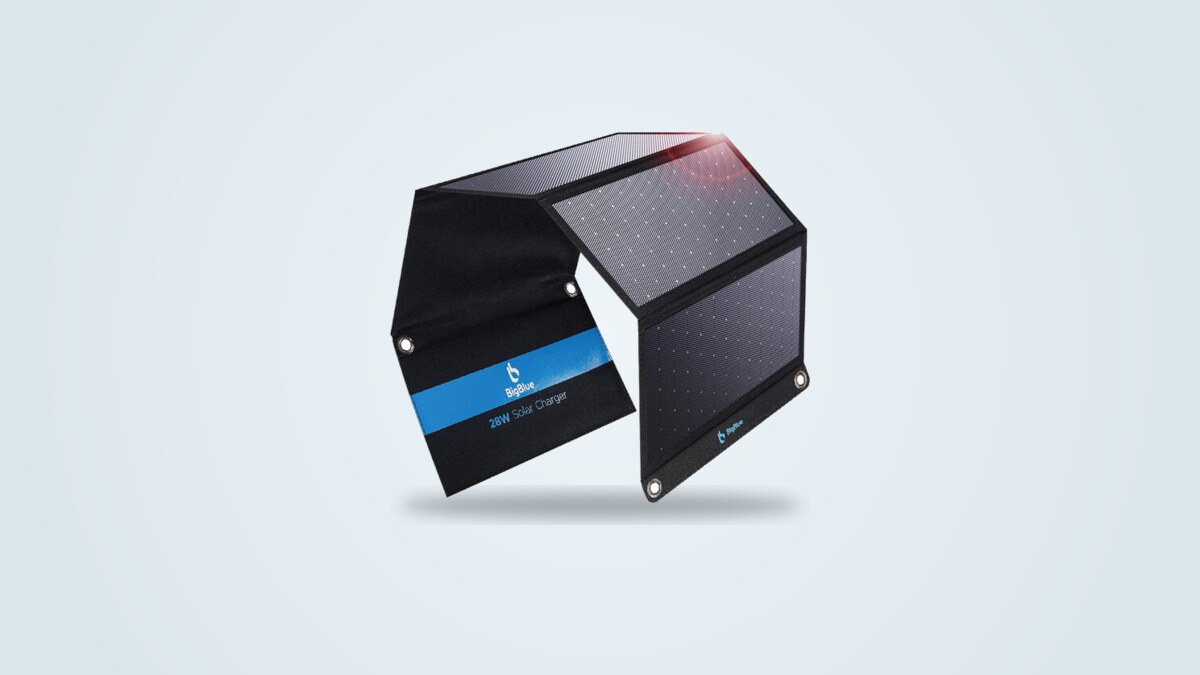
Foldable BigBlue 28W solar panel on a light background

The essentials

The BigBlue 28W keeps part of its promise, but not the one that gives the product its name. Compared with three other panels under the same conditions, it comes out at 37.5% of its rated power, the lowest share of the group, while a cheaper competitor comes close to its own advertised power. The same order of magnitude shows up separately across several generations since 2016: 10 to 14W in full, well-angled sun. Its real strengths lie elsewhere: SunPower cells that keep producing under overcast skies, a generally quick recovery after a brief shading event, one of the most compact formats in its category, and a weight often below the advertised 680g. Two things worth knowing: the IP44 rating protects the fabric but not the USB ports, and several port configurations have circulated under this same commercial name across generations. For backup use (topping up a power bank while hiking, rescuing a phone), it is an honest panel, as long as you do not expect the advertised 28W.

Strengths

  • High-end monocrystalline SunPower cells (~24%), keep producing even under overcast skies
  • Charging generally resumes quickly after a brief shading event (cloud, shadow), with no need to unplug and replug
  • Size and weight among the most compact in its power category, often below the advertised 680g
  • 24-month manufacturer warranty
  • No product recall found for this model

Limitations

  • Real-world power well below advertised: 10 to 14W against a rated 28W, a gap more pronounced than among competing panels tested under the same conditions
  • USB ports and ammeter (on variants that have one) not covered by the panel's IP44 rating
  • Port configuration that has varied across generations of the product, a real source of confusion between versions sold under the same "28W" name
  • In at least two distinct cases, a device that was already charged lost a little charge into a second device plugged in at the same time
  • Two isolated failure cases after around 3 years of heavy use
BigBlue 28W: see the full details and price →

Real-world power, well below the advertised 28W

The BigBlue 28W delivers real-world power well below the advertised 28W. Compared with three other panels under the same conditions (full sun, midday), it comes out at 10.5W, or 37.5% of its rated power: the lowest share of the four panels compared, while a notably cheaper panel reaches nearly its own advertised power under these same conditions. The same order of magnitude shows up separately in several countries and across several generations of the product since 2016: between 10 and 14W in full, well-angled sun, up to 13-14W at best when the panel is held perpendicular to the sun.

28 W
Advertised power
10 to 14 W
Real power in full sun
24 %
SunPower cell efficiency
24 months
Warranty

Under overcast skies, power drops much lower, between 2.5 and 6W depending on cloud cover. The panel still keeps producing in these conditions rather than stopping, and generally recovers quickly after a brief shading event (a passing cloud, the shadow of a tunnel or a tree), with no need to unplug and replug the devices.

Size and weight, the product's real strength

Folded, the BigBlue 28W is about the size of a magazine, roughly 28 x 16 x 3.3cm, and unfolds to around 84 x 28cm at a thickness of a few millimetres. The advertised catalogue weight is 680g; the real weight tends to sit between 580 and 670g, consistently under that figure. This size and weight make it one of the most compact panels in its rated power category, regularly cited favourably against smaller panels that do not offer a compactness gain proportional to their lower power.

Weather resistance: IP44, but not for the ports

The panel is IP44 rated, a resistance to rain and splashes that does not cover immersion. This rating covers the fabric and the main housing, not the USB ports or the ammeter housing on variants that have one, a nuance that the marketing emphasis on IP44 does not spell out. No immersion test or standardised resistance rating beyond this certification was found either, in any of the languages consulted.

Ports: several generations, one current configuration

One point is worth knowing before buying: BigBlue has sold different variants of its "28W" for several years, with port configurations that have varied across generations (two or three USB-A ports, mixed USB-A/USB-C ports, with or without a built-in ammeter). The current spec sheet for this model lists 2 USB-C ports and 1 USB-A port, up to 5V/4.8A combined, enough to charge up to three devices at the same time.

In at least two distinct cases, a device that was already well charged can lose a little charge into another device plugged in at the same time, rather than the other way round. This behaviour has not been confirmed across a large number of cases, but is worth keeping in mind for anyone planning to charge several devices at very different charge levels at once.

Build quality and lifespan

The advertised manufacturer warranty is 24 months. The build (reinforced fabric, stitching, carabiners) is generally judged solid, with no manufacturing defect reported on a recurring basis. One unit did, however, arrive faulty on delivery (scratches, a defective eyelet, flaking paint), the same unit where the lack of automatic recovery after shading also appears, which suggests an isolated unit rather than a design flaw. After around 3 years of heavy use, a failure (charging stops, signs of wear) also appears in two distinct cases, unrelated to each other. These cases remain isolated and do not allow for any conclusion about a general failure rate, but are worth knowing about.

A backup panel, not a primary power source

Given the gap between advertised and real-world power, the BigBlue 28W fits best as a backup solution: topping up a power bank during the day to have energy in the evening, rescuing a phone while hiking or in an emergency, without expecting a fast charge comparable to a wall socket. It does not suit anyone looking to power an energy-hungry device continuously or to quickly recharge several devices at once.

Price and availability

The catalogue price sits around €60 to €70 in France, with occasional promotions bringing it down to around €63. No product recall has been found for this model, either with the US consumer product safety authority or its European counterpart, although these databases could not be searched exhaustively and directly.
The product and its alternatives

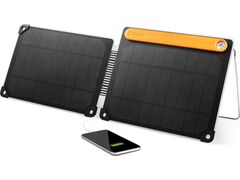
BioLite SolarPanel 10+

BioLite SolarPanel 10+

See price (3)

The rare portable panel that stores what it captures: the BioLite SolarPanel 10+ has a 3200 mAh onboard battery and a 360° kickstand to charge day and night.

View product
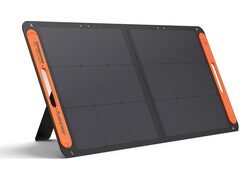
Jackery SolarSaga 100W

Jackery SolarSaga 100W

See price (4)

100W of solar power in a light, foldable panel with kickstands and USB outputs: enough to recharge a Jackery station or your devices straight from the sun.

View product

Frequently asked questions

Rarely in real-world use. Real-world power sits more around 10 to 14W in full, well-angled sun, a gap more pronounced than among some competitors tested under the same conditions.

Yes, but at much lower power: between 2.5 and 6W depending on cloud cover, against 10 to 14W in full sun.

It is IP44 rated (resistant to rain and splashes), but this rating does not cover the USB ports or the ammeter on variants that have one: it is best to protect them in the rain.

No. Like most portable solar panels of this format, it does not store energy: you need to pair it with a power bank to store it and use it later.

The rating in detail

Our rating
3.7/5
Efficiency 3.1
Portability and size 4.3
Weather resistance 3.7
Output ports 3.6
Capacity and expansion not measured
Solar input and MPPT not measured
Control and smart features not measured
Installation and compliance not measured
Build and endurance 3.9
BigBlue 28W: see the full details and price →