What the built-in 140W USB-C cable is really worth
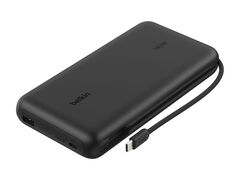
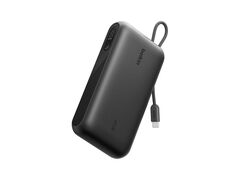
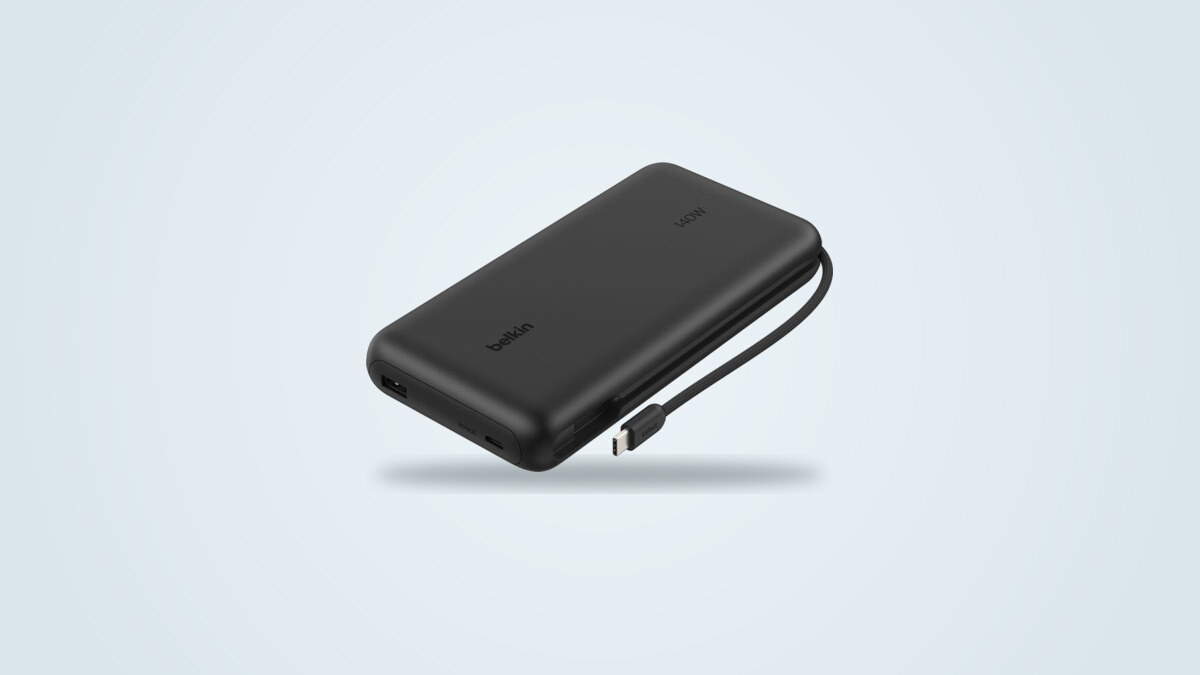
The UltraCharge Pro 25K's headline feature is a built-in, braided 35cm USB-C cable, permanently attached to the housing. Used on its own with a single device, it delivers up to 140W over USB Power Delivery 3.1, plenty to charge a 14-inch MacBook Pro or any USB-C laptop as fast as with its original wall charger. Belkin advertises up to 17 extra hours of runtime for a 14-inch MacBook Pro and a 50% charge in about 28 minutes.
The built-in USB-C port also works as an input: Belkin describes it as an in/out port that automatically detects the direction of current. The same port can therefore both recharge the power bank (up to 90W input) and power a device, a genuine simplification compared with power banks that reserve a separate port for each function.
Sharing power across three devices, and what Belkin does not specify
The extra USB-C port also reaches 140W when used on its own, and the USB-A port tops out at 18W. All three outputs can run together to charge up to three devices at once (laptop, phone, earbuds...), but their combined output is then capped at 158W rather than adding up. Belkin states this plainly in its own documentation: charging power is shared across all active ports, and speeds drop once a second or third port is in use.
A simple calculation gives a rough idea: subtract the USB-A port's 18W maximum from the shared 158W, and at most 140W is left to split between the two USB-C ports, or 70W each if the split is even. Belkin never confirms this port-by-port detail, though, only the shared total and the fact that speed drops once several outputs are active. Anyone planning to charge a demanding laptop while a second device is plugged in should expect noticeably less than the single-port 140W, without being able to predict the exact figure in advance.
140W on one port: the number rivals with a bigger total do not match
The UltraCharge Pro 25K's shared total of 158W is the lowest of the four power banks compared later in this review. But that total hides a more useful number for everyday use: the maximum power a single port can deliver to one device. On that measure, its 140W (built-in cable or second USB-C port) matches the best in the category and clearly beats two rivals advertised as more powerful.
| Product | Max power, single port | Shared total power |
|---|---|---|
| Belkin UltraCharge Pro 25K | 140W | 158W |
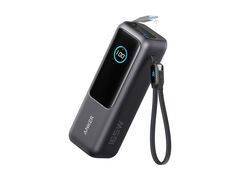
| Anker A1695 | 100W | 165W |
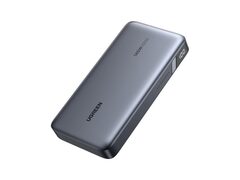
| UGREEN Nexode 145W | 140W | 145W |
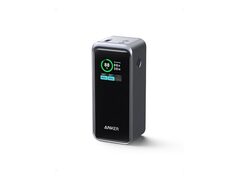
| Anker Prime 20000 | 100W | 200W |
The mechanism is simple: the 165W and 200W totals advertised by the two Anker models assume several active ports at once, each capped at 100W. For frequent use with a single laptop plugged in at a time, the most common case for this kind of product, the UltraCharge Pro 25K and the Nexode 145W actually deliver more real-world power than rivals with a more impressive total on paper.
90Wh under the cabin limit, without an obvious trade-off on capacity
The 25,000mAh capacity works out to 90Wh of nominal energy, implying a cell voltage of roughly 3.6V, a consistent figure that is not inflated relative to the advertised 25,000mAh. That is exactly the same capacity as the Anker A1695, its closest equivalent, and slightly less than the UGREEN Nexode 145W's 92.5Wh. The Anker Prime 20000, for its part, trades away a good share of capacity (72Wh) in exchange for a higher total output.
This capacity stays under the 100Wh cabin limit allowed without special permission by the TSA and most airlines, a genuine advantage for a product built for business travel. Belkin gives a concrete usage figure: up to 17 extra hours of runtime for a 14-inch MacBook Pro, a manufacturer estimate best treated as a rough guide rather than a universal promise, since a laptop's real consumption varies widely with workload and screen brightness.
No independent measurement of the actual discharge efficiency (the share of nominal energy actually recoverable through the ports, once charging-circuit losses are accounted for) was found for this specific model. As a precaution, this review does not publish a real-world Wh estimate rather than putting one forward without a solid basis.
The trade-off in weight and thickness
At 590g for 164 x 89 x 26.2mm, the UltraCharge Pro 25K is something you notice in a bag. It is thicker and heavier than a typical phone power bank, a direct consequence of its capacity and, above all, its charging power, which demand larger components and more heat dissipation than a small backup battery.
Against its closest rivals, it sits at the upper end of the format: the Anker A1695 weighs barely more (around 595g) for comparable dimensions, while the UGREEN Nexode 145W (around 505g) and the Anker Prime 20000 (around 545g) are lighter, but respectively without a built-in cable and with a noticeably lower capacity. None of the four fits in a jacket pocket: this type of power bank travels in a backpack or laptop bag, a deliberate trade-off rather than a hidden flaw.
Digital display and 15W pass-through: two real pluses, one limit to know
The built-in digital display always shows the remaining charge percentage, with a simple lightning-bolt icon indicating an active charge. It is not the animated colour LCD Belkin reserves for the UltraCharge Pro 27K, the higher-end version in the same family (more on that below), but a simple digital readout is more than enough to remove the guesswork of power banks that rely on a handful of LEDs.
The UltraCharge Pro 25K also supports pass-through charging up to 15W: it can be recharged from the wall while still powering a device plugged into one of its ports. The limit to know is that this mode caps at 15W, well below the 140W the unit can normally deliver on a charged port. Pass-through is therefore suited to keeping a small accessory topped up (earbuds, a smartwatch through an adapter) while the power bank itself recharges, not to acting as a fast-charging hub for a laptop at the same time.
10K, 20K, 25K, 27K: a lineup where it is easy to grab the wrong model
Belkin uses the UltraCharge Pro name for several very different product families, which creates a genuine risk of buying the wrong one. This review covers only the UltraCharge Pro Laptop Power Bank 25K, manufacturer reference BPB039 (BBA019 in the US), identifiable by its built-in 35cm USB-C cable and its shared 158W output.
| Product | Type | Capacity / power |
|---|---|---|
| UltraCharge Pro Laptop Power Bank 25K (BPB039) | Power bank, built-in USB-C cable | 25,000mAh (90Wh), 158W shared |
| UltraCharge Pro Laptop Power Bank 27K (BPB040) | Power bank, built-in USB-C cable | 26,190mAh (96.2Wh), 240W shared |
| UltraCharge 20K (no Pro) | Power bank, no built-in cable | 20,000mAh (74Wh), 45W |
| UltraCharge Pro 10K with Qi2 | Magnetic wireless power bank | 10,000mAh, 25W over Qi2 |
| UltraCharge Pro 3-in-1 | Wall charging dock, no battery | 25W over Qi2, no capacity of its own |
Two mix-ups come up most often. The first involves the UltraCharge Pro Laptop Power Bank 27K, a newer and pricier version of the same Laptop Power Bank lineup: slightly higher capacity (26,190mAh, 96.2Wh), and above all a much higher shared total (240W), paired with an animated colour screen and a price well above the 25K's. The two power banks look very similar in photos, and some online content mixes up their specifications without always making clear which one is being discussed.
The second mix-up is even more misleading: the UltraCharge Pro name also covers a fixed wall charging dock (a desk stand for a phone and smartwatch, with no internal battery at all) and a small 10,000mAh magnetic power bank compatible with Qi2. Neither product has anything to do with a laptop power bank, and they share nothing with the 25K beyond the UltraCharge Pro marketing name. Anyone looking for information on this 140W built-in cable should check that the source they are reading is actually about the BPB039 model, not one of these other products.
Against the Anker A1695, the UGREEN Nexode 145W and the Anker Prime 20000
In the segment of high-power laptop power banks around 25,000mAh, three rivals help place the UltraCharge Pro 25K precisely.
| Criterion | Belkin UltraCharge Pro 25K | Anker A1695 | UGREEN Nexode 145W | Anker Prime 20000 |
|---|---|---|---|---|
| Capacity | 25,000mAh (90Wh) | 25,000mAh (90Wh) | 25,000mAh (92.5Wh) | 20,000mAh (72Wh) |
| Max power, single port | 140W | 100W | 140W | 100W |
| Shared total power | 158W | 165W | 145W | 200W |
| Built-in USB-C cable | Yes (35cm) | Yes | No | No |
| Display | Digital (%) | Digital (%) | Digital (%) | Digital (%) |
| Weight | 590g | ≈ 595g | ≈ 505g | ≈ 545g |
The Anker A1695 remains the closest rival on paper: same capacity (90Wh), the same built-in-cable approach, nearly identical weight. It wins on shared total (165W versus 158W) but caps at 100W on a single port, against 140W for the Belkin. The UGREEN Nexode 145W matches the UltraCharge Pro 25K on per-port power (140W) and weighs less, but gives up the built-in cable, one of the Belkin's central selling points. The Anker Prime 20000 targets a different use case: the highest total power in the lineup (200W), at the cost of noticeably lower capacity (72Wh) and, again, a 100W per-port cap. None of the three rivals combines the built-in cable, 140W per port, and 90Wh of capacity all at once: that exact combination is what sets the UltraCharge Pro 25K apart, more than a total-power figure that actually places it last in the group.
Build, warranty, and a still-limited track record
The housing uses at least 75% post-consumer recycled plastic, in fully plastic-free packaging. Belkin backs the product with a 2-year limited warranty, plus a Connected Equipment Warranty covering electrical damage to connected devices during a charge, a level of coverage that goes beyond what many competitors offer at this price point. No safety recall has been identified to date for this specific reference (BPB039 / BBA019).
Two reservations are still worth flagging clearly. First, the UltraCharge Pro 25K is a recent product, on the market for only a few months as of this review: no multi-year track record exists yet on its real-world reliability, unlike older lineups from competitors. Second, it is currently available in a single colour (black) in several markets, even though the manufacturer's own marketing images also show lighter colourways: a buyer drawn in by those images should check which colour is actually in stock before ordering.
Who it's for, and who it is not for
It suits anyone who regularly charges a USB-C laptop on the move and wants a single cable to carry instead of a separate power bank and cable. Its 140W on a single port covers the vast majority of laptops on the market, its 90Wh capacity travels without special permission in the cabin, and its 2-year warranty with connected-device protection is reassuring over time.
It suits less anyone chasing the highest possible total power to charge several demanding devices at once (the Anker Prime 20000 does better here), anyone who prioritizes the lightest, most compact format possible, or anyone who wants to buy with the confidence that comes from years of real-world feedback, a track record this recent model has not had time to build yet.