
99.36Wh: one of the largest capacities that still clears cabin rules
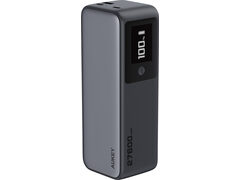
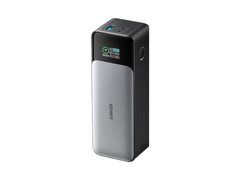
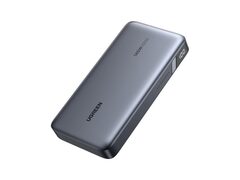
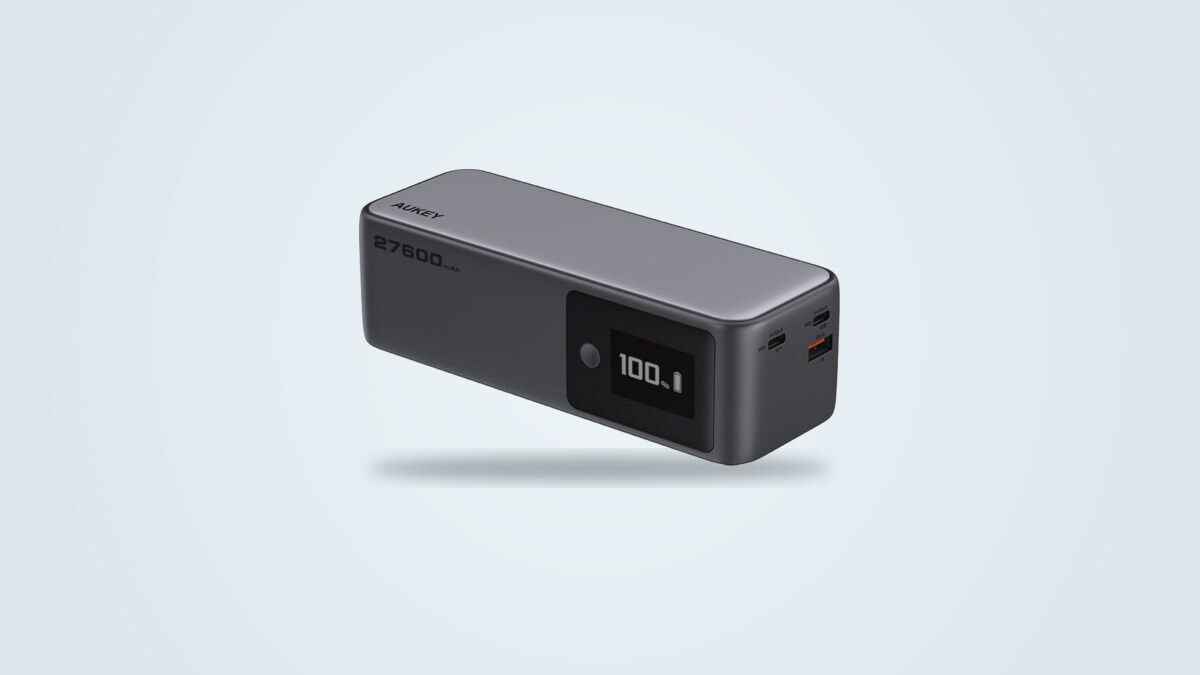
The 27,600mAh printed on the Aukey PB-Y63's shell works out to 99.36Wh once converted at the cells' nominal voltage (3.6V), the figure that actually matters when judging a power bank. That number puts the PB-Y63 near the top of its class: it stores more energy than the Anker 737 (86.4Wh) or the Ugreen Nexode 145W (92.5Wh), while staying under the 100Wh threshold beyond which most airlines require prior approval, typically capped at two units per passenger.
A power bank above 100Wh, and plenty of high-capacity laptop power banks are, moves into a category where boarding depends on the airline's prior consent, often capped at two units per passenger. Staying just under that ceiling while still offering 140W of output is a balancing act few manufacturers pull off at this capacity level: it's the PB-Y63's strongest card against rivals that sometimes look more generous on paper but require a request at the airport gate.
140W per port, 145W to share once both are working together
Each USB-C port on the PB-Y63 is rated at 140W individually, enough to fast-charge a demanding laptop such as a 16-inch MacBook Pro or a creator/gaming machine paired with a USB-C charger of similar power. That figure holds up as long as only one port is working at a time.
The nuance shows up once both USB-C ports are drawing power at the same time: the total 145W budget doesn't double, it gets shared. One port then gets 100W and the other 45W, never 140W on both simultaneously. That's not a hidden flaw: the product's own spec sheet lists a 145W total, not 280W. But the gap between the "140W" printed large on the box and the reality of running two devices at once is worth knowing before buying the PB-Y63 to power a laptop and a second power-hungry device together.
The USB-A port rounds out the lineup at 22.5W, a familiar figure for an older phone or accessories that don't need USB-C fast charging. It also draws from the same overall 145W budget when all three outputs are active at once.
What 140W actually changes for a laptop
Many power banks advertise 65W or 100W over USB-C, enough for a phone or a small laptop but well short of the pace of an original charger on a creative or gaming machine that calls for 96, 120, or even 140W. Using a single port, the PB-Y63 reaches that level and recharges a 16-inch MacBook Pro or an equivalent laptop at the same pace as its stock mains charger, without the slowdown typical of an undersized power bank.
On protocols, output relies on USB PD 3.1 with PPS, the newest version, which fine-tunes voltage in 20mV steps rather than fixed values. In practice, that cuts down the heat generated during fast charging on compatible phones (recent Samsung Galaxy S and Note models in particular), a real improvement even if it isn't visible day to day. On input, the PB-Y63 still supports USB PD 3.0 and Quick Charge 3.0, two older protocols: a USB-C charger bought a few years ago is enough to recharge it, just more slowly than with the full 100W it can accept.
650g, 47mm thick: the cost of a genuine backup power station
160 x 58 x 47mm and 650g on the scale: the PB-Y63 doesn't slide into a jacket pocket like a small phone power bank, it travels in a bag. That's the logical trade-off for packing 99.36Wh at this power level, even if the name "Spark Sling" might suggest a more compact format.
Relative to its weight, though, the energy it carries still holds up well against the Anker 737, which is less dense despite a similar weight: about 15.3Wh per 100g of total weight versus 13.7Wh/100g for the Anker (86.4Wh for 630g). The Ugreen Nexode 145W, the lightest battery in this comparison, does even better on this one measure.
The digital screen, the most useful everyday feature
The PB-Y63's LCD screen shows the remaining percentage, the live input or output wattage on each active port, and an estimate of the time left until full charge or full discharge, all at once. That's noticeably richer than a simple 25% step indicator, still common on power banks of similar power.
That level of detail makes it easy to check in real time whether a connected device is actually getting the power it should, a genuine help for keeping an eye on the port-sharing behaviour described above. On the Anker 737, an equally complete screen also shows cell temperature and cycle count, information the PB-Y63's screen doesn't provide: on sheer information depth, the Anker keeps a small edge, even though the general idea is much the same.
Against the Anker 737 and the Ugreen Nexode 145W: the spec sheet doesn't tell the whole story
On paper, the PB-Y63 wins the capacity comparison against its two most-cited direct rivals in this power class: 27,600mAh versus 24,000 for the Anker 737 and 25,000 for the Ugreen Nexode 145W. It matches their stated total power and beats the Anker on manufacturer warranty.
| Criterion | Aukey PB-Y63 | Anker 737 Power Bank | Ugreen Nexode 145W |
|---|---|---|---|
| Capacity | 27,600mAh / 99.36Wh | 24,000mAh / 86.4Wh | 25,000mAh / 92.5Wh |
| Total power | 145W (140W on a single port) | 140W claimed (93W measured over direct USB-C) | 145W (140W on a single port) |
| Weight | 650g | 630g | 505g |
| Recharging, max input | 100W | 100W | 65W |
| Manufacturer warranty | 24 months | 18 months | 24 months |
| Availability | Aukey's own site only | Widely available | Widely available |
But the spec sheet doesn't tell the whole story. The clearest case is the Ugreen Nexode 145W: a nearly identical power architecture (145W total, 140W on a single port), for 145g less and an equally long warranty, at an official price of £68.41 against £88.88 for the PB-Y63. It does accept slower input charging (65W versus 100W) and stores a little less energy (92.5Wh versus 99.36Wh). Of the three, the Anker 737's real USB-C ceiling (93W over direct USB-C) is the only one of the three established with certainty, even though it is lower than the other two on paper. Both the Anker and the Ugreen are also widely distributed, with after-sales support available wherever they're sold, unlike the PB-Y63, which depends on a single sales channel.
Don't confuse it with the PB-Y45 Sprint X: same headline numbers
A quick search for the PB-Y63 regularly turns up another Aukey product, the PB-Y45 "Sprint X", also advertised at 27,600mAh and 140W with a digital screen. The two power banks share the same marketing angle and much of their headline spec sheet, but they are two separate products: different commercial names ("Spark Sling" or "Spark Mega" for the Y63, "Sprint X" for the Y45), different product codes, and likely different generations or internal components.
Another possible source of confusion is specific to the PB-Y63 itself: Aukey sells it as "Spark Sling" on its European site, the one behind this product's listing, but as "Spark Mega" on its North American and Asian sites. It's genuinely the same product, same PB-Y63 code, same specifications: only the marketing name changes from one market to another. Conversely, anything specific to the PB-Y45 Sprint X should not be attributed to the PB-Y63 reviewed here, and vice versa.
What the absence from the major marketplaces really means
In May 2021, Amazon suspended Aukey's seller accounts, along with more than 600 other Chinese electronics brands including RAVPower, over an organised fake-review scheme: buyers were refunded via PayPal in exchange for a five-star review posted a few days after delivery. The penalty wasn't symbolic. Aukey and its sister brand Tacklife saw their combined revenue drop from about $222 million to $46 million, a 73.5% fall. Across the whole group (Augroup, Aukey's parent company, which listed on the Hong Kong Stock Exchange in late 2024), revenue fell 21.7% between 2021 and 2022, with a net loss of $81 million in 2021 alone.
Since then, Aukey has sold the PB-Y63 only through its own site, away from the major marketplaces. In practice, that changes nothing about the product's technical qualities and isn't tied to any known recall on this specific model, but it does narrow the buyer's options if something goes wrong: no third-party buyer protection, no simplified marketplace returns, after-sales support that depends entirely on the brand itself. A complete failure within two months of use and unclear included instructions turn up in isolation, with nothing recurring beyond these two mentions.
Recharging the PB-Y63 itself: 100W input, an unconfirmed duration
The PB-Y63 accepts up to 100W over its USB-C input, with broad compatibility (USB PD 3.0, Quick Charge 3.0) that lets it work with an older charger, at the cost of speed. No independently confirmed full recharge time exists for this model to date.
A rough calculation gives a sense of scale: recharging 99.36Wh with 100W available comes to a theoretical floor of just under an hour, if power stayed constant from start to finish. That never happens with a lithium battery, whose charging current always tapers in the final stretch to protect the cells. In practice, expect a noticeably longer duration, likely between an hour and a half and two hours, until an independent figure narrows this down. Aukey also doesn't specify whether the PB-Y63 supports pass-through charging (recharging the battery while powering a connected device): that information couldn't be confirmed with certainty and isn't stated here.
Who the PB-Y63 is for, and who it isn't
The PB-Y63 suits anyone who genuinely needs to recharge a demanding laptop on the move while still being able to carry it in the cabin without prior paperwork. Its near-maximum allowed capacity and its 140W on a single port make it one of the few power banks able to sustain heavy professional use far from an outlet, with the bonus of a screen that genuinely details what's happening port by port.
It suits fewer people who want a pocket-sized format for a phone, who would rather buy from a well-known marketplace with simple returns if something goes wrong, or who prioritise value for money above all: the Ugreen Nexode 145W covers a very similar use case for noticeably less money, and less weight. The shared budget between the two USB-C ports is also worth factoring in before buying the PB-Y63 to power two power-hungry devices at once: it can, just not at 140W on both at the same time.