
What the 400W rating is really worth
Like any solar panel, the PS400's 400W corresponds to a standardised power rating (1000 W/m² of irradiance, standard cell temperature, reference spectrum), a useful reference for comparing panels but not a figure you'll see outdoors as-is. In full midday sun, under clear skies, the PS400's output reaches 368W out of a 400W nominal rating, that's 92%, one of the best ratios in our portable panel catalogue.
On a sunny summer day (9am to 5pm), average output settles around 285W, for a total close to 2280 Wh. Under overcast skies, available power drops to between 80 and 120W, an average of about 100W over 8 hours: a typical drop for this panel format, not unique to the PS400. With roughly a third of the panel shaded, output stays close to 220W thanks to the built-in bypass diodes, decent behaviour that avoids a total production collapse, unlike panels with less capable wiring.
Weight: the real trade-off of the 400W format
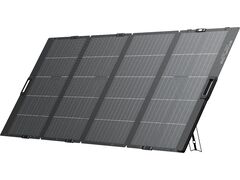
Once unfolded, the PS400 weighs a rated 15.9 kg, making it the heaviest portable panel in our catalogue to date: more than three times the weight of the PS200 (4.8 kg) from the same brand, and about 56% heavier than an EcoFlow panel of the same power (400W, 10.2 kg) already compared on this product's page. So this isn't just the mechanical effect of doubled power: at equal power, a direct competitor is noticeably lighter.
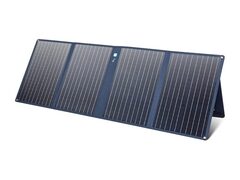
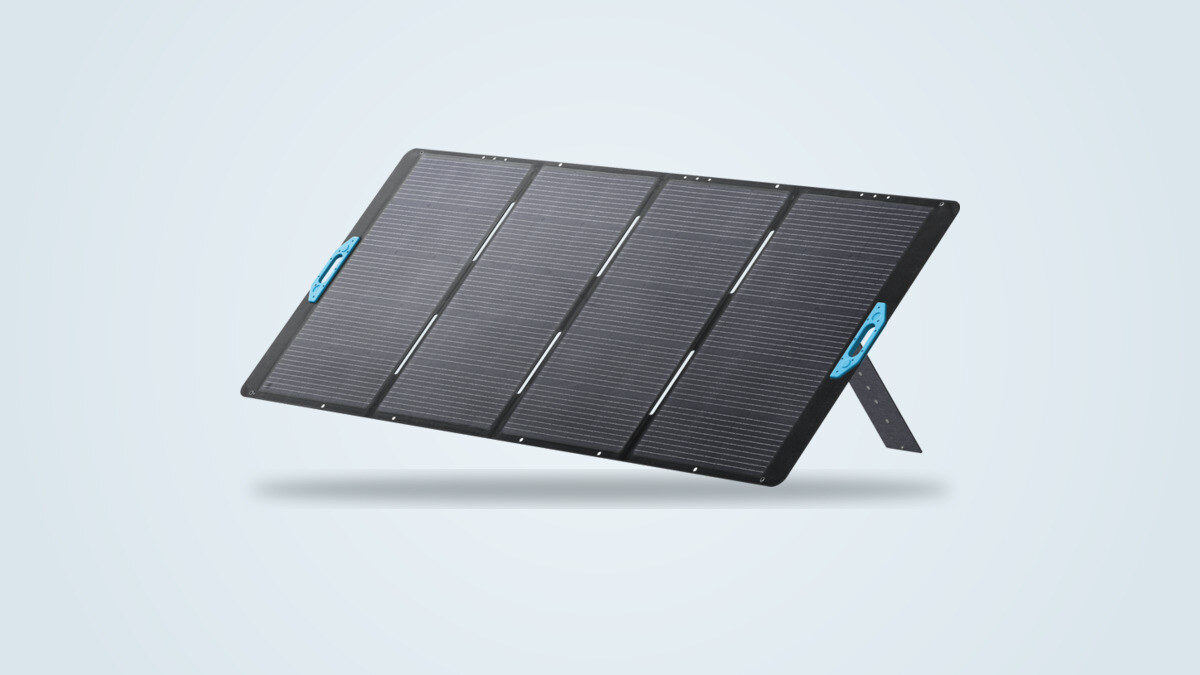
Once folded (91.3 x 65.9 cm, 4.7 cm thick), the PS400 keeps a larger footprint than the more compact Fossibot SP200 (64 x 53 cm), a logical gap given the power difference. Two built-in handles help with short-distance carrying, but at this weight, it's clearly a panel you carry from the vehicle to the setup spot, not one you slip into a backpack for hiking.
The kickstand: the most frequent reservation
The point that comes up most often about the PS400 concerns neither its power nor its waterproofing, but its kickstand. The built-in system doesn't always evenly support all four panel sections across the panel's full width (2.59 m) once unfolded: the centre sections can sag slightly, especially on uneven ground. This isn't a defect that stops the panel from working, but a real point of friction for a product at this price point.
This is worth knowing before buying, as it contrasts with the rest of the spec sheet (reinforced frame, ETFE coating, IP67) which otherwise aims at the premium end. Careful ground anchoring, using the tie-down loops provided for that purpose, limits the issue but doesn't fully remove it on a panel this wide.
Watch out: a newer bifacial version shares the same name
An important point before looking for other reviews of this product: the commercial name "Anker Solix PS400" today covers two panels with different hardware. The version described in this review, the one referenced by this site's product page, is the original monofacial model (classic monocrystalline cells, up to 23% rated efficiency, IP67, 15.9 kg, 2-year warranty). The manufacturer's official documentation now also lists a newer bifacial version, with an active rear face, an IP68 rating, and a noticeably lower rated weight.
| Feature | Version described here (monofacial) | Newer bifacial version |
|---|---|---|
| Cells | Classic monocrystalline | Bifacial |
| Waterproofing | IP67 | IP68 |
| Rated weight | 15.9 kg | Noticeably lower |
| Warranty | 2 years | Longer |
IP67 and weather resistance: what to know
The PS400 carries an IP67 rating against water and dust, one tier below the IP68 of the PS200 or of an EcoFlow 400W panel already in our catalogue. The ETFE fluoropolymer coating and reinforced aluminium frame aim to limit wear from repeated outdoor handling (folding, carrying, setting down on the ground).
The manufacturer's official documentation states that the rubber caps on the MC4 connectors must stay in place before any exposure to rain: a simple instruction, but not one to overlook, or the rating no longer applies at that specific point. Anker also notes that the panel isn't designed to stay set up outdoors permanently, but to be deployed and then put away after use.
Output ports: complete MC4 kit, but no USB
The PS400 outputs through MC4 connectors, the most widely used standard in the solar market, with two 3m extension cables included in the box. A shorter MC4-to-XT-60 adapter rounds out the kit: no cable to buy separately, whether staying within the Anker Solix ecosystem or connecting a third-party charge controller or station with an MC4 input.
One real limitation though, shared by nearly every panel of this power class: no USB output. You can't charge a phone or a power bank directly without an intermediate station. The 60V open-circuit voltage also means checking the maximum input voltage your own station or charge controller accepts before connecting, especially with older or more modest gear.
Compatibility with Anker Solix stations and beyond
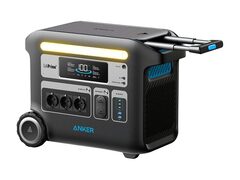
Anker recommends pairing the PS400 with its Solix F2000 station and states a full recharge of that station in 5.7 hours with this panel, under favourable conditions. More broadly, the panel's output stays compatible with any solar station or charge controller on the market accepting an MC4 input up to 60V, not limited to the Anker ecosystem.
For anyone who already owns an Anker Solix station, the included XT-60 adapter avoids an extra purchase. For anyone with a station from another brand, the native MC4 output works directly, provided the maximum accepted input voltage is checked first.
Build quality, warranty and reliability
The reinforced aluminium frame and scratch-resistant ETFE coating aim at repeated outdoor use without rapid wear. No recall affects this panel to date: Anker's known recalls concern exclusively its products with an onboard lithium battery (portable chargers, power banks), never its passive solar panels, which contain no storage cell or internal charging electronics.
One point is worth flagging though: the PS400's manufacturer warranty is only 2 years, well short of the 5 years on the PS200 from the same brand or on an EcoFlow 400W panel already in our catalogue. This isn't a sign of fragility by itself (the Fossibot SP200 in our catalogue carries the same duration), but an objective comparison point worth knowing before buying, especially against its own little sibling, which is far better covered on this point.
Against an EcoFlow panel of the same power
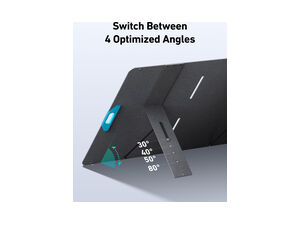
At equal power (400W), the most direct comparison is an EcoFlow panel already in our catalogue. The PS400 keeps the edge on its 4-angle stand, but falls clearly behind on weight, waterproofing and warranty.
| Criterion | Anker Solix PS400 | EcoFlow 400W |
|---|---|---|
| Cells | Monocrystalline (23%) | Bifacial (up to 25%) |
| Weight | 15.9 kg | 10.2 kg |
| Stand / angles | 4 angles (30-80°) | 3 angles + guide |
| Waterproofing | IP67 | IP68 |
| Warranty | 2 years | 5 years |
| Catalogue price | £849.00 | £549.00 |
On this market, the EcoFlow panel comes out ahead on nearly every objective criterion (weight, waterproofing, warranty) and at a noticeably lower catalogue price, a gap worth factoring in before choosing on brand alone. The PS400 keeps one advantage tied to its own ecosystem: for anyone who already owns an Anker Solix station, direct compatibility and the included adapter simplify the purchase, with no need to check third-party brand compatibility.
Who the PS400 is really for
The PS400 is aimed first at anyone who already owns a large Anker Solix station (the F2000 range in particular) and wants to recharge it quickly in the sun, for a fixed base-camp use: a campervan parked for several days, extended camping, or a standby backup at a fixed location. Its high output makes it a good pick for anyone needing a lot of energy in a short time, without being too concerned about the weight involved.
Conversely, anyone after a genuinely portable format, easy to carry from one spot to another, should look instead at a lighter panel like the PS200 (4.8 kg) from the same brand, accepting a lower output in exchange. And anyone who already owns a station from another brand with the same input power will find the EcoFlow 400W panel a lighter, better-warrantied competitor, at a somewhat higher catalogue price.
Price and availability
In the UK, the PS400 is found around £849.00 at the time of writing, with prices regularly dropping during promotional periods to noticeably below that catalogue figure. Prices vary between retailers and over time, well below the launch-era catalogue figure in most cases.
Before buying, it's worth checking the rated weight (15.9 kg) and the absence of the word "bifacial" on the product page or seller listing: as covered above, the same commercial name now also covers a newer, lighter version, not to be confused with the model described in this review.