
Weight: the PS200's central argument
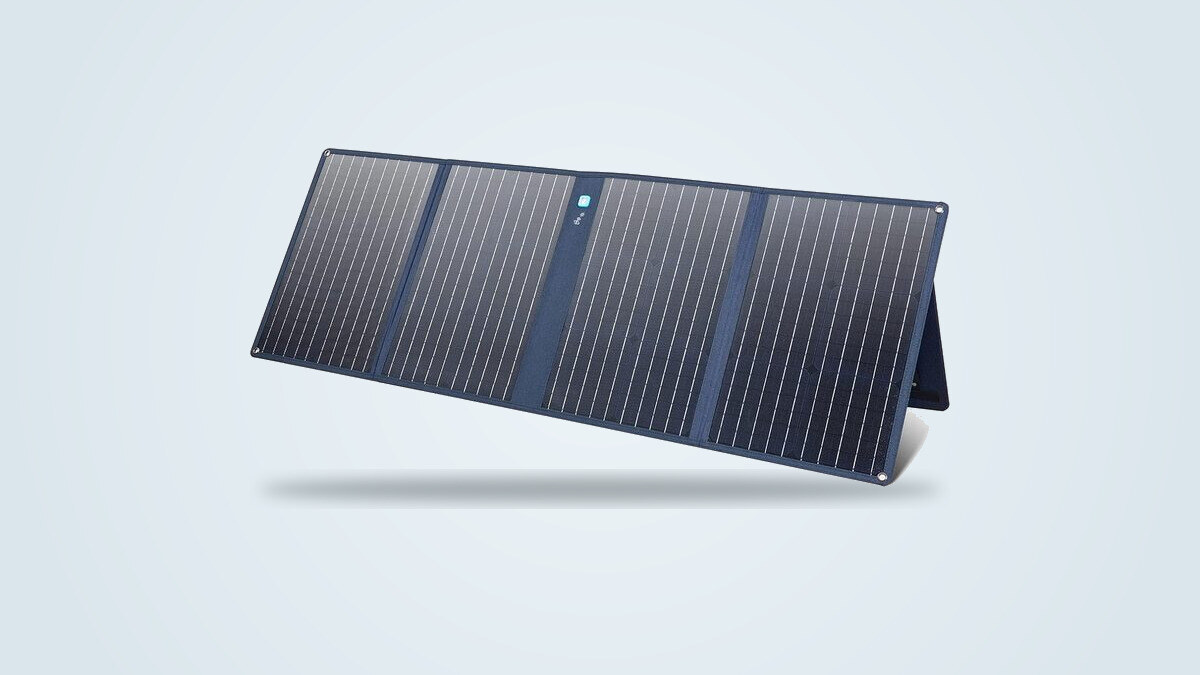
The PS200's most visible selling point comes down to the scale: 4.8 kg as advertised, a figure confirmed by the manufacturer's own official spec sheet for this current bifacial version. Against the other 200W panels in our catalogue, the gap is clear: the Jackery SolarSaga 200W weighs 6.2 kg, the Allpowers SP033 200W 6.3 kg, and the rigid Bluetti MP200 suitcase-style panel climbs to 8.14 kg. Set against the average of these three comparable panels, the PS200 comes in more than 30% lighter, a gap that matches the manufacturer's own claim almost exactly.
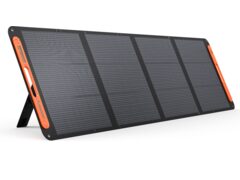
Folded, the panel measures 79.2 x 68.6 cm (31.2 x 27.0 in) at 4.6 cm (1.8 in) thick, and unfolds to 137.7 x 79.2 cm (54.2 x 31.2 in). Folding into just two panels, against four for the Bluetti MP200 for instance, partly explains this low weight: fewer hinges, less reinforcement needed. The trade-off is a folded footprint that covers more ground area than the SolarSaga's: the PS200 packs flatter rather than taller, worth checking against the storage space available in a trunk or a van. The built-in stand adjusts across four positions (30, 40, 50 and 80°), and a magnetic closure paired with a carry handle round out the package.
Output: N-type cells and the bifacial gain, separating claim from reality
Like any solar panel, the 200W advertised on the PS200 corresponds to a standardised rating (1000 W/m² of irradiance, a cell temperature of 77 °F (25 °C), a standard light spectrum), a reference figure useful for comparing panels but never quite met outdoors: angle of incidence, cloud cover and the panel heating up in direct sun all pull it down mechanically. No independent figure for peak output specific to this bifacial version has been found so far: almost every number circulating online under the "PS200" name actually concerns an earlier generation of the product (see the next section), which rules out carrying them over here without caution.
Two features still work in the PS200's favour on this front. First, its new-generation N-type cells, rated above 25% efficiency: this technology generally handles heat better than the P-type cells more common on entry and mid-range portable panels, which in theory limits the efficiency loss in full summer sun compared with a classic panel of the same nominal power. Second, its active bifacial rear face, which adds genuine output even though its exact size (up to 10% according to the manufacturer) depends heavily on the ground under the panel: next to nothing on grass or dark soil, more worthwhile on light sand, snow or a concrete patio. Anyone setting their PS200 up on grass should not expect that advertised gain.
Watch out: two quite different generations share the PS200 name
The single most important thing to know before looking up other reviews of this product: the "Anker Solix PS200" name has been used for two panels with noticeably different hardware. An earlier version is built from four classic monocrystalline panels folding accordion-style, advertises around 23% efficiency, carries an IP67 rating, and generally weighs between 7.9 and 9.2 kg depending on the listing, folding down to roughly 56 x 61 cm (22.0 x 24.0 in). The current bifacial version, the one described in this review and referenced by this site's product page, weighs only 4.8 kg, folds into just two panels, packs N-type cells rated above 25% efficiency, and steps up to an IP68 rating.
| Feature | Earlier version | Current bifacial version |
|---|---|---|
| Cells | Classic monocrystalline | Bifacial N-type |
| Advertised efficiency | Around 23% | Above 25% |
| Fold | Four panels | Two panels |
| Weight | 7.9 to 9.2 kg depending on the listing | 4.8 kg |
| Weatherproofing | IP67 | IP68 |
This mix-up is not unique to this product: Anker regularly evolves several references in its Solix range under an unchanged commercial name. The most reliable discriminant here remains the weight and the explicit mention of the bifacial feature, more reliable than a plain search by model name.
IP68: what this rating actually covers
The current PS200 version carries an IP68 rating, the best protection against water and dust in our comparison of 200W panels, and a clear step up from the IP67 of the earlier generation of the same product. In its own spec sheet, however, Anker describes this protection as splash resistance rather than protection against sustained immersion, a more cautious wording than what the IP68 label alone might suggest. A practical point worth knowing: the rubber caps that protect the MC4 connectors need to stay in place for this protection to actually apply; a connector left exposed in the rain is no longer covered by the panel's rating.
No hinge failure has been found for this version. Folding along a single axis (two panels) mechanically limits the number of seams and hinges exposed to moisture and dust compared with a panel with multiple folds, a plausible structural advantage even though it has not been independently verified over the long term.
Output connectivity: native MC4, XT-60i included, but no USB
The PS200 outputs through MC4 connectors, the most widespread standard in the solar market, wired straight from the factory on two 2.5 m (8.2 ft) cables included in the box. A third, shorter cable (0.5 m / 1.6 ft) adapts this MC4 output to the XT-60i connector used by Anker Solix stations: no separate adapter to buy, whether staying within the Anker ecosystem or connecting a third-party controller or station with an MC4 input.
One real limitation, though: like most panels of this power class, it has no USB output at all. Charging a phone or a power bank directly without going through an intermediate station is impossible, unlike a more modest trickle-charging panel such as the BigBlue 28W, which offers USB-A and USB-C ports but no MC4 output. The PS200 is clearly built to pair with a generator or a station, never as a stand-alone nomad solution for small devices.
Compared with the Goal Zero Nomad 100, whose single proprietary 8mm connector shuts off access to any ecosystem outside Yeti, the PS200 is noticeably more open: its MC4 output works with pretty much any solar controller or station on the market, with the Anker adapter cable being a bonus convenience rather than a requirement.
Compatibility with Anker Solix stations, and beyond
The manufacturer lists direct compatibility with the Anker Solix F2000, C1000X, C800X and C300X stations via the included XT-60i adapter. More broadly, the panel's PV output stays within the standard input range of most solar stations and controllers on the market with an MC4 input: checking the maximum input voltage and current accepted by one's own station before buying remains essential, since the 57.6V open-circuit voltage can exceed the threshold some smaller devices accept.
For anyone who already owns an Anker Solix station, this native compatibility, adapter cable included, is a genuine convenience. For anyone with a station from another brand, the native MC4 output works directly, with no need for that adapter.
Build quality, warranty and brand track record
Anker advertises a lifespan of around 10 years for the PS200 and a 5-year manufacturer warranty, the longest in our comparison of 200W panels: the Jackery SolarSaga 200W carries a 3-year warranty, while the Bluetti MP200 and the Allpowers SP033 200W each carry just 2 years.
The advertised reinforced aluminium frame and the top protective layer over the cells show no sign of a recurring manufacturing defect for this bifacial version. One point deserves to be kept separate: Anker's known recalls concern exclusively its products with a built-in lithium battery (portable chargers, power banks), hit more than once by fire risks tied to the cells. The PS200, like any passive solar panel, contains no storage cell and no internal charging electronics: that particular risk does not apply to it.
Against the direct 200W competition
Compared with the three other 200W panels already mentioned, the PS200 stands in a singular spot: by far the lightest, the only bifacial one, and the only one with a 5-year warranty.
| Criterion | Anker Solix PS200 | Jackery SolarSaga 200W | Bluetti MP200 | Allpowers SP033 200W |
|---|---|---|---|---|
| Weight | 4.8 kg | 6.2 kg | 8.14 kg | 6.3 kg |
| Weatherproofing | IP68 | IP68 | IP67 | IP66 |
| Bifacial | Yes | No | No | No |
| Warranty | 5 years | 3 years | 2 years | 2 years |
Jackery's SolarSaga 200W shares the same IP68 rating but weighs 30% more and has no active rear face. Bluetti's MP200, the heaviest of the three at 8.14 kg, goes for a rigid suitcase-style format, bulkier but potentially tougher against knocks than a soft-fold panel. The Allpowers SP033 200W sits in the middle, without a standout technical edge over the PS200 in this comparison.
Who the PS200 really suits
The PS200 suits first and foremost anyone after the lightest 200W panel to carry, whether for an Anker Solix station or for any other generator with an MC4 input: camping, a converted van, or a backup solution at home during a power cut. The larger folded footprint (31.2 x 27.0 in / 79 x 69 cm) needs storage space laid flat rather than stood up, worth checking against the vehicle or bag involved.
On the other hand, anyone wanting to charge a phone or a small power bank directly without carrying a station is better served by a more modest panel fitted with USB ports, such as the BigBlue 28W. And anyone chasing the most compact folded footprint possible, even at the cost of extra weight, should look instead at a panel with multiple folds.
Price and availability
In the UK, the PS200 is priced around £298.46 at the time of writing, against a list price of £342.07 shown by the partner retailer: a regular promotion on this product rather than a one-off exception. In the US, Anker's direct list price sits around $499.99.
Before buying, it is worth checking the product listing for the explicit "bifacial" mention and the advertised weight (4.8 kg / 10.6 lb): as covered above, the same model name also applies to an earlier version, heavier and less weatherproof, which is sometimes still listed on certain marketplaces.