
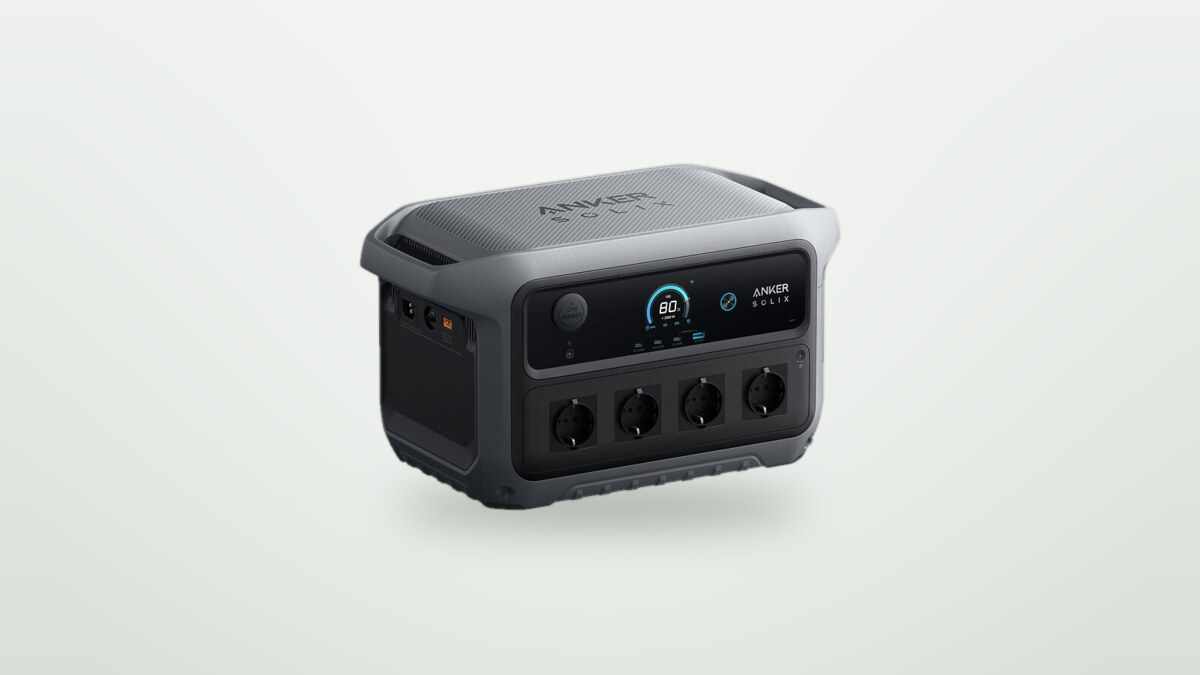
What the 2048 Wh capacity is really worth
The C2000 Gen 2 packs a 2048 Wh LiFePO4 battery, rated for 4000 cycles before dropping to 80 % of capacity, or roughly a decade of regular use. On real-world delivery, usable capacity actually runs between 77 % at low power (around 200 W) and 90 % at high power (around 1800 to 2400 W).
That is good news in itself: unlike other products in this segment, the advertised capacity is not artificially inflated. But the gap between 77 % and 90 % is not simple measurement noise. It points to a physical mechanism with real consequences for everyday use, covered in the next section.
The real cost of slow solar charging
This is the most interesting angle of this product, and the one best supported by the numbers. It lands directly on the use case the spec sheet promotes the hardest: gentle solar charging to stay off-grid for several days. The mechanism is physical and well understood: the fixed losses in the conversion electronics (self-consumption, switching) weigh proportionally heavier on a low power flow than on a large one. A reasonably sized portable solar panel rarely delivers more than a few hundred watts, exactly the regime where efficiency is at its worst.
In practice, a reader charging mainly off the sun with a small portable panel pays more per stored kWh than one charging quickly from the mains. This is not a hidden flaw, more a physical limit inherent to any conversion electronics, but one that partly contradicts the off-grid case the product sheet promotes.
The 58-minute recharge, and what it implies
This headline figure holds up, but under one precise condition: it requires combining mains AND solar power at the same time, at 2600 W. On mains power alone, the duration depends heavily on local grid voltage: around 66 minutes in Europe (230 V, 2300 W), and 88 to 90 minutes in the United States (120 V, 1800 W), two measured figures consistent with the theoretical calculation once conversion losses are factored in.
| Method | Measured time |
|---|---|
| Mains + solar combined (2600 W) | 58 min |
| Mains only, Europe (230 V, 2300 W) | 66 min |
| Mains only, United States (120 V, 1800 W) | 88 to 90 min |
Under overload, the measured behaviour is reassuring: the station holds 2600 W continuously without issue, handles 3000 W for around 45 seconds, and cuts out after just 3 seconds beyond 3700 W. A protection threshold consistent with the advertised 4000 W peak, which is therefore a transient spike, not a continuous power rating.
There is no “C2000 Gen 1”: understanding the real lineage
A useful point to clarify before buying: unlike other Anker Solix ranges (the C1000, for instance, which has a real Gen 1 and a real Gen 2 with different specs), there is no “C2000 Gen 1”. This C2000 Gen 2 is the first product to carry that name. The “Gen 2” marks its place in the lineage of Anker's roughly 2 kWh stations: the Anker 767 PowerHouse (30.5 kg, with wheels and a telescopic handle), later renamed the Anker Solix F2000, then replaced by this redesigned C2000 Gen 2.
The F2000 has, in fact, all but disappeared from active sale in France, absent from several general retailers and price-comparison sites checked. The technical comparison still tells its own story: the F2000 topped out at 2300 W continuous, took around 85 minutes to charge from the mains alone, and capped USB-C at 100 W. The C2000 Gen 2 improves on all three points (2400 W, 58 minutes combined, 140 W USB-C), while shedding 11.6 kg and losing the LED torch bar that equipped the old model.
Four mains sockets and 140 W USB-C: the real connectivity
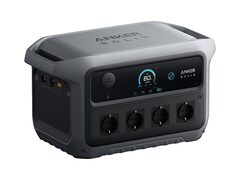
The station has four 230 V mains sockets (2400 W continuous, 4000 W peak) and two 140 W USB-C ports for charging a laptop at full speed with no dedicated adapter. This combination makes it a generalist station rather than a USB-C-focused niche product like some more compact references from the same brand.
| Output | Power |
|---|---|
| Mains sockets (×4) | 2400 W continuous, 4000 W peak |
| USB-C (×2) | 140 W each |
| Solar input | 800 W max, 1 MPPT |
On the Japanese market, the same unit is sold with power capped at 2000 W continuous and 3300 W peak, a regional specification officially confirmed by Anker Japan. This limitation does not apply to the French market, but it illustrates that a power figure found online should always be checked against its region before being reused.
Real runtime by device
For fridge use, often highlighted for camping or as a home backup, the gap with the manufacturer's claim is the most striking in this review: runtime comes to 22 hours for a fridge drawing 85 to 95 W, against the 32 to 64 hours Anker advertises. On other appliances, the numbers are more generous, in line with the capacity available.
| Device | Measured runtime |
|---|---|
| Fridge (85-95 W) | 22 h |
| 55" TV | 19 to 20 h |
| Laptop | 24 h and more |
| Air fryer | ~90 min |
| Electric kettle | 75 to 80 min |
Solar input versus real-world conditions
Solar input tops out at 800 W on a single MPPT, a limit already below the station's total output (2400 W). In practice, this native cap is rarely the limiting factor: on a 400 W portable panel, the power actually captured ranges between 223 W and 350 W depending on conditions, or 56 to 87 % of the panel's own rated output. A partially shaded balcony can make solar charging unusable in practice.
This is not a flaw specific to the C2000 Gen 2, but a general limit of portable solar charging with small folding panels, one worth anticipating before basing an extended off-grid setup on this charging source alone.
Expandable to 4, even 5 kWh: a genuine differentiator
Unlike the C1000 Gen 2 from the same brand, which lost all expandability compared with its previous generation, the C2000 Gen 2 stays modular. One extra BP2000 Gen 2 battery brings total capacity to 4096 Wh, and Anker officially confirms compatibility with a BP3000 to reach 5120 Wh in total, through the dedicated XT60i port.
That is a real advantage over competitors who often abandon modularity in this station format. One caveat, though: this larger-capacity combination has not been tested by any independent source found, so real-world use of the full expansion remains a blind spot in this review rather than a settled fact.
Noise, reliability, and what remains unknown
Anker states 30 dB, a figure the manufacturer itself specifies as valid under 1000 W. At 1 metre under heavy load, noise reaches 35 dB, which is not a contradiction: the fan logically speeds up with the power being dissipated. The backup UPS switchover, rated at 10 ms, has not been verified by any independent oscilloscope reading, and remains a manufacturer figure not confirmed by a third party.
More broadly, no genuinely independent test lab was found for this specific product, and no teardown has identified the exact brand of the cells or of the battery management circuit. These are not negative signals, only blind spots that limit what can be said about long-term reliability beyond the 4000 cycles the manufacturer advertises.
Real price, and who this station is for
Pricing on this range fluctuates heavily with frequent promotions from Anker and its resellers, more so than on many other products in this comparison. It is worth comparing current offers before buying rather than relying on a fixed figure, since the recommended price and the price actually charged can differ by several hundred euros depending on the period.
Against direct competitors in this roughly 2 kWh station segment, the C2000 Gen 2 stands out for its combined recharge speed and its modularity, two traits rarely found together in a single product at this format.