The 10,000 mAh do not exist
The 10,000 mAh printed on the case is an accurate figure, and yet it describes nothing usable. It is the arithmetic sum of two 5,000 mAh cells. Those two cells are wired in series, not in parallel: the pack delivers 5,000 mAh at 7.2 volts, and not 10,000 mAh at 3.6 volts.
The only quantity that carries across from one device to another is energy, in watt-hours. The product's regulatory label states it without ambiguity: 36 Wh. It also gives the certified nominal capacity, the one that legally binds the manufacturer, and that comes to 5,900 mAh. These are the two numbers to compare from one battery to the next, never the figure on the lid.
Those 36 Wh do not come back out as 36 Wh. A converter has to bring the pack's 7.2 volts down to the 5 volts of a USB port, and that conversion has a price. Under a 5 V, 3 A load, the device returns between 28.2 and 28.3 Wh, or about 78 % of what it holds.
The full path is harsher still. Filling those 36 Wh takes 39.1 Wh from the wall socket. Between the electricity paid for and the electricity handed to the phone, close to 28 % disappears as heat. This is not a flaw of this model, it is the physics of every power bank, but nobody writes it on the packaging.
Efficiency depends on voltage, not on current alone
The 78 % figure is not the efficiency of this device. It is the least favourable one, and it happens to match the commonest case. Drawn at lower power, the same device does distinctly better.
| Load | Energy delivered | Share of the 36 Wh |
|---|---|---|
| 5 W | 30.4 Wh | 85 % |
| 9 W | 29.7 Wh | 83 % |
| 18 W | 28.9 Wh | 80 % |
| 20 W | 28.6 Wh | 79 % |
The obvious reading is that the faster you draw, the less you get back. It is correct, but incomplete. Two further points, set side by side, say something else: 28.2 Wh at 5 V and 3 A, but 29.6 Wh at 9 V and 2 A. The second of the two asks for more power than the first.
The explanation lies in the pack voltage. The two cells in series work at around 7.2 volts. Coming down to 5 volts imposes a more violent conversion ratio on the converter than aiming for 9 volts, which sits far closer. Charging a modern device at 9 volts or more therefore returns more energy than charging it at 5 volts, at equal or higher power. It is counter-intuitive, and it can be turned to account: a recent phone plugged into the built-in cable will negotiate the more favourable voltage by itself, an old 5 volt accessory will not.
Under 5 V and 1 A, the returned capacity comes to 27.75 Wh, that is 77 % of the 36 Wh, very close to the 78 % obtained at 5 V and 3 A. Between 5 and 15 watts, at equal voltage, the current drawn therefore changes almost nothing: voltage is what decides, not power.
How many charges, in reality
The 28 usable Wh translate badly into a number of charges, because the phone loses energy receiving it too. Counting around 90 % efficiency on the device side, which is the usual value, the order of magnitude becomes concrete.
The promise of two to three full charges only holds for compact phones. A large handset stops at one charge and a third. Worth noting that Anker itself claims no number of charges on its spec sheet.
The 30 W exist only on one port at a time
Three devices can be plugged in at once: the built-in cable, a second USB-C port and a USB-A port. On an object this size that is a real advantage. But the power does not follow.
On its own, a device gets up to 30 W on the cable or on the USB-C port, and 22.5 W on the USB-A. The moment a second device is plugged in, the whole thing switches to 5 volts and 4.8 amps, or 24 W in total, to be shared. A phone that was charging at 20 volts drops back to 5 volts, with the efficiency penalty described above. This is not a malfunction: it is the specification, and the manufacturer publishes it.
| Configuration | Power | Voltage |
|---|---|---|
| One device only, cable or USB-C port | 30 W | up to 20 V |
| One device only, USB-A port | 22.5 W | up to 12 V |
| Two devices or more | 24 W in total | 5 V |
On a high-end phone, the power genuinely drawn tops out around 23 W, whether through the built-in cable or through the port. The 30 W are a reserve, then, not a cruising rate. And they do not hold indefinitely: under a sustained 20 volt load, the device shuts down to cool with roughly a third of its charge still left, then restarts on its own.
Surface temperature reaches 43.9 °C under sustained output. That is warm in a pocket, without being alarming.
The built-in cable: the right risk and the wrong charge
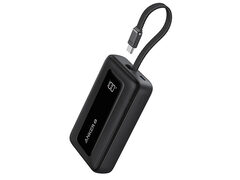
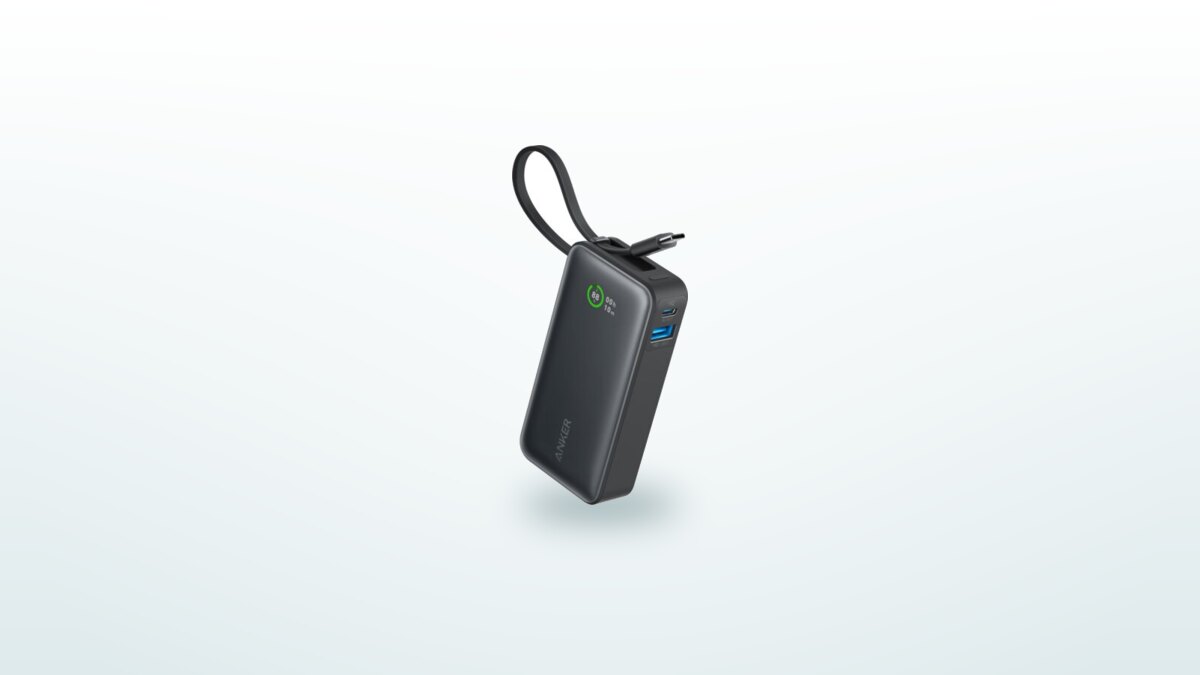
This is the product's central argument, and the subject on which almost every page devoted to it gets things wrong. The USB-C cable, some twenty centimetres of it, is attached to the case, ends in a metal clip, and does not retract. It forms a loop that Anker presents as a carrying handle.
The charge usually laid against it is mechanical wear: the sheath fraying at the flex point, the cable snapping from being bent once too often. That charge does not stand up. The sheath does not fray at the flex point, and the built-in cable registers overwhelmingly as a strength rather than a weakness.
The real failure mode is a different one, and it is genuine: the cable stops conducting, sometimes intermittently at first depending on how it sits, while the battery carries on working. It is an electrical fault, not a break. Cases exist, spread from one week to sixteen months of use, and remain a minority. In one of them, the replacement unit developed the same fault.
One detail says more about the manufacturer's caution than any amount of argument: Anker publishes endurance figures for the cables on other models in its range, in tens of thousands of bends. For this one, no figure is published. And since April 2025 its support portal has carried a page devoted to built-in cables that no longer charge, attached to twelve references including this one. It offers nothing beyond a reset, and never names a cause.
The flaw nobody mentions
A power bank spends most of its life doing nothing at all. That is where this one disappoints, and it is the least documented aspect of its behaviour.
It drains while sitting idle. The loss runs beyond 20 % with no use whatsoever, and starker cases exist: a full charge found at 80 % after three or four days, one unit down to zero in less than a week inside a bag. The colour display, which remains one of the product's strengths, is probably not unconnected to that residual draw.
Nor does it do pass-through charging: plugging a phone into the battery while the battery itself is recharging is not provided for. Anker states as much across its whole range, with a few exceptions that do not include this model.
Recharging it
The device accepts 30 W on input, on the built-in cable as on the USB-C port. A full recharge falls between 90 and 100 minutes, with a peak input recorded at 30.8 W. Half the charge goes back in around 35 minutes, which beats the 45 minutes claimed.
One thing to watch for anyone recharging on the move: once the device has warmed up, the input drops back towards 20 W. Filling it then takes appreciably longer. Nothing abnormal, but it takes some of the point out of a quick top-up during a short stopover.
The box contains neither a mains charger nor a spare cable, only the battery and its manual. At 40 euros, the omission is noticeable.
Earbuds and watches: a hidden function
One complaint comes up regularly: the device refuses to charge earbuds, a watch or a smart ring, or stops after thirty seconds or so. This is not a fault, it is a safety measure: failing to detect a sufficient draw, the battery goes to sleep.
There is a way round it. A trickle charging mode, current-regulated below 0.5 A, is enabled by a double press on the button and bypasses that cut-off. It switches itself off after two hours.
What is inside
The device is seriously assembled: tabs spot-welded onto nickel strips, vulcanised paper over the electrodes, damping foam, thermally conductive adhesive as filler and a temperature probe. Nothing about it is slapdash.
The electronics were also redesigned mid-life. The first version relied on a separate converter and controller; the second gathers everything into a single chip. Two units bought a year apart therefore do not carry the same board, which explains part of the divergence between published figures.
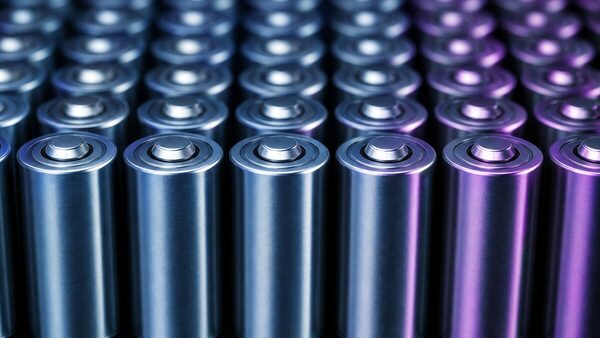
The cells themselves do not change: two 21700 cylindrical units from a Chinese maker, rated for 500 cycles. That is the entry-level figure on the market, where better cells claim double. On a battery recharged twice a week it works out at roughly five years before any noticeable loss of capacity, which stays consistent with the expected use. The case is 80 % recycled plastic.
Recalls and warranty: what to know
Anker recalled several power banks in 2025, two 10,000 mAh models among them, over defective cells from a single supplier. The question therefore arises legitimately, all the more so as this model was on sale over exactly the same period and in the same price bracket.
It is covered by no recall. Not in the United States, not in Germany, not in the United Kingdom, not in France: it appears on no official register of recalled products, nor on the pages the manufacturer devotes to its own recalls.
The manufacturer warranty runs to 24 months on this range, and adds to the legal conformity guarantee. Normal wear is duly excluded, but the clause cites only capacity loss and colour change, never the cable. In practice, the only ground for refusal genuinely seen is the absence of proof of purchase: keep the invoice, it is demanded without exception. One last point worth knowing, the warranty applies in the country of purchase.
Who it suits
This device aims at one particular person: the one who wants a battery that is always ready, with no cable to hunt for, for a day out. On that ground it is hard to fault. The captive cable removes the commonest thing to forget, the display gives exact information instead of four indicator lights, and the efficiency sits above the market average.
It does not suit in three cases. Anyone after the lightest option: 215 grams, where the best cable-free 10,000 mAh models come in at 175 grams, a fifth less. Anyone wanting to charge two devices quickly: 24 W shared at 5 volts is a real limit. And anyone after an emergency battery to forget about: the self-discharge rules it out.
That leaves the price. At around 40 euros, against built-in cable rivals costing distinctly less, you are paying for the display, the finish and the brand. It is defensible, it is not obvious.
Its thickness, on the other hand, does not deserve the suspicion the spec sheet invites. The 26 millimetres sit well above the slim models, but the rounded edges mean the unit settles into a pocket without getting in the way: in use it is the weight you notice, not the thickness.