
25,000 mAh, 90 Wh, 74 Wh: three figures for one battery
On the box, a single number is put forward: 25,000 mAh. In the manufacturer's spec sheet there are two, written one under the other. Total capacity, 25,000 mAh at 3.6 V, 90 Wh. Battery capacity, 5,000 mAh at 18 V, 90 Wh, five cells in series. The same device, the same energy, two ways of counting it.
A milliamp-hour does not measure energy, it measures a quantity of charge. To turn it into energy you have to multiply it by a voltage. The marketing figure uses 3.6 V, the nominal voltage of a single lithium cell. But the A1695 does not have one cell, it has five, 5,000 mAh 21700 units wired in series, which brings the pack to 18 V. At that voltage, the 90 Wh no longer read as 25,000 mAh but as 5,000. Both calculations are correct. Only one describes the device.
This gymnastics is not specific to this manufacturer, and that is precisely the problem. The watt-hours quoted for this category of product are almost never measured: they are the milliamp-hours multiplied by an assumed voltage, which is not the same from one brand to the next. A battery advertised at 25,000 mAh will be declared at 90 Wh by a maker counting at 3.6 V, and at 92.5 Wh by one counting at 3.7 V, without a single cell having changed.
That leaves the question neither figure addresses: how much energy actually reaches the devices? Converting the 18 V down to the 5, 9, 12, 15 or 20 V a device asks for has a cost, and that cost is heat. Over a continuous 27 W discharge, 74 Wh come out of the battery. At 15 W, 70 come out. At 45 W, 76. In other words, between 78 and 85 % of the stored energy makes it through the output, and 82 % is the figure that best represents everyday use.
| Figure | Value | What it describes |
|---|---|---|
| Quoted capacity | 25,000 mAh | The charge held in the cells, counted at 3.6 V |
| Stored energy | 90 Wh | What the pack contains, at its real 18 V |
| Delivered energy | 74 Wh | What reaches the devices, at 27 W |
| Nominal capacity | 15,000 mAh | That same delivered energy, recounted at 5 V |
To its credit, the manufacturer does not hide that loss. Its own European product page states that conversion losses account for 30 to 45 % of capacity, and that a 25,000 mAh battery delivers between 13,750 and 17,500 in practice. The 15,000 mAh measured land exactly in the middle of that range. It is more honest than the sector average, and it makes the A1695 verifiable from end to end, which is rare.
One last word on the 90 Wh, because they decide something else: it is the figure airlines read, and their threshold for a battery carried into the cabin is set at 100 Wh. The A1695 gets through with ten watt-hours to spare, which is not the case for every model quoted around 27,000 mAh.
165 W, and the two conditions that are not on the box
The 165 W are a maximum total, and they come with two conditions the manufacturer documents without ever highlighting them. The first is a matter of number: the battery delivers up to 165 W with two devices connected, and 130 W with three or four. The second is far more restrictive, and it deserves to be known before buying: those power figures are only reachable above 78 % charge. Below that threshold, the battery cuts back on its own what it agrees to supply. The behaviour is deliberate and openly stated.
In other words, the 165 W on the box describe a nearly full battery feeding exactly two devices. As soon as either parameter changes, the figure no longer holds.
| Active outputs | Quoted split | Total |
|---|---|---|
| One USB-C output | 100 W | 100 W |
| The USB-A port alone | 33 W | 33 W |
| Two USB-C outputs | Split dynamically, 100 W maximum per output | 165 W |
| USB-C and USB-A | 100 W and 33 W | 133 W |
| Three or four outputs | 100 W on the priority output, 30 W shared between all the others | 130 W |
It is the last row that counts, and it is far harsher than a simple drop from 165 to 130 W. The remaining 30 W are not comfortably spread across two or three devices: they are divided. The split shows up unambiguously. With three devices connected, the priority output holds 57 W while the other two receive 7 W each. With four, the priority output still holds 57 W and the three others share 7, 12 and 7 W.
What it recharges, and at what pace
On a single output, the figures are excellent. A 16-inch MacBook Pro draws close to 90 W, a Huawei ultrabook climbs to 96 W, and a 15-inch MacBook Air M2 regains 30 % of its battery in 21 minutes at 70 W. That is the throughput of a laptop mains charger: the battery does not keep the machine waiting, it feeds it at full speed. It is exactly what separates this category from the 20 W packs carried around for a phone.
| Device | Power recorded | Charge regained | Time |
|---|---|---|---|
| Huawei MateBook X Pro | 95.7 W | not recorded | not recorded |
| MacBook Pro 16-inch | 89.9 W | not recorded | not recorded |
| MacBook Air M2, 15-inch | 70 W | 0 to 30 % | 21 minutes |
| iPhone 16 Plus | 33 W | 0 to 50 % | 26 minutes |
| OnePlus 12 | not recorded | 0 to 57 % | 32 minutes |
| realme GT5, on the USB-A port | 23.1 W | not recorded | not recorded |
The downside arrives quickly. Half an hour at 70 W draws 35 Wh, close to half of the 74 Wh actually available. The A1695 is not a battery you empty slowly, it is a battery you empty hard: pushed to its maximum, it lasts two to three hours, not a day. On paper it recharges a modern smartphone four times; kept for a laptop, it manages one full charge and a good half of the next.
One useful clarification on the 100 W per output. The power drawn peaks around 96 W, right up against the ceiling, the gap coming down to cable losses and to the measurement itself. A sustained 100 W discharge, on the other hand, does not hold over time, since the battery limits itself to around 65 W once its reserve falls below a quarter.
The USB-A port, the one output that does not keep up
Three 100 W USB-C outputs, one 33 W USB-A port. The gap is written in black and white in the spec sheet, and it shapes how the device is used: the USB-A port will never recharge a laptop at the pace of the other three. On a battery sold to feed four devices, the fourth socket is therefore not the equal of the ones before it.
That said, 33 W over USB-A is nothing ordinary. Most such ports stop at 18 W, and several of the A1695's direct rivals do no better. This one accepts a 5 to 11 V profile at 3 A, which puts it on a level with the fastest phone chargers. For a phone, a tablet, a controller or a camera, it holds nothing back at all.
Above all it renders a service the USB-C outputs do not. A double press on the button switches the battery into trickle-charge mode, meant for devices that draw too little to be detected: wireless earbuds, trackers, smartwatches. Without that mode, the battery assumes nothing is connected and goes to sleep after a few seconds. It is a detail, but it is the kind of detail that decides whether a power bank is kept or sold on.
Two built-in cables, only one rewinds
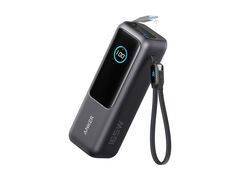
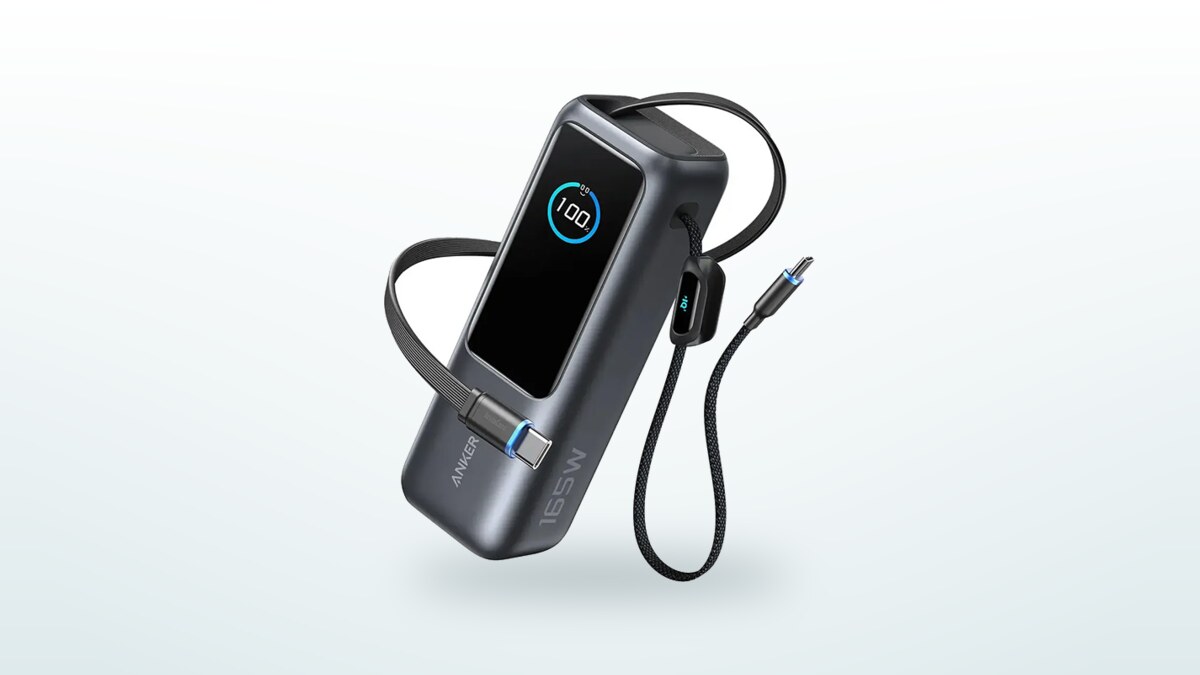
This is the product's central argument, and it holds up. Two USB-C cables are attached to the case: nothing left to carry, nothing left behind at the office, nothing to untangle at the bottom of a bag. Both run to 100 W, so they are genuine fast-charging cables and not stopgap appendages. On a battery meant to feed a laptop, that is a real daily gain, and it is what sets it apart from most of its rivals, which offer none at all.
One nuance deserves to be known before buying. The product name speaks of built-in and retractable cables, plural for the cables and singular for the mechanism, and that is accurate. The first cable unwinds to 70 cm and rewinds itself into its housing, an automatic reel set in a screwed enclosure, with a magnetic ring that holds the plug in place. The second unfolds but does not retract: it has to be pushed back into its channel by hand, and it doubles as a carrying strap.
That leaves the mechanics, and the question is a serious one. A spring-loaded reel is a moving part in a device that has no other, and statistically that is where such a product ends up giving way. The manufacturer quotes more than 20,000 retractions for the cable and as many folds for the strap, but those are claimed figures, and the A1695 is too recent for any long-term usage history to exist. Above all, neither cable can be replaced: if one fails, the whole device is lost.
Recharging itself: 1 hour 57 minutes, never 100 W
The input accepts up to 20 V at 5 A, which is 100 W, and the manufacturer quotes a full charge in two hours at that power. The measured result is slightly better than the promise, but the path to it looks nothing like what the figure suggests.
Input power peaks at 92 W, never 100, and it only holds that level for 22 minutes. It then falls back to 50 W and stays there until around the eightieth minute, before tapering off to the end. The battery reaches 50 % in 39 minutes, 80 % in 1 hour 13 minutes, and a full charge in 1 hour 57 minutes. This is not a flaw but the normal behaviour of a lithium pack, whose acceptable current falls as cell voltage rises.
A less intuitive point is worth flagging: the three USB-C inputs do not add up. If several power sources are plugged in at the same time, the battery keeps the most powerful one and ignores the others. Plugging in two 60 W chargers does not give 120 W at the input, it gives 60. Pass-through charging, on the other hand, works very well: the battery accepts around fifty watts at the input while feeding devices.
595 grams, and what they buy
595 g for 157 × 54 × 49 mm: a thick bar, noticeably closer to a large food tin than to a phone. No jacket pocket takes it properly, and it has to be bought in full knowledge of that. It is a bag object, and it is the number one complaint that can be made about it.
Set against the energy it carries, that works out at about 151 Wh per kilogram, casing, cables and electronics included. The figure looks harsh in isolation, and not at all once put back in its group: batteries of comparable capacity and power weigh between 565 and 630 g, and the A1695 sits in the lower half of that range.
| Model | Weight | Total output | USB-C outputs | Attached cables |
|---|---|---|---|---|
| Anker A1695 | 595 g | 165 W | 3, at 100 W | 2, one of them retractable |
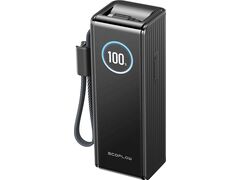
| EcoFlow Rapid 25K | 565 g | 100 W | 2, at 100 W | 1, retractable |
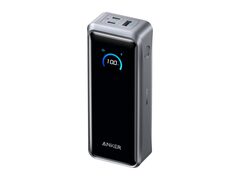
| Anker Prime 26K | 600 g | 300 W | 2, at 140 W | None |
| Ugreen Nexode 25K | 609 g | 200 W | 2, at 140 W | None |
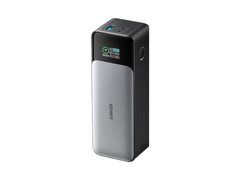
| Anker 737 | 630 g | 140 W | 2, at 140 W | None |
The table reads clearly. The A1695 is neither the most powerful nor the lightest, but it is the only one to combine three 100 W USB-C outputs with two cables attached to the case. What its grams buy is not a record: it is having no cable to carry at all. The trade is excellent for anyone recharging a laptop on the move, questionable for anyone recharging only a phone, in which case a battery half the weight will do the job just as well.
The display, and the admission it contains
The display shows what is expected at this level: the remaining percentage to one decimal place, the time left to a full charge, an input arrow, an output arrow, and a double arrow when the battery recharges while feeding a device. It also shows the power output by output, which makes it possible to see at a glance which of the four devices is monopolising the available budget, along with the cell temperature and the number of cycles already completed. Several of these readouts serve a very concrete diagnosis: a failing cable shows up immediately in the power reported on the matching port.
Above all it flags three states most batteries keep to themselves. Active cooling mode indicates that the temperature is rising and that power has been deliberately reduced to bring it back down. Temperature protection mode goes further: beyond a certain threshold, towards hot as much as towards cold, the device suspends operation until things return to normal. Circuit protection, finally, asks you to unplug and plug the connected device back in.
And then there is the last message, the one worth knowing before buying rather than after: low battery health. It appears when cell capacity falls below 60 % of its original value. No power bank escapes ageing, almost none tells its owner. This one gives warning. That obviously does not slow the wear down, but it marks the point where you stop relying on it for a long-haul flight, and that is information nearly the whole market prefers to keep quiet.
What is inside, and what can be repaired
Inside sit five 5,000 mAh 21700 cells wired in series, two stacked circuit boards, a combined buck and boost converter, a dedicated microcontroller, a primary protection circuit, a secondary one, and a fuel gauge. The nickel tabs are spot welded, the foam and kraft paper insulators are in place, and so is the thermal gap filler. It is a serious assembly: ripple never exceeds 45 millivolts peak to peak, under load or at rest, which is very clean for a device of this type.
The counterpart is twofold. The assembly is heavily glued and is not designed to be opened: the device is not repairable. And since neither cable is removable, the failure of one of them is permanent. The unit stays usable, its three USB-C ports and its USB-A port being independent of the cables, but the very argument that justifies its price is lost. On a product costing as much as three ordinary power banks, that is worth factoring in.
On the thermal side, the front surface reaches 45.7 °C after thirty minutes of continuous discharge at 100 W. That is hot without being alarming, and the battery protects itself: it cuts its power back when the temperature rises, and suspends operation below 0 °C as well as above 35 °C ambient. With no air circulation around the device, a sustained 100 W discharge can trigger that shutdown. In normal use, on a table or in an open bag, the case does not arise.
One case is an exception, and it is worth knowing about before buying. On one unit, a cable failure damaged the mainboard of the laptop it was powering: charging became impossible, the machine forced a restart after a minute of use, and the graphics cores were left unusable. No recall followed, and this model appears on no official register of recalled products.
Against the other 25,000 mAh batteries
The group is tight: five or six models quote between 24,000 and 27,000 mAh, weigh between 565 and 630 g and target the same use, recharging a laptop away from a socket. They separate on three criteria, and the A1695 wins on one, loses on another and sits in the middle of the third.
| Criterion | Anker A1695 | Anker Prime 26K | Ugreen Nexode 25K | Anker 737 |
|---|---|---|---|---|
| Quoted capacity | 25,000 mAh | 26,250 mAh | 25,000 mAh | 24,000 mAh |
| Declared energy | 90 Wh | 99.75 Wh | 90 Wh | 86.4 Wh |
| Measured energy delivered | 74 Wh | 85.7 Wh | 74.6 Wh | not measured |
| Quoted total output | 165 W | 300 W | 200 W | 140 W |
| USB-C outputs | 3, at 100 W | 2, at 140 W | 2, at 140 W | 2, at 140 W |
| USB-A port | 33 W | 22.5 W | 18 W | 18 W |
| Attached cables | 2, one of them retractable | None | None | None |
| Maximum input | 100 W | 250 W | 140 W | 140 W |
| Manufacturer warranty | 18 months | 24 months | 24 months | Not published |
The most interesting row is delivered energy, because it is the only one resting on a measurement rather than on a claim. The A1695 and the Nexode return the same thing, 74 Wh, and the Prime 26K takes a ten watt-hour lead with a bigger pack. The differences in declared energy, on the other hand, are largely artificial: they depend on the voltage each brand picks to convert its milliamp-hours.
On raw power the A1695 is beaten: the Prime 26K quotes 300 W and the Nexode 200 W. But those two models concentrate their power on two outputs, where the A1695 offers three. For anyone plugging in two devices the comparison tightens considerably, since all three quoted totals rest on equally favourable conditions.
On its own recharge, by contrast, the A1695 is clearly behind. Its theoretical 100 W input, reduced to 90 W at the peak and 50 W on the plateau, makes it the slowest of the group, a long way from the Prime 26K, which fills in under an hour. On a trip where a single stopover is all you get to fill up, the gap is felt.
On cables, finally, there is no comparison to be made: it is the only one in the group to attach two to the case. That is its reason for being, and none of the other three matches it on that ground.
Who it suits, and who it does not
It suits anyone working away from a socket, on a laptop, who hates hunting for a cable. That is a very precise profile, and for it the A1695 is close to ideal: it recharges a machine at the pace of its original charger, it feeds a phone at the same time, and it asks for nothing more than to be slipped into a bag. Its 90 Wh let it through into the cabin without discussion, which counts for anyone who flies often.
It also suits anyone who wants a battery that tells the truth about its own condition. The health alert below 60 %, the cycle counter and the temperature readout change nothing about performance, but they head off the classic scenario of the battery you believe is full and that gives up halfway through after three years.
It does not suit anyone counting on feeding three or four devices seriously. The split of 100 W on the priority output and 30 W shared across all the others makes it a poor power strip, and two laptops at once are beyond its reach. Nor does it suit anyone who only ever recharges a phone: 595 g and 49 mm of thickness for a device asking 20 W is out of proportion, and a battery three times lighter will render the same service. Nor anyone wanting wireless or magnetic charging, since the A1695 has neither.
Finally, it will suit poorly anyone who needs to fill it fast and often. Close to two hours for a full charge, and only on condition of carrying a powerful charger, is the point on which several rivals do appreciably better. If the pace of your travel means filling up in an hour, look elsewhere, even at the cost of giving up the built-in cables.