
What the 2048 Wh base capacity is really worth
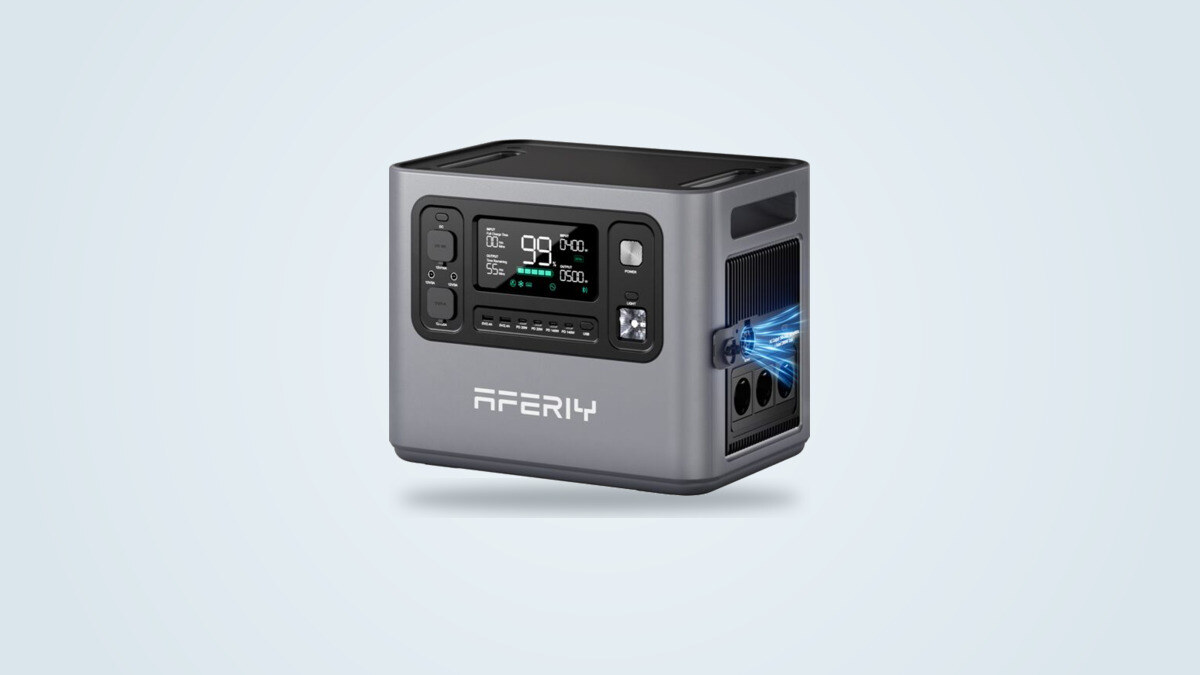
The Aferiy P280 ships with a 2048 Wh LiFePO4 battery as standard, rated for over 4000 cycles at 80% remaining capacity, roughly a decade of everyday use. As with any station built around an inverter, the capacity printed on the spec sheet is not what actually reaches the socket: some of it is lost converting DC to AC.
Under a continuous load near 200 W, the unit returns around 1740 Wh, about 85% of the rated capacity. The same ratio shows up at 2000 W, ten times more: 1760 Wh returned, 85.9%. The usable share barely moves between a light load and a heavy one, which isn't always true of stations this size, where efficiency can drop noticeably below a few hundred watts.
Fully recharging the battery from the mains takes about 2250 Wh at the meter, for a round-trip efficiency of roughly 77 to 78%, an average figure for the category rather than an exceptional one. On operating conditions, the manufacturer recommends charging between 0 °C and 45 °C, and advises against operating or storing the unit below -10 °C or above 45 °C, a wide enough range for outdoor use across most of the year in Europe.
How far the 10.24 kWh expandability really goes
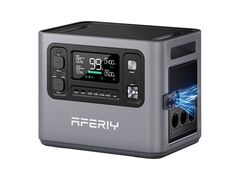
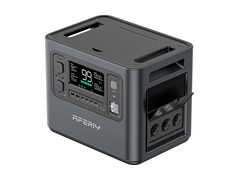
The P280 is the first Aferiy station to accept expansion batteries: up to four P280-B units of 2048 Wh each connect in parallel, bringing total capacity to 10.24 kWh without swapping the main unit. The P210, its direct predecessor, shares the same footprint and a similar power rating (2400 W) but stays fixed at 2048 Wh, with no expansion option at all.
This 10.24 kWh ceiling matches the best expandability available at this price point. The trade-off is budget: each expansion battery is sold separately from the base unit, a cost to plan for from the outset if the goal is to reach maximum capacity, rather than growing the system gradually as real needs emerge.
This changes the nature of the purchase itself: instead of picking one fixed capacity for the next decade, buyers start with 2048 Wh and grow the reserve as the use case becomes clearer, whether that means securing an entire home or fitting out a van for progressively longer trips.
The 90 minute recharge claim, and what it actually takes
On paper, the P280 charges from 0 to 80% in 55 minutes and reaches 100% in about 90 minutes, thanks to a mains input rated up to 1800 W. In practice, that last stretch takes longer.
A full mains recharge takes between 112 and 115 minutes, against a 90 minute spec sheet figure, about 25% longer. The 80% mark follows the same pattern: 65 to 70 minutes instead of the stated 55. The station still charges fast in absolute terms for a 2 kWh unit, most direct rivals needing several hours for a full top-up.
On the solar side, two independent XT90 MPPT inputs accept up to 600 W each, 1200 W combined, a generous allowance at this price that lets two panels face different directions at once. Combining mains and solar at the same time gets closer to the manufacturer's headline recharge figure, but that requires both sources available together and close to ideal sunlight, a condition rarely met in everyday use.
2800 W continuous on paper, not past 2600 W in practice
The spec sheet lists 2800 W continuous and up to 5600 W peak, generous figures for a station this size. Two less visible ceilings temper that headline.
The second ceiling concerns UPS mode, the automatic mains-to-battery switchover in under 10 ms: the manufacturer itself caps admitted power at 2400 W on 230 V, 1800 W on 120 V and 1500 W on 100 V, below the 2800 W continuous rating promoted elsewhere on the spec sheet. A high-power appliance plugged in for home backup could therefore trip overload protection where the 2800 W label suggested more headroom.
Neither case is a defect that stops the unit from working: it keeps powering the load, just with a real margin somewhat narrower than the marketing suggests.
Noise under load, far from the claimed 25 dB
The spec sheet advertises a 25 dB noise level, a very low figure that clearly corresponds to idle operation, fan off.
Once the fan spins up under full load, noise at one metre climbs to 43-48 dB depending on the power drawn, comparable to a quiet conversation or a fridge running nearby. That's not excessive for a station this powerful, but the gap with the spec sheet's 25 dB is real and worth knowing before buying, especially for night-time use as home backup or in an RV where quiet matters more than during the day.
The app is the weakest link
Control runs through a Bluetooth and WiFi mobile app, an onboard LCD screen, and the UPS function that switches to battery in under 10 ms during a mains outage, fast enough to keep a computer or a router running.
On iOS, the app struggles to hold a stable Bluetooth connection. On Android, it works but feels basic, and the German localisation is rough around the edges. Neither issue stops the unit from working on its own, screen, physical buttons and outlets remain directly usable, but anyone planning to control the P280 remotely from an iPhone should factor this in before buying.
Real-world use: backup power, RVs, workshops
Over time, the unit recharges the equivalent of three 625 Wh e-bike batteries from a near-full charge down to about 12% remaining, a solid runtime for regular e-bike charging. A compressor cooler runs for several days straight during family camping on the 2048 Wh base capacity alone, and a standard corded chainsaw runs normally off it, confirming the pure sine wave output plays well with everyday power tools.
For home backup, the 2800 W continuous rating, 2600 W in practice past the threshold covered above, comfortably covers a fridge, a freezer, a router and lighting, and an induction hob or an oven also work. Expandability up to 10.24 kWh changes the scope of that backup: from a few hours for one appliance, it stretches to several days for an entire household once batteries are added. In an RV, the 398 x 280 x 315 mm footprint and 21.6 kg weight point to a fixed spot rather than daily carrying, but the two independent solar inputs and the 25 A XT60 port, handy for fast-charging external packs, make it a solid base for a van setup that needs to grow over time.
Against the P210 and the market's benchmarks
At a price matching or undercutting most rivals in its class, the P280 sits as the bridge between the P210, cheaper but fixed at 2048 Wh, and the market's leading expandable stations.
| Criterion | Aferiy P280 | Aferiy P210 | EcoFlow Delta 3 Max Plus | Bluetti AC200L |
|---|---|---|---|---|
| Capacity | 2048 Wh (expandable to 10.24 kWh) | 2048 Wh (not expandable) | 2048 Wh (expandable to 10.24 kWh) | 2048 Wh (expandable to 8192 Wh) |
| Continuous / peak power | 2800 W / 5600 W | 2400 W / 4800 W | 3000 W / 6000 W | 2400 W / 7200 W |
| Max solar input | 1200 W | 500 W | 1000 W | 1200 W |
| Warranty | 7 years | 7 years | 5 years | 5 years |
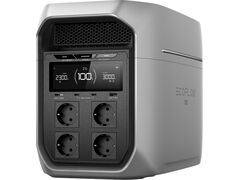
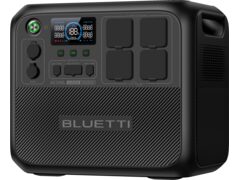
The P280 matches the EcoFlow Delta 3 Max Plus on maximum capacity (10.24 kWh) and the Bluetti AC200L on solar input (1200 W), while keeping the 7-year warranty that sets Aferiy apart from both, each limited to 5 years. The EcoFlow wins on rated continuous power and the Bluetti on extreme peak power, but neither comes close to the P280's price.
Build quality, reliability and warranty
No hardware failure stands out on this unit, including after several months of real-world use. The LiFePO4 battery is rated for over 4000 cycles at 80% remaining capacity, and the manufacturer backs it with a 7-year warranty, two years longer than the EcoFlow Delta 3 Max Plus and Bluetti AC200L mentioned above.
The unit carries no official IP rating against dust or water, a common gap at this price point and partly offset by a protective cover over the mains outlets. For regular outdoor use, on a job site or exposed campsite, that absence is worth weighing alongside the 21.6 kg weight, which points to a fixed spot rather than daily carrying.
Who the P280 is for, and who should look elsewhere
The P280 is built first for buyers who want a power reserve that grows over time: a household starting with 2048 Wh of home backup and adding batteries as needs grow, or a fitted-out van that needs to cover progressively longer off-grid stretches. The dual solar input and the XT60 port also make it a sound choice for anyone regularly recharging external packs or e-bikes.
It suits buyers less well who need flawless peak power down to the last watt, since the real ceiling sits closer to 2600 W than 2800 W, who plan to control the unit exclusively from an iPhone, or who need total silence during fast charging, say for night-time backup in a bedroom. For serious home backup or a van setup meant to grow over time, without expecting the label's numbers down to the last watt, it delivers on the promises that matter most.