
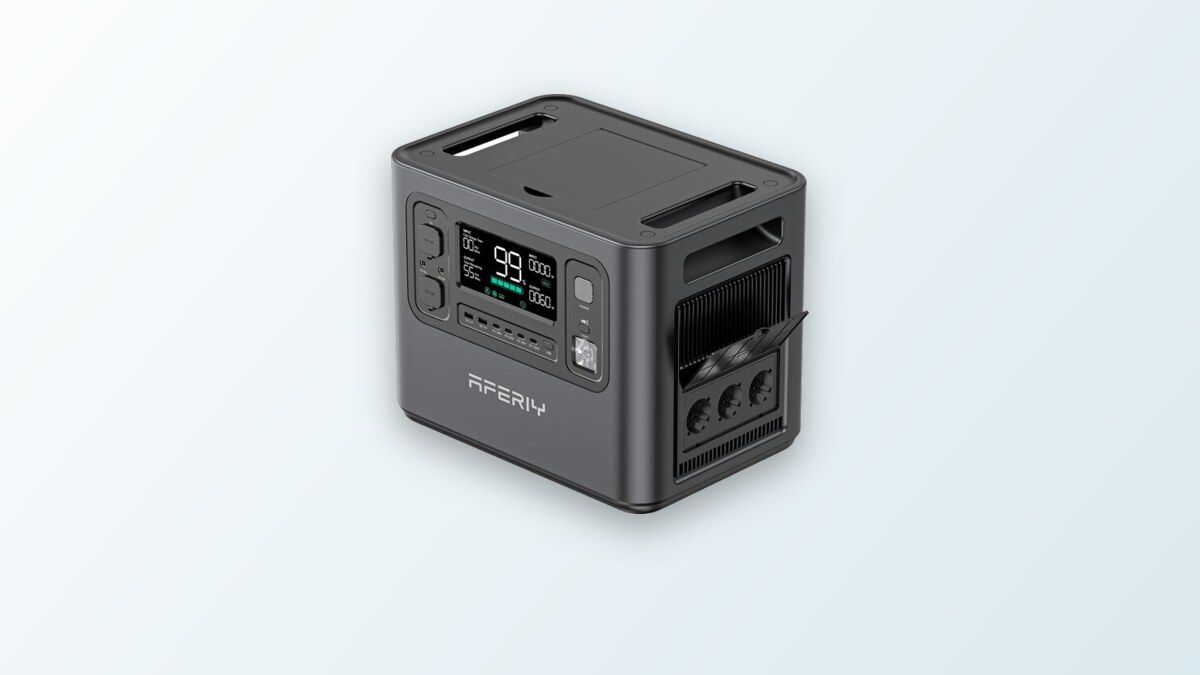
On paper: an aggressive capacity-to-price ratio
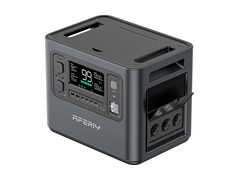
With 2048 Wh of LiFePO4 capacity and an output of 2400 W (4800 W peak) at a price well below the market's established benchmarks, the Aferiy P210 plays a clear card: offering the same capacity as pricier stations for a tighter budget. The connectivity follows suit: 3 mains sockets, 4 USB-C ports including one at 100 W, 2 USB-A ports, a cigarette lighter socket and an XT60 port.
The most serious point in this review: a voltage drop under sustained load
Under a load close to the inverter's limit, output voltage drops from 120 V to 85.2 V instead of triggering a clean safety cutoff. This behaviour, a system that degrades voltage rather than cutting power, exposes connected devices to a risk rather than a simple loss of power. This is not an isolated case within the range: a related model shares a trait from the same family, a limit on output power that engages under sustained load with no setting available to disable it.
Elevated temperatures also occur on certain internal components of this same related model under sustained use, with a regulator that appears not to limit current as strictly as its specification states. These points do not all directly concern the P210 itself, but they outline a profile of caution worth knowing before prolonged full-load use.
Real efficiency: around 77 to 78 %
Under a 2245 W load, the runtime advertised by the device was 55 minutes, against 43 minutes actually achieved, giving an efficiency of around 78 %. On a related model in the same range, the output measured under continuous discharge falls to around 85 % of the advertised capacity, for a combined charge-plus-discharge efficiency of around 77 %. These two figures, obtained under different protocols and on similar models, converge on the same range: real efficiency below the category's usual standards, rather than the 86 % sometimes claimed without a described measurement protocol.
The 7-year warranty: a figure that needs clarifying
The 7-year figure, heavily promoted, does not apply automatically from the moment of purchase. The manufacturer's official documentation sets a base period of 24 months, and the extension up to a total of 7 years requires online product registration. The exact length of the base period is not clearly established, ranging from 2 to 5 years before the extension depending on the case: a grey area worth clarifying before relying on it.
Another piece of context: the P210 has been on the market for a little over two years. No one has therefore yet been able to verify how this warranty behaves at the end of its term, or even in its later stages. This is not a negative signal in itself, only a reminder that the promise has not yet been proven over time.
Noise level: a figure impossible to establish
The figures available for this model range from 16 to 55 dB, a spread far too wide to draw a credible value from. No comparable measurement protocol accompanies these figures. The real noise level of the P210 therefore remains unknown, neither reassuring nor worrying in the absence of reliable data.
Connectivity and app: generous on one side, reported bugs on the other
Connectivity remains a genuine strength: four USB-C ports including one at 100 W, two USB-A ports, a cigarette lighter socket, an XT60 port and three mains sockets cover a wide range of needs. The control app, on the other hand, shows signs of immaturity on a related model in the same range: the iOS app fails to connect over Bluetooth, while the Android version works but with French localisation that could be improved. App support itself appears to have been added after the product's initial launch rather than being present from the start.
The price actually seen on the market
The official price is listed at 739 € (against a reference price of 1169 €), but the price actually seen on the market tends to vary between 650 and 750 € depending on the retailer, the period and promotional codes, with the occasional refurbished offer dropping to around 580 €. No price history spanning several months is available for this model, which makes it harder to distinguish a genuine bargain from an everyday price.
Who it suits, and who it does not
It suits anyone looking for 2 kWh of LiFePO4 at the best possible price, willing to stay cautious with loads close to maximum power, and ready to take the time to register the product to benefit from the extended warranty.
It does not suit anyone planning to regularly draw on its peak power under sustained loads, nor anyone who values above all the peace of mind of a long-established brand with a well-documented track record for reliability.