
Xtorm XR203
(3 reviews)
The Xtorm XR203 promises a rugged IP65 power bank with 10,000mAh and a built-in solar panel, but its solar charging disappoints in testing and reviews.
Buy at AmazonAs an Amazon Associate I earn from qualifying purchases.
Characteristics
- Capacity: 10,000 mAh (37Wh)
- Power: 20W max (USB-C PD)
- Water resistance: IP65 (shocks, dust, water)
- Outputs: 2 USB-C + 1 USB-A (3 devices)
- The toughest of Xtorm's solar power banks (IP65)
Detailed overview: Xtorm IP65 10,000 mAh solar power bank
The Xtorm XR203 (Rugged Series) is a 10,000mAh outdoor power bank built to take a beating. IP65 rated, it resists shocks, dust and water splashes, a step up from the IPX4 rating of the Xtorm XR104, its older and cheaper sibling in the brand's line-up.
On the charging side, it delivers up to 20W over its USB-C Power Delivery port (18W on input), backed by a second 15W USB-C port and an 18W USB-A Quick Charge 3.0 port, for three outputs usable at the same time thanks to pass-through charging. A full charge over USB-C takes about 2.5 hours.
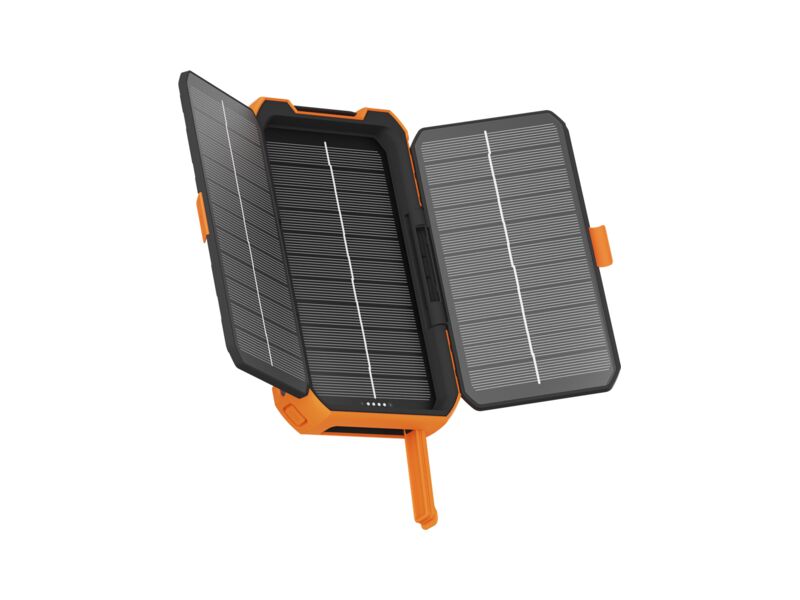
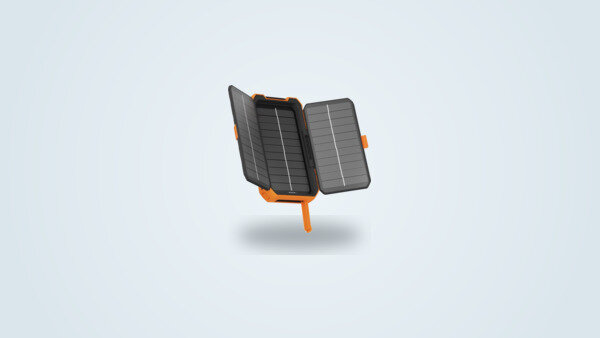
Its headline feature is a foldable, three-panel Gen'24 solar array, with a built-in kickstand to angle it towards the sun and a dedicated indicator light to check whether there's enough sunlight. On paper, Xtorm claims a full solar charge in 12 to 14 hours of direct sun. In practice, this is the main sore point flagged by many verified customers on Amazon (UK, France, Germany): several users report extremely slow solar charging, sometimes close to zero gain even after repeated multi hour sessions in full sun over several days. One French buyer even describes a unit he believes is faulty, since the solar function produced no measurable effect at all. We recommend treating the panel as an occasional emergency top-up rather than a real charging method, and relying on USB-C for a fast, reliable full charge.
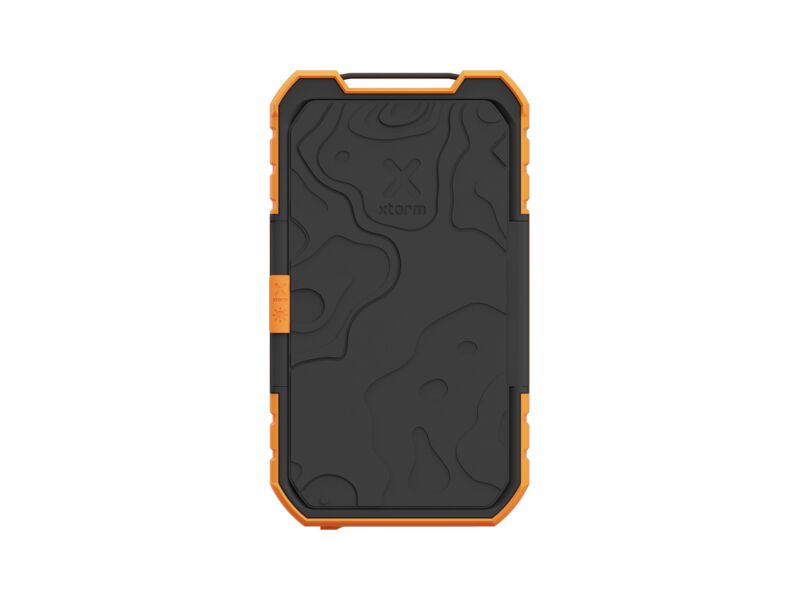
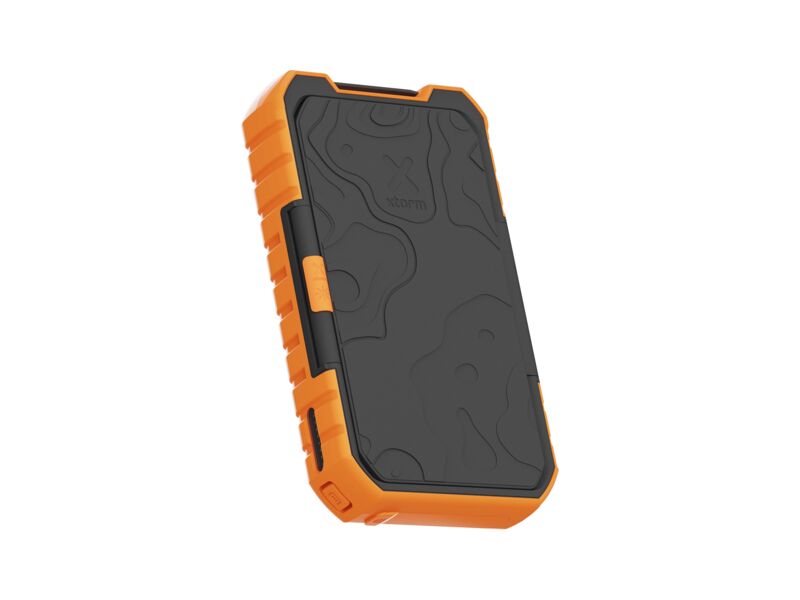
The recycled plastic and TPU shell also houses a built-in torch and a carabiner for clipping onto a backpack. At 506g and 166 x 95 x 27mm, the XR203 stays portable without being discreet, thanks to its distinctive orange colour designed to stand out in a bag or tent. Its 10,000mAh (37Wh) battery recharges a smartphone roughly twice, and stays well under the 100Wh limit generally allowed in aircraft cabins. For hiking, cycling or camping, it's a rugged and versatile power bank, as long as you don't rely on the sun to recharge it in the field.
Full specifications
Detailed characteristics (EAN: 8718182277685)
Battery
| Rated capacity?Cell capacity in milliamp-hours, as stated by the manufacturer. | 10000 mAh |
|---|---|
| Actual energy?Actual stored energy in watt-hours; what matters for runtime and air travel (100 Wh cabin limit). | 37 Wh |
| Battery chemistry?Cell type; LFP lasts longer, Li-ion/LiPo is lighter. | LiPo |
Output (device charging)
| Max output power?Maximum total power delivered; above 60 W it can charge a laptop. | 20 W |
|---|---|
| USB-C ports?Number of USB-C ports and the fastest port's power. | 2 × 20 W |
| USB-A ports?Number of USB-A ports and maximum power. | 1 × 18 W |
| Fast-charge protocols?Supported fast-charge standards (PD, QC, PPS…); PD/PPS is the most universal. | USB PD, QC 3.0 |
| Wireless charging (Qi)?Inductive charging of a phone placed on top, and its power. | No |
| Magnetic attachment (MagSafe)?Attaches magnetically to the back of a MagSafe-compatible iPhone. | No |
Recharging the power bank
| Recharge power (input)?Maximum input power to recharge the power bank; higher means faster. | 18 W |
|---|---|
| Recharge time 0-100%?Time to fully recharge the power bank. | 150 min |
| Pass-through charging?Can charge a device while being recharged itself (pass-through). | Yes |
Cable and interface
| Built-in cable?A cable is permanently attached to the power bank (nothing extra to carry). | No |
|---|---|
| Retractable cable?The built-in cable retracts into the housing. | No |
| Cable included?A cable is included in the box. | No |
| Display?Level display: simple LED indicators or a digital screen (%, watts). | LED indicators |
| LED light?Built-in LED torch / light. | Yes |
Form factor
| Weight?Weight of the power bank, in grams. | 506 g |
|---|---|
| Dimensions (L × W × D)?Length × width × depth, in millimetres. | 166 × 95 × 27 mm |
Availability and warranty
| Warranty?Length of the manufacturer's warranty. | 2 years |
|---|
⚡ How many charges with this power bank?
With 37 Wh of capacity, the Xtorm XR203 power bank recharges iPhone 16 ~1.9 times or Samsung Galaxy S25 ~1.7 times.
| Smartphone | Charges |
|---|---|
| iPhone 14 | ~2.1 |
| iPhone 16 Pro | ~1.9 |
| iPhone 15 Pro Max | ~1.6 |
| Google Pixel 10 | ~1.4 |
| Tablet / console | Charges |
|---|---|
| iPad mini (A17 Pro) | ~1.4 |
| iPad Pro (M5) | ~0.9 |
| Xiaomi Pad 7 | ~0.8 |
| Asus ROG Ally X | ~0.3 |
Rough estimate: real-world losses (conversion, cable, heat) are around 25 to 35%.
Comparison
Around £70 to £90, the Xtorm XR203 goes up against several outdoor power banks that shoppers search for with queries like "best solar power bank" or "rugged waterproof power bank". Here's how it compares with three alternatives: the Xtorm XR104, its own older and cheaper sibling; the Elecom Nestout 10000, a direct rival that's tougher but skips solar entirely; and the Dexnor 27000, far bigger on capacity and power.
| Criterion | Xtorm XR203 | Xtorm XR104 | Elecom Nestout 10000 | Dexnor 27000 |
|---|---|---|---|---|
| Capacity | 10,000 mAh (37Wh) | 10,000 mAh (37Wh) | 10,000 mAh | 27,000 mAh |
| Max power | 20W (USB-C PD) | 20W (USB-C PD, QC 3.0) | 20W (USB-C PD) | 65W (PD 3.0, QC 3.0) |
| Built-in solar panel | Yes, 5.1W tri-fold | Yes, ≈ 1.2W fixed | No | Yes |
| Water resistance | IP65 | IPX4 | IP67 | Not specified |
| Observed price | ≈ £70 to £90 | ≈ £50 | ≈ £70 | ≈ £80 |
In summary, the Xtorm XR203 stands out with its IP65 rating, the highest in Xtorm's own line-up, and a noticeably larger tri-fold solar panel than the XR104's. The Elecom Nestout 10000 is still better sealed on paper (IP67) and cheaper, but drops solar entirely. The Dexnor 27000 wins comfortably on raw capacity and charging power, for more versatile everyday use. The XR104, Xtorm's entry point, remains the most affordable option if solar isn't a deciding factor. Either way, it's best to treat the solar feature as a backup top-up rather than a genuine charging method, whichever model you pick.
Our tester's review: Guillaume Hoarau
The Xtorm XR203 won us over on paper: IP65 rating, foldable solar panel, kickstand, torch, three outputs including a 20W USB-C. In real use, wired charging keeps its promises: a full USB-C charge takes about 2.5 hours, and the three ports handle several devices at once without a hitch. The build feels reassuring too, with a rubberised shell that shrugs off knocks. The serious catch concerns the very feature that gives the product its name: solar charging. Digging through verified customer reviews on Amazon UK, France and Germany, the same complaint keeps coming back: solar charging is disappointing, sometimes close to useless. One German buyer measured several 6 hour sessions in full sun without gaining a single visible charge point. A French customer sent the unit back entirely, convinced it was faulty. This clearly isn't an isolated case. Our take: buy the XR203 for its IP65 toughness and versatile USB charging, not for the solar panel, which stays a token extra far more than a genuinely useful feature in the field.
In-depth review Xtorm XR203: our full review 3.7/5 Read our full review → Capacity and runtime 3.6 Output power 3.9 Size and weight 3.4 Ports and cables 3.8 Recharging 3.5 Build and endurance 4.0Frequently asked questions: Xtorm IP65 10,000 mAh solar power bank
Based on our research and many verified customer reviews (UK, France, Germany), solar charging is very slow, sometimes close to zero even after several hours of full sun. Treat it as an occasional backup, not a primary charging method: rely on USB-C for a fast, reliable full charge.
About 2.5 hours over USB-C (18W input). Xtorm claims 12 to 14 hours of direct sunlight for a full solar charge, but our research shows this figure is rarely reached in real conditions according to many customer reports.
Yes, it's IP65 rated: resistant to shocks, dust and water splashes, a step up from the older Xtorm XR104 (IPX4). This rating doesn't cover full immersion though, it isn't designed to be submerged.
With 10,000mAh (about 37Wh), the XR203 recharges most smartphones roughly twice depending on their battery size, enough for a weekend away from a mains socket.
Yes. At about 37Wh, it stays well under the 100Wh limit generally allowed in aircraft cabins by most airlines, with no special approval needed.
Need help choosing?
Other products in the "Solar power banks" category
Blavor Solar Power Bank 20000
See price (36)
A rugged 20,000 mAh outdoor power bank with 4 foldable solar panels, 18 W USB-C, 2 USB-A, a camping light and an IPX5 casing, built for the outdoors.
elzle Solar Charger 26800
See price (32)
A rugged 26,800 mAh outdoor power bank from elzle: 4 foldable solar panels, 15 W USB-C, a 4-mode LED torch and an IPX5 casing for adventure.
Xtorm XR104
See price (4)
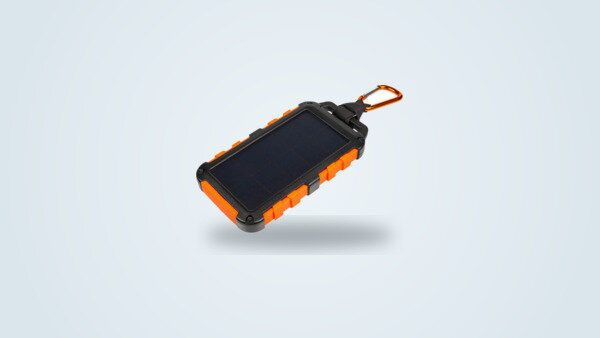
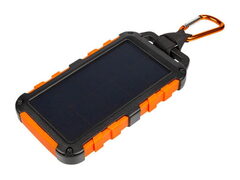
A rugged 10,000 mAh power bank with a built-in solar panel, LED torch and 3 USB outputs, designed for hiking and camping.
Published on 30/08/2026