
What the 10,000 mAh (37 Wh) are really worth
The Xtorm XR203 lists two figures on its spec sheet: 10,000 mAh, and 37 Wh. The first is the total charge of the lithium-polymer (LiPo) cells that make up the pack, counted at a voltage close to 3.7 V. The second is the energy it actually represents, the figure that lets you compare two batteries of different voltages. The LiPo chemistry used here is more energy-dense per kilogram at the cell level than the lithium iron phosphate (LiFePO4) found in some of the catalogue's larger power stations, but it generally tolerates fewer full charge cycles before losing capacity. Xtorm does not publish a guaranteed cycle count for the XR203, only a warranty period (covered later in this review).
This 37 Wh figure puts the XR203 among the smallest capacities in its own Best Batteries sub-category: the three other solar power banks compared later in this review all offer a higher capacity, up to 99 Wh for the most generous. In practical terms, 37 Wh recharges most smartphones about twice depending on their own battery size, enough for a weekend hike away from a wall outlet.
No independent measurement of the energy the XR203 actually delivers once conversion losses are accounted for is available for this specific model: that figure, documented on other references in the catalogue, is missing here. What can be stated without reservation, though, is that its nominal 37 Wh stays very comfortably under the 100 Wh threshold generally allowed in aircraft cabins without special paperwork, a practical point for anyone taking it travelling.
The solar panel: from 12 hours to more than 45, and why
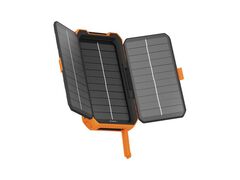
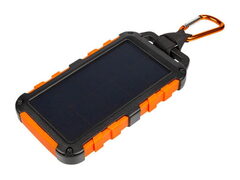
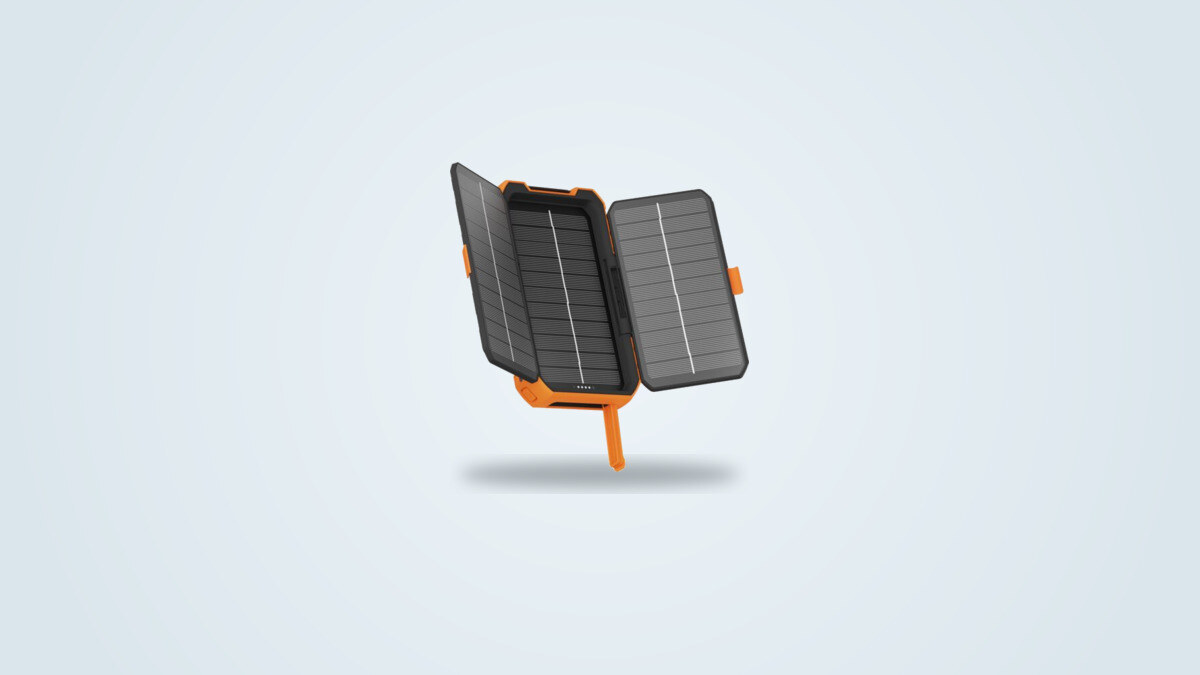
The solar panel is the feature that gives this catalogue sub-category its name, and the XR203's stands out for its size: three foldable Gen'24 panels with a combined output of 5.1 W, against a single fixed panel of about 1.2 W on the XR104, the non-solar cousin from the same brand featured later in this review. Once unfolded, the three panels angle towards the sun thanks to a built-in kickstand, and a row of LEDs on the panel shows in real time whether there is enough sunlight.
Xtorm itself documents a full charge time that varies hugely with conditions: 12 to 17 hours in full summer sun, in the most favourable window between 11am and 2pm, up to more than 45 hours under cloud cover or outside that window. The gap comes down to a physical mechanism the manufacturer spells out itself: winter sun shines roughly half as strongly as summer sun, efficiency drops sharply before 11am and after 2pm, thick cloud cover cuts the input further, and charging behind glass lets through only a fraction of the usable light.
Within a few hours on an average-weather day, outside the peak sunlight window, the charge gained therefore stays necessarily modest against the battery's 37 Wh total. The XR203's panel remains, even so, the most generous across the brand's compact power banks, and a genuine top-up on bright, sunny days, as long as you don't expect a full charge in just a few hours.
USB-C charging: 2.5 hours, the fastest in its solar category
On the wired side, the XR203 accepts a USB-C input of up to 18 W (USB PD and Quick Charge 3.0 protocols) and states a full charge in 2.5 hours (150 minutes). Against its 37 Wh, that figure puts the XR203 ahead of the four solar power banks compared in this review: the XR104, of the same capacity, takes 3.5 hours despite the same stated 20 W input power; the Blavor PN-W12 Pro (74 Wh) takes about 6 hours; the elzle 26800 (99 Wh) takes 8 to 9 hours.
| Model | Xtorm XR203 | Xtorm XR104 | Blavor PN-W12 Pro | elzle 26800 |
|---|---|---|---|---|
| Capacity | 37 Wh | 37 Wh | 74 Wh | 99 Wh |
| Full USB-C charge | 2.5 h | 3.5 h | 6 h | 8 to 9 h |
Pass-through charging, which lets you charge a connected device while the XR203 itself is charging, is supported. In practice, a smartphone goes from 50% to a full charge in around forty minutes on the main USB-C port, a speed consistent with the stated 20 W on that port. This is by far the charging method to favour for a fast, predictable full charge, with the solar panel staying in the top-up role described above.
IP65: what the rating actually protects
The XR203 is IP65 rated, the highest protection index across Xtorm's whole solar power bank line-up. That label deserves a precise reading, because it doesn't always cover what people assume it does.
The first digit (6) concerns dust: it's the maximum value on the scale, total protection against its ingress. The second digit (5) concerns liquids: protection against water jets sprayed from any direction, a stricter requirement than simple splash resistance.
| Model | Xtorm XR203 | Xtorm XR104 | Blavor PN-W12 Pro | elzle 26800 |
|---|---|---|---|---|
| Rating | IP65 | IPX4 | IPX5 | IPX5 |
| Dust | Total protection | Not rated | Not rated | Not rated |
| Water | Jets, any direction | Splashing | Jets, any direction | Jets, any direction |
The XR203 is thus the only one of the four to offer total dust protection, a real asset for beach, dusty trail or building-site use. One point remains common to all four models: none covers full immersion, and an IP rating never certifies shock or drop resistance on its own, which falls under a separate standard (the best known being the MIL-STD-810 family). The XR203's reinforced shell is built to take everyday outdoor knocks, but no numbered drop-resistance standard is published for this model.
Three ports, 20 W peak: what you can actually plug in
The XR203 offers three outputs: a primary USB-C Power Delivery port up to 20 W (the main SuperCharge port), a second USB-C up to 15 W, and a USB-A Quick Charge 3.0 port up to 18 W (22.5 W with certain Huawei devices). All three ports can power up to three devices at the same time.
The XR203's official documentation does not, however, publish a power-sharing table for using all three ports at once, unlike some newer batteries from the brand that spell out exactly how much power remains on each port once a second or third is active. It is therefore reasonable to expect a drop in per-port power once several devices are plugged in together, without being able to put a precise figure on it for this model.
Flashlight, carabiner and kickstand: the outdoor gear
Beyond the battery and the panel, the XR203 includes a built-in flashlight, handy for lighting up a campsite or for a night-time fix, and a carabiner that lets you clip it to a backpack while walking to catch the sun on the move. The kickstand built into the solar panel serves both to angle it towards the sun and to stand the whole unit upright on a flat surface.
The cover protecting the ports stays shut in normal use, a useful precaution to keep sand and dust away from the connectors out in the field. No lumen figure is published for the flashlight, nor a runtime for that function independent of the main battery's charge level.
1.1 lb: the weight of ruggedness and the panel
1.1 lb (506 g) on the scale, for a shell measuring 6.5 x 3.7 x 1.1 in (166 x 95 x 27 mm) folded (9.8 in / 250 mm wide once the three solar panels are unfolded): the XR203 owns its bulk, thicker and heavier than a plain power bank of the same capacity, due to its built-in solar panel and reinforced IP65 shell.
Against the energy it carries, the numbers are less flattering than for its catalogue cousins. At 73 Wh per kilogram (37 Wh for 506 g), the XR203 has the lowest energy density of the four solar power banks compared in this review.
This result mostly comes down to what the XR203 adds on top of a plain power bank: a three-panel solar array noticeably bigger than the XR104's, and a reinforced shell to hold the IP65 rating. Both add weight without adding stored energy, a trade-off made in favour of ruggedness and solar rather than light weight.
Brand, build quality and warranty
Xtorm is a Dutch brand published by Telco Accessories, based in Houten, the Netherlands; design is Dutch, manufacturing is Chinese, an arrangement common across most of the electronic accessories industry. The XR203's shell is largely made from GRS-certified (Global Recycled Standard) recycled plastic, paired with TPU for the flexible part that absorbs impacts.
The standard warranty is 2 years. Xtorm generally offers to extend it to 3 years through free product registration within a few months of purchase, a policy applied across the brand's whole catalogue rather than specific to this model.
The brand's after-sales service generally applies a process requiring proof (photo or video) before a replacement in case of failure, and processing times can run longer than a straightforward exchange would suggest. No recall or safety defect specific to the XR203 stands out, but the model remains, compared with the catalogue's best-selling references, still lightly commented on, which limits how far any statistical read on its long-term reliability can go.
Against three other solar power banks in the catalogue
At around £70 to £90 depending on the retailer and promotions, the Xtorm XR203 goes up against several solar power banks that shoppers search for outdoors. Here's how it compares with three references from the catalogue.
| Criterion | Xtorm XR203 | Xtorm XR104 | Blavor PN-W12 Pro | elzle 26800 |
|---|---|---|---|---|
| Capacity | 10,000 mAh (37 Wh) | 10,000 mAh (37 Wh) | 20,000 mAh (74 Wh) | 26,800 mAh (99 Wh) |
| Max power | 20 W (USB-C PD) | 20 W (USB-C PD) | 18 W (USB-C PD) | 15 W (USB-C) |
| Solar panel | 5.1 W, 3 foldable panels | ≈ 1.2 W fixed | 4 foldable panels | 4 foldable panels |
| Water/dust rating | IP65 | IPX4 | IPX5 | IPX5 |
| Weight | 1.1 lb (506 g) | 0.6 lb (289 g) | 1.1 lb (500 g) | 1.2 lb (556 g) |
| Full USB-C charge | 2.5 h | 3.5 h | 6 h | 8 to 9 h |
The table sums up the XR203's position well: it isn't the most capacious on any criterion against these three references, but it wins on water/dust resistance and USB-C charging speed, and its built-in solar panel stays noticeably bigger than its XR104 cousin's. The Blavor and the elzle bank on far higher capacity and four-panel arrays, at the cost of comparable or higher weight and a longer USB-C charge. The XR104, lighter and cheaper, gives up most of the solar promise to focus on ruggedness and wired charging.
Real-world use: hiking, camping, home backup
The XR203's positioning is clearly outdoor and backup use, not everyday urban carry. Three concrete situations show where its mix of ruggedness, fast charging and occasional solar top-up makes sense.
On a multi-day hike or trek, the carabiner lets you clip it to a backpack and catch the sun while walking, on top of a USB-C charge the night before at a hut or campsite. Camping or wild camping, the built-in flashlight saves packing separate lighting, and the IP65 shell shrugs off sand, dust and water splashes without any special care. During a power cut at home, the 37 Wh is enough to keep a smartphone and a small connected gadget running through a short outage, though its more modest capacity than the catalogue's larger backup batteries limits this to a top-up role rather than an extended solution.
For cycling or long drives, the solar panel stays an occasional extra rather than a reliable source while moving, because of shifting shade and frequent angle changes that cut into its output, and because charging behind glass lets through far less usable light than in the open air. It's best unfolded at a stop, facing due south, to get any real benefit from it.
Who it suits, who it doesn't
The XR203 suits anyone after a genuinely rugged power bank (IP65, reinforced shell) for hiking, camping or cycling, who mainly recharges a smartphone, and who appreciates having an occasional solar top-up on bright days. Its fast USB-C charge (2.5 hours for 37 Wh) also makes it a sound pick for topping up quickly between outings.
It suits less anyone hoping to do without a wall outlet long-term thanks to solar alone: the charge time Xtorm itself states, from 12 hours in the best conditions to more than 45 hours as sunlight fades, and the inability to start a solar charge from a fully drained battery, keep this function firmly in top-up territory. It also suits less anyone who prioritises the biggest capacity or the lowest weight per watt-hour: the Blavor PN-W12 Pro and the elzle 26800, more generous in Wh, serve that specific need better, at the cost of a longer USB-C charge.