
What the 10,000 mAh (37 Wh) are really worth
The Xtorm XR104's spec sheet lists two figures: 10,000 mAh, and 37 Wh. The first is the total charge of the lithium-polymer (LiPo) cells that make up the pack, measured at a voltage close to 3.7 V. The second is the energy it actually represents, the figure that lets you compare two batteries of different voltage. It is this 37 Wh figure, not the 10,000 mAh, that matters for judging capacity.
One discrepancy is worth flagging: several price comparison sites list 50 Wh for this same product, a figure obtained by multiplying the 10,000 mAh by a 5 V USB output voltage rather than the cells' real voltage. This mix-up between output voltage and cell voltage is common on power banks and inflates the stated energy by around 35%. The 37 Wh figure, consistent with a LiPo cell voltage of about 3.7 V and used in the manufacturer's technical documentation, is the one to trust.
Sources diverge on what these 37 Wh charge in practice: the manufacturer states "at least two" full smartphone charges, while some retailers claim "up to three" or "four". A simple calculation helps settle it: with the conversion losses typical of this kind of circuit (15% to 25%), the nominal 37 Wh translate to roughly 28 to 32 Wh of usable energy, against the 15 to 20 Wh a recent smartphone battery stores, which lands close to two full charges, three for a phone with a smaller battery. No independent data on the energy the XR104 actually delivers is available to go further.
At 37 Wh, the XR104 stays comfortably under the 100 Wh threshold generally allowed in airline cabins without special paperwork, a practical point for anyone taking it travelling or trekking abroad. It is also the smallest capacity in the whole Xtreme Series solar line-up: cousin XR203 shares the exact same 37 Wh, while XR202 and XR204 climb to 74 and 154 Wh respectively.
The fixed 1.2 W solar panel: a top-up to the top-up
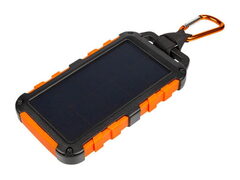
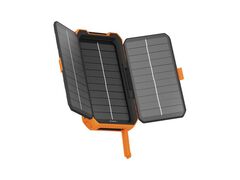
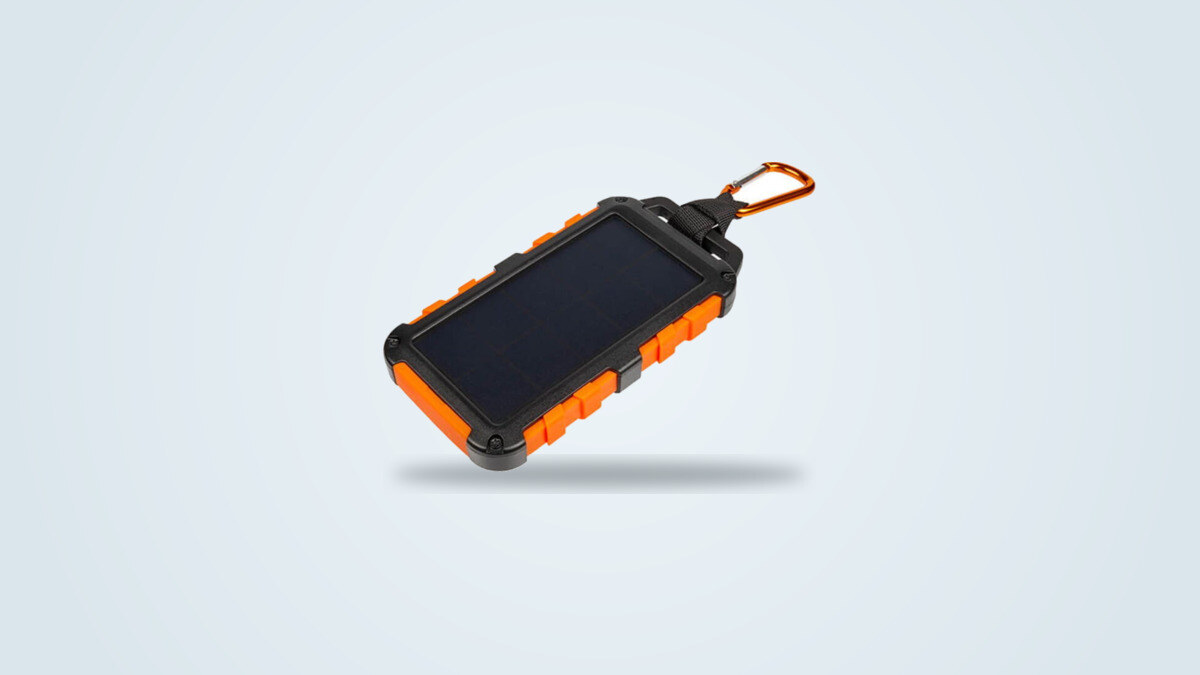
The built-in solar panel is the feature that gives the whole Xtreme Series solar line-up its point, but the XR104's is the more modest of the catalogue's two solar models: a fixed 1.2 W monocrystalline SunPower cell, built flush into the top face of the case, with no folding mechanism or aiming stand. Cousin XR203, covered further down in this review, carries a foldable three-panel 5.1 W array, more than four times as powerful.
Xtorm itself puts the time needed for a full solar charge at around 60 hours of cumulative direct sunlight, and translates that into a calendar estimate: about 10 days in clear spring or summer weather, and up to 20 days in autumn or winter. The mechanism is straightforward once spelled out: even a clear day only offers a few hours of sunlight direct enough for a small, fixed, unaimed panel to draw a real yield from, and that useful window shrinks further once the sun sits low in winter. Under these conditions, the average daily gain is limited to around 5 Wh on a sunny day, out of the pack's 37 Wh total.
Once framed this way, the panel keeps a genuine use: on a multi-day hike, clipping it to a backpack while walking regains a few percent of charge effortlessly, a gain that adds up day after day and can make a real difference on a week-long trek with no wall outlet at all.
USB-C charging: 3.5 hours, the slowest in its own solar line-up
On the wired side, the XR104 charges through its single USB-C port, which accepts up to 20 W of input (USB PD and Quick Charge 3.0 protocols), for a full charge stated at 3.5 hours (210 minutes). The same port also serves as the main output, a design choice that simplifies the case to a single fast-charging spot rather than duplicating two.
Set against its 37 Wh, this delay puts the XR104 behind its own cousin XR203: same capacity (37 Wh), same rated input power (20 W), yet 2.5 hours for a full charge, an hour less. No public documentation explains the gap between two products this close on paper. One nuance does surface in the product's documentation, though: a USB-C PD charger of at least 18 W would bring the full charge down to around 2.5 hours, which suggests the 3.5-hour figure corresponds to an entry-level charger rather than a full PD one.
| Model | Xtorm XR104 | Xtorm XR203 | Xtorm XR202 |
|---|---|---|---|
| Capacity | 37 Wh | 37 Wh | 74 Wh |
| Stated input power | 20 W | 20 W | 35 W |
| Full charge | 3.5 h | 2.5 h | not published |
Pass-through, which lets you power a connected device while the XR104 itself charges, is not documented for this specific model, unlike other references in the catalogue that explicitly claim it. It is safer to treat charging the XR104 and charging a device from the XR104 as two separate operations, run one after the other rather than at the same time.
A 20 W USB-C port and two USB-A ports: what you can really plug in
The XR104 offers three outputs: one USB-C Power Delivery port up to 20 W, and two USB-A Quick Charge 3.0 ports up to 18 W each on their own. All three can be used together to power up to three devices at once.
The point to understand before buying: these per-port figures do not add up. Total output across all outlets stays capped at 20 W, the USB-C port's own ceiling. As soon as a second or third device plugs in, that 20 W budget gets split between the active ports, with no table from Xtorm spelling out the exact split port by port. A single smartphone on the USB-C port gets the full PD power; the same phone joined by a head torch and a GPS unit on the two USB-A ports will have to settle for a far smaller share of that same 20 W split three ways.
This limit is nothing unusual for a power bank at this capacity and price: it is an electronic constraint common to most compact power banks, and the XR104 makes no claim to escape it. It is simply worth knowing before counting on it to fast-charge several power-hungry devices at once, a use case where pricier, more recent references in the catalogue, fitted with screens detailing power per port, offer better visibility.
IPX4: the least protective rating in the Xtreme solar line-up
The XR104 is rated IPX4, a protection rating worth reading precisely rather than assuming. The "X" in the dust position means that criterion simply was not evaluated: the case is neither certified dust-tight nor certified as failing dust protection. The "4" in the water position guarantees resistance to splashing water from any direction, useful protection against a rain shower or a bag that takes on water, but not against immersion.
It is the most modest rating in the whole Xtreme Series solar line-up. Direct cousin XR203, built on the same 37 Wh capacity but a bigger, heavier case, reaches IP65 (total dust protection, water jets from every angle); XR202, with no solar panel but double the capacity, also reaches IP65.
| Model | Xtorm XR104 | Xtorm XR203 | Xtorm XR202 |
|---|---|---|---|
| Rating | IPX4 | IP65 | IP65 |
| Dust | Not evaluated | Total protection | Total protection |
| Water | Splashing | Jets, every direction | Jets, every direction |
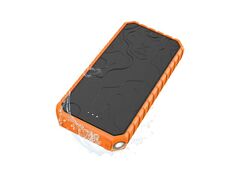
The XR104's rubberised case, with the protective ridges on all four edges visible in official photos, is still built to take everyday outdoor knocks and drops, a mechanical resistance distinct from waterproofing and not covered by any IP rating. No numbered drop-resistance standard (such as MIL-STD-810) is published for this model, though. For a beach trip, a dusty trail or a building site, the gap with its IP65-rated cousins is the most concrete trade-off to know before buying.
Built-in light and carabiner: the outdoor kit
Beyond the battery and the panel, the XR104 packs a built-in LED light and a carabiner with a strap, two features that earn its place in the catalogue's outdoor line-up rather than among ordinary city power banks.
The manufacturer's official pictures show a light built as a grid of LEDs covering much of the case's back face, rather than a focused torch-style beam. That design suits ambient lighting (inside a tent, a camp table, finding something in a bag) better than throwing light far like a head torch or a narrow-beam torch. No lumen figure is given for this feature, nor any runtime independent of the main battery's charge.
The carabiner, attached to a webbing strap fixed to the case, lets you clip the XR104 to the outside of a backpack so it catches the sun while walking, exactly the use its built-in solar panel calls for. It is a simple but well-thought-out touch, missing from many city power banks that offer nothing but a smooth case with no attachment point.
0.6 lb: the lightest and most energy-dense of the solar line-up
On the scale, the XR104 weighs 0.6 lb (289 g) for a footprint of 6.5 x 3.4 x 0.9 in (165 x 86 x 22 mm); a few retailers' spec sheets list a 0.7 in (18 mm) depth instead, likely measured without the protective ridges. That is a contained weight for an outdoor battery with a built-in solar panel and a reinforced case.
Set against the energy it carries, the numbers are even more flattering: at 128 Wh per kilogram (37 Wh for 289 g), the XR104 posts the best energy density of the catalogue's two solar power banks with a built-in panel, well ahead of cousin XR203 and its 73 Wh per kilogram, weighed down by its foldable three-panel array and reinforced IP65 case.
Against the wider market, two solar references in the catalogue still do better: the Blavor PN-W12 Pro (148 Wh/kg) and the elzle 26800 (178 Wh/kg), both with higher capacity. The XR104 remains a solid trade-off within its own price and size bracket, and is far more pleasant to carry on a hike than cousin XR203.
Brand, build and warranty
Xtorm is a Dutch brand published by Telco Accessories, based in Houten, the Netherlands; the design is Dutch, manufacturing is Chinese, an arrangement common across most of the electronics accessories industry. The XR104 has been on sale since April 2021 and remains actively stocked five years on at several European retailers, a sign of lasting commercial staying power for this kind of product.
The standard warranty is 2 years. As with the rest of the Xtorm catalogue, it can generally be extended to 3 years through free product registration within a few months of purchase. Unlike more recent references from the same brand (XR203 and its GRS-certified recycled plastic, for instance), no recycled-material certification is documented for the XR104's case, an older model in the brand's line-up.
No recall or safety issue specific to the XR104 is on record. The product even holds an edge over its more recent cousins: five years of market history and accumulated customer feedback, where XR202, XR203 and XR204 remain lightly reviewed so far, with no recurring structural fault showing up, only the expected, occasional remarks about the symbolic nature of solar charging already covered above.
Against its Xtorm cousins and the direct competition
At around £43 to £60 depending on the retailer, the XR104 sits as the entry point of Xtorm's Xtreme Series solar line-up, and also faces more recent solar references in the catalogue.
| Criterion | Xtorm XR104 | Xtorm XR203 | Xtorm XR202 | Blavor PN-W12 Pro |
|---|---|---|---|---|
| Capacity | 37 Wh | 37 Wh | 74 Wh | 74 Wh |
| Max power | 20 W | 20 W | 35 W | 18 W |
| Solar panel | 1.2 W fixed | 5.1 W foldable | none | foldable |
| Waterproofing | IPX4 | IP65 | IP65 | IPX5 |
| Weight | 0.6 lb (289 g) | 1.1 lb (506 g) | 1.2 lb (540 g) | 1.1 lb (500 g) |
| USB-C charge | 3.5 h | 2.5 h | not published | 6 h |
The table sums up the XR104's place well: it is the lightest and cheapest in this comparison, but also the least waterproof and the least capacious. Cousin XR203 offers a far more generous solar panel and better waterproofing for a substantial weight penalty; XR202 doubles capacity and power while dropping solar entirely; the Blavor PN-W12 Pro matches XR202's capacity with a foldable panel, at the cost of a much longer USB-C charge. None of these four references wins across the board, so the choice comes down to priority: lightness and price for the XR104, waterproofing for its cousins, capacity for the two bigger references.
Who it suits, who it does not
The XR104 suits anyone after a light, affordable outdoor power bank mainly to charge a smartphone while hiking, camping or travelling, and who likes the idea of an occasional solar top-up without demanding it. Its contained weight (0.6 lb / 289 g) and its carabiner make it an easy companion to clip to a bag without weighing it down, and its USB-C charge, admittedly slower than hoped next to cousin XR203, is still plenty for a full charge overnight at a stop.
It suits less anyone hoping to genuinely go without a wall outlet thanks to the sun: the 60 hours of cumulative sunlight needed for a full solar charge, spread over 10 to 20 days depending on the season according to Xtorm itself, confine that feature to a simple top-up. It also suits less anyone who needs genuine waterproofing for a beach trip or a dusty building site (XR203 and XR202, both IP65-rated, serve that need better), or anyone wanting to fast-charge several power-hungry devices at once, with the shared 20 W total budget across the three ports remaining the limiting factor.