
What is a solar power bank actually good for?
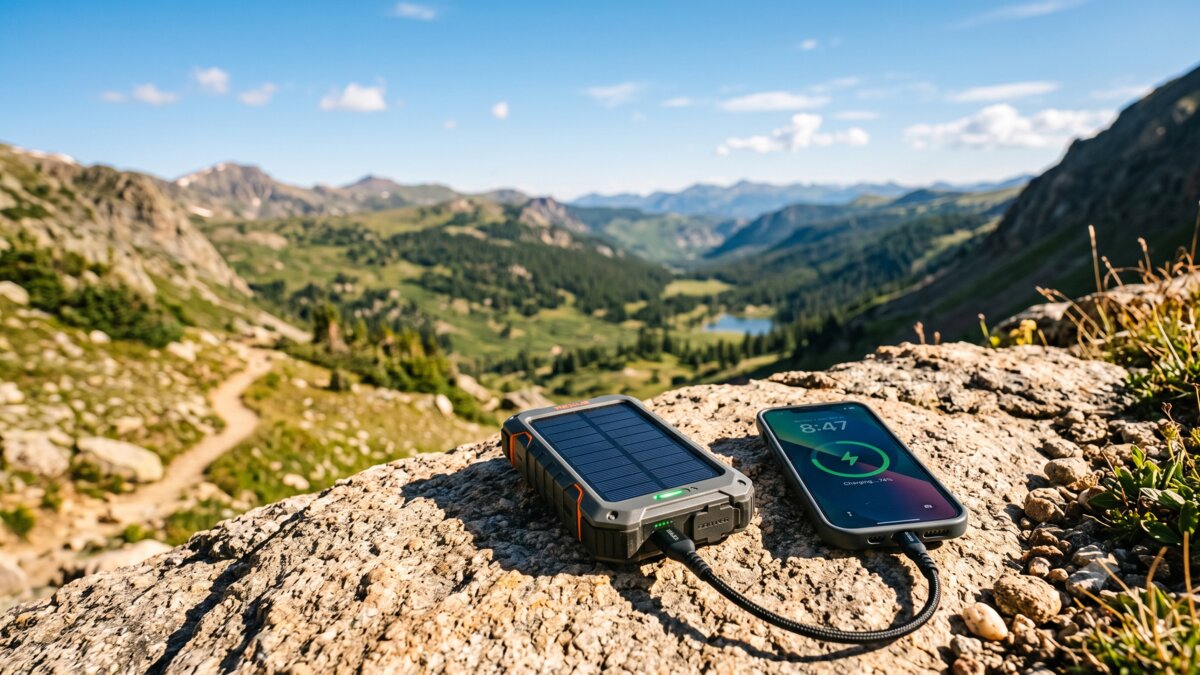
A solar power bank is a regular power bank with a small photovoltaic panel added on top. The idea is appealing: recharge your phone from the sun, wherever you are. After ten years testing these products in the field, our take is honest and nuanced: yes, it works, but not the way the marketing visuals suggest.
The right way to see it: the built-in panel is a safety net, not a charger in its own right. On a multi-day hike, when wild camping, travelling somewhere without a reliable socket, or in an emergency kit, being able to scrape a few percent of battery from the sun can save the day. But if you want to recharge your devices daily, it is the mains socket or a proper dedicated solar setup that will do the job.
In other words: you don't buy a solar battery for the solar, you buy it for its capacity, with the panel as an added safety net. That is exactly what this guide is about.
Charging in the sun: how long does it really take?
This is THE point product listings keep quiet about. A panel built into a power bank typically outputs between 1 and 7 watts, over an area the size of your hand. In full sun, cloudless and perfectly angled, a 5 W panel delivers at best 0.4 to 1 A. To fill a 20,000 mAh battery (about 74 Wh) you would therefore need roughly 15 hours of perfect sun, and in practice more like 30 to 50 hours once you account for shade, angle, heat and the real efficiency of the cells.
For comparison, the same battery recharges in 2 to 3 hours from a wall socket over USB-C. Built-in solar is therefore roughly ten to twenty times slower.
The lesson: judge the battery first on its capacity and its mains charging speed. Treat the panel as a bonus that buys you time when you genuinely have no socket within reach.
The 5 criteria that really matter
Here, in order of importance, is what separates a good solar power bank from a gadget:
- Real capacity: aim for 20,000 to 27,000 mAh. Below that, runtime is too tight for outdoor use; above it, weight becomes a burden. Be wary of cheap '100,000 mAh' claims, they are pure fiction.
- Fast USB-C charging (Power Delivery): since solar is slow, the battery must at least refill quickly from the mains before you set off. A USB-C PD port for input and output is essential.
- Panel quality and area: favour monocrystalline cells, which are more efficient. Some models unfold into three or four panels to triple the exposed area, which is a genuine plus.
- Ruggedness and water resistance: these batteries live outdoors. An IP65 rating or better, a shockproof shell and a carabiner are concrete assets.
- Useful extras: an emergency LED torch, dual USB output to charge two devices, a charge display. They often make the difference in real conditions.
Solar battery, foldable panel or power station: which to choose?
If solar genuinely matters to you, the all-in-one battery is not always the best answer. Here is how the three main options stack up:
| Criterion | Solar power bank | Foldable panel + battery | Solar power station |
|---|---|---|---|
| Real solar charging | Weak (top-up) | Good to very good | Excellent |
| Bulk | Very compact | Moderate (panel to unfold) | Bulky |
| Devices powered | Phone, watch, earbuds | Phone, tablet, laptop | Everything, up to mains appliances |
| Typical price | £25 to £70 | £50 to £180 | £180 to £1,300 |
| Ideal use | Hiking, emergency kit | Wild camping, van, long trips | Motorhome, power cuts |
In short: for a light safety net that fits in your bag, a solar power bank is enough. To actually recharge from the sun, a foldable solar panel paired with a good battery offers the best efficiency-to-weight ratio. And to run a fridge or a laptop off-grid, you need to step up to a power station.
Our picks and the best alternatives
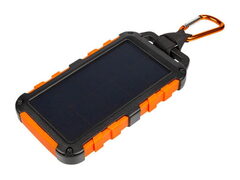
When it comes to true solar power banks, the market remains a niche, and few models are really worth it. The Xtorm XR104 is a good example of the category: large capacity, fast USB-C charging, and a well-designed backup panel, exactly in the 'safety net' spirit described above.
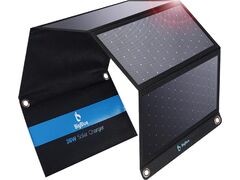
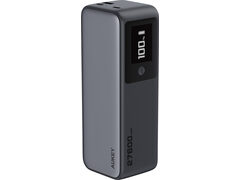
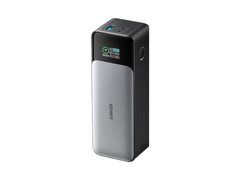
But let's be honest: if solar is a real criterion for you, two alternatives are often more relevant. On one hand, a foldable solar panel such as the BigBlue 28 W, to pair with any battery: it recharges a phone in a few hours of sun, where a solar battery would take days. On the other, a large, hard-wearing power bank such as the Aukey PB-Y63 (27,600 mAh) or the Anker 737 (24,000 mAh, 140 W charging): you set off with several days of runtime in your pocket, without depending on the weather. That is often the simplest and most reliable solution.
⚡ Pro tip: for a long trek, the winning combination is not 'a solar battery', but 'a large battery charged to the brim before departure, plus a small foldable panel to extend it'. You get the best of both worlds.
Mistakes to avoid
Three mistakes come up again and again among disappointed buyers:
- Believing inflated capacities: a '100,000 mAh' battery sold for £20 does not exist physically. A real 26,800 mAh unit already weighs nearly 500 g. Trust reputable brands and the stated Wh.
- Relying on solar as the main source: that is the surest way to run flat. Always set off with the battery full; the panel is only a supplement.
- Leaving the battery in full heat: charging in the sun is fine, but a lithium battery that gets too hot degrades and shuts down for safety. Put it in the shade for the panel where possible, or keep an eye on its temperature.
Keep these caveats in mind and a solar power bank remains a reassuring companion for anyone heading away from sockets. As long as you buy it for what it really is: a reliable battery, with a solar safety net.