
What the claimed 166.5 Wh are really worth
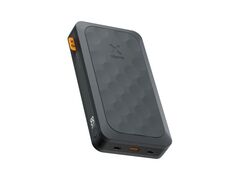
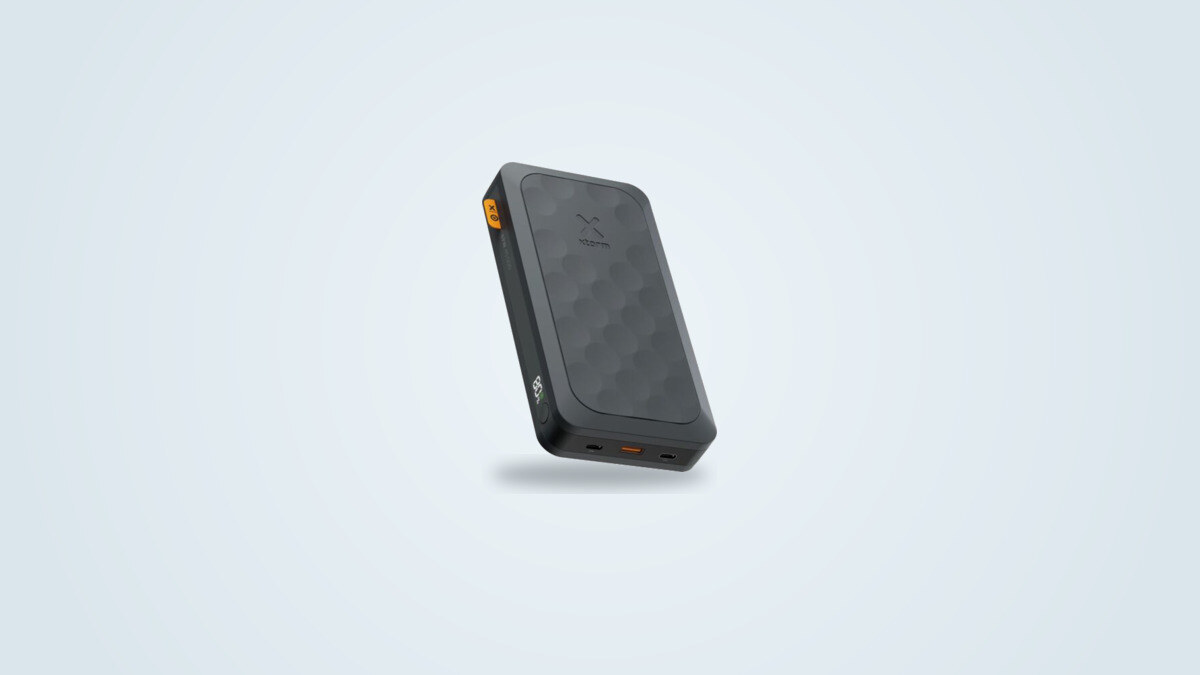
The Xtorm Fuel Series 5 67 W 45,000 mAh lists a nominal capacity of 166.5 Wh, calculated from its 45,000 mAh of cells at a conventional 3.7 V. Across five different output settings, it returns between 142.6 and 158.1 Wh, or 86 to 95% of that nominal figure depending on the power drawn.
The mechanism comes down to voltage conversion: stepping up from a cell voltage near 3.6 to 4.2 V to reach 20 V on the output costs more energy than staying at 5 or 9 V. Output is therefore highest at low voltage, up to 95% at 9 V and 1 A, and lowest at high voltage and high current, 86% at 20 V and 3 A, which is exactly the configuration used to fast-charge a laptop.
Across all five settings, the average works out to around 152.7 Wh, the figure used throughout this review as the real-world output reference.
The 67 W port keeps its promise, but only one of three does
The main USB-C port delivers up to 67 W of Power Delivery, with extended PPS support from 3.3 to 20.3 V and up to 3 A, an unusually wide range for this type of product. This port keeps its claimed promise without reservation.
The other two ports are considerably more modest: the second USB-C port caps at 27 W (PPS from 3.3 to 11 V), and the USB-A port at 18 W with Quick Charge 3.0. That means charging two laptops at full speed at the same time is not possible: only one device at a time gets the full 67 W.
No independent test has confirmed how the total power budget behaves when all three ports are used at once: that point still needs checking case by case, depending on the exact combination of devices plugged in.
Pass-through and simultaneous charging: a real asset on the road
Pass-through charging lets the pack recharge itself from a wall outlet while powering one or more devices plugged into its three ports at the same time. That is genuinely useful for extended travel: plug the pack and a laptop into the same wall adapter overnight, and find both fully charged in the morning, without having to run two separate charging sessions.
The manufacturer also builds in protection against overcharging, short circuits and overheating, mechanisms that are standard on this type of product by now but still a necessary baseline for a battery carried in a bag every day.
The claim: a smartphone charged nine times, a laptop twice
The manufacturer claims enough for about nine full smartphone charges or two laptop charges. That kind of figure generally assumes output close to 100% of nominal capacity against reference batteries (roughly 18 to 20 Wh for a recent smartphone, 55 to 60 Wh for a laptop). With real output of 86 to 95% rather than 100%, the number of full recharges actually achieved sits slightly below the claim, in a proportion directly tied to the output gap covered above.
That gap does not undermine the claimed order of magnitude: the manufacturer is broadly in the right ballpark. It is simply a reminder that a multiple-recharges figure is always a theoretical estimate, not a contractual guarantee, and one that is especially sensitive to the exact battery size of the device being charged and the charging power actually used.
Recharging the pack itself: 3.5 hours claimed, about 4 hours in practice
The manufacturer claims a full recharge in 3.5 hours with a sufficiently powerful charger. In practice, at 60 W or more on the input, that time comes closer to 4 hours, roughly 15% longer than claimed.
The gap between the two figures remains favorable overall: fully recharging 166.5 Wh in 4 hours is fast for this capacity class, where several similarly sized rivals need 6 to 10 hours. The gap versus the manufacturer's claim is still worth knowing before buying, especially for anyone planning an overnight recharge before a trip.
The main friction point: 722 g and a size you notice
At 722 g for 180 x 100 x 30mm, the Xtorm Fuel Series 5 67 W 45,000 mAh is an object you feel in an already-full bag. That is the direct, expected trade-off of a capacity close to double that of the most common power banks: at equal energy density, doubling the capacity cannot come at the same weight.
The size still stays reasonable relative to the energy it carries: around 4.3 g per nominal Wh, a ratio on the high side of average but not out of line for lithium-polymer cells housed in a protective shell. The trade-off is therefore coherent, but very real for anyone who values everyday lightness.
The LED display: useful, but minimal
An LED display constantly shows the remaining charge percentage, a genuine plus over the simple stepped light indicators, in 20 or 25% increments, that many rivals still use. The reading is immediate and accurate to the percentage point.
This display still stays minimal next to those of some direct rivals at a similar price point, which also show live wattage on each port, an estimated time to full charge, or a cell-health indicator. None of that is available here: only the overall percentage is shown.
One thing to know before buying: air travel
At 166.5 Wh, this pack is well above the 100 Wh threshold generally allowed in airplane cabins without prior approval, and even above the 160 Wh ceiling beyond which no special approval helps any more. The manufacturer states this explicitly on its own official product page: it is not designed for air travel.
Xtorm's lineup offers a direct alternative for anyone who needs a large capacity that can still fly in the cabin: the same Fuel Series 5, in a 27,000 mAh version with the same 67 W power, tops out at 99.9 Wh, just under the 100 Wh limit. The trade-off is clear: roughly 40% less capacity, in exchange for cabin use that the 45,000 mAh version rules out entirely.
Against the direct competition: capacity versus power
In the segment of very-high-capacity power banks that can also charge a laptop, the Xtorm Fuel Series 5 67 W 45,000 mAh runs up against several well-known rivals.
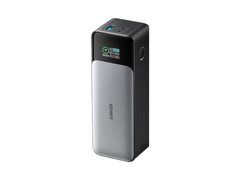
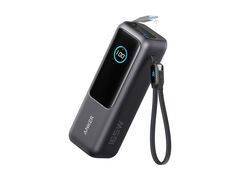
| Criterion | Xtorm Fuel Series 5 67 W 45,000 mAh | Anker 737 Power Bank | Anker A1695 |
|---|---|---|---|
| Claimed capacity | 45,000 mAh (166.5 Wh) | 24,000 mAh (86.4 Wh) | 25,000 mAh (90 Wh) |
| Maximum power | 67 W | 140 W | 165 W |
| Output | 142.6 to 158.1 Wh (86 to 95%) | 72.6 Wh (~84%) | 74 Wh (~82%) |
| Weight | 722 g | 630 g | 595 g |
| Flight-legal | No (166.5 Wh) | Yes (86.4 Wh) | Yes (90 Wh) |
The Xtorm stands out clearly on capacity, close to double that of these two direct rivals. Its output, between 86 and 95%, is also proportionally the highest of the three, even though the absolute power on tap (67 W) is well below the 140 W and 165 W of the two Anker units, which charge a demanding laptop faster. Weight follows capacity logically: the Xtorm is the heaviest of the three, but not out of proportion given its capacity advantage. For a use case where battery life matters more than charging speed, it keeps a clear edge; for anyone charging a power-hungry laptop and wanting to stay flight-legal, the two Anker units remain the more versatile choices.
Build quality, warranty and reliability
The shell is made from GRS-certified (Global Recycled Standard) recycled plastic, an environmental approach that does not come at the expense of sturdiness: the finish is judged close to premium for this price bracket.
On warranty, the Dutch manufacturer offers a two-year base warranty, extendable to three years (2+1) through a free product registration on its official site, a condition worth not missing to benefit fully. No official recall covers this model at the time of writing.
This European and international version makes no claim to any water or dust resistance rating. Xtorm's wider catalog does include separate, newer models, of different capacity, aimed at resistance to water splashes and dust: they should not be confused with this 45,000 mAh version, which offers none of that.
Who it suits, who it doesn't
It suits anyone heading off for several days without easy access to a wall outlet (car, motorhome, train, a multi-day trek), who wants a comfortable energy reserve for a smartphone and a laptop at once, and who accepts the weight trade-off in exchange for very comfortable battery life.
It does not suit anyone who flies regularly and needs to carry their power bank in the cabin (the 27,000 mAh version in the same lineup is the right alternative then), anyone who wants lightness above all for everyday city use, or anyone who needs to charge two laptops at full speed at the same time.