
A precision shunt rather than a plain voltmeter
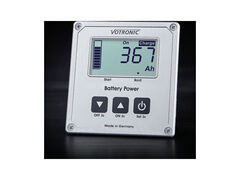
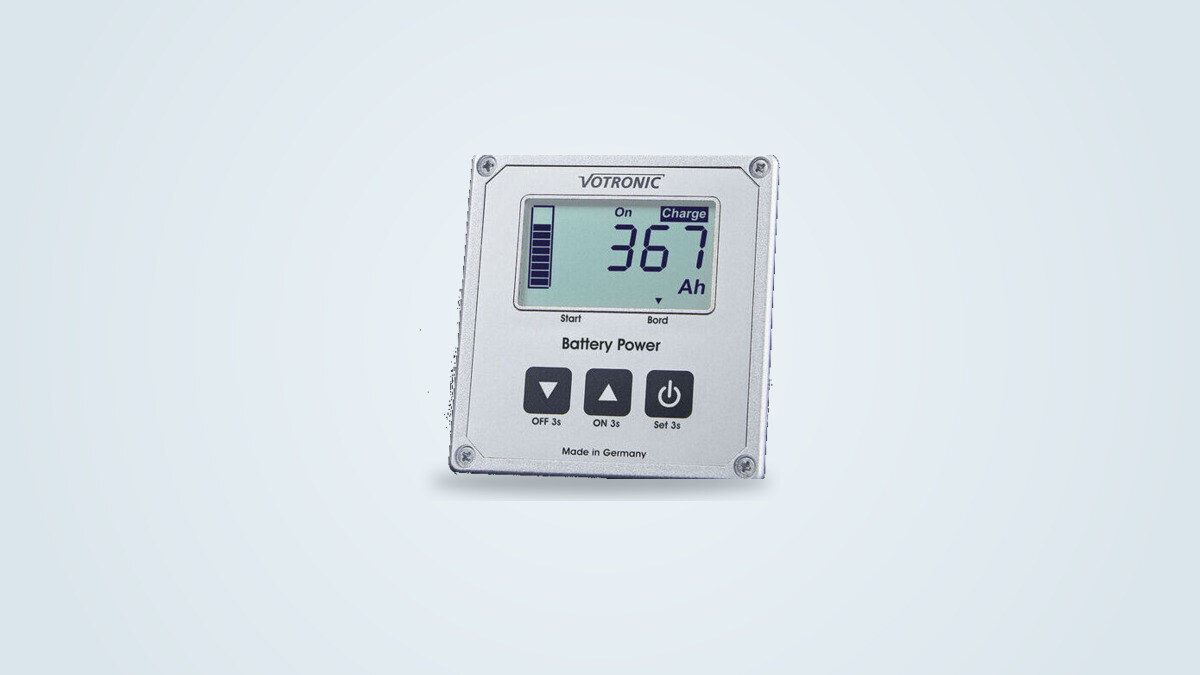
The LCD Battery Computer 100 S monitors a leisure battery in a converted van, motorhome or boat through a shunt fitted on the negative terminal: rather than guessing the state of charge from voltage alone, it continuously integrates incoming and outgoing current to display a percentage and an amp-hour value, working like a fuel gauge for the battery. The backlit LCD screen stays readable in bright sunlight and in the dark, and the unit works right out of the box, with no account or app to install.
The supplied kit includes the display, the Smart-Shunt, a connecting cable and a ground strap: enough to cover a complete install with no extra accessory, aside from the optional Bluetooth module covered later in this review.
0.1A and 0.1V resolution, with no stated accuracy percentage
The supplied shunt's rating sets the unit's reliable measuring range: 100A continuous, 120A with good cooling, and tolerated peaks of 150A for 15 minutes then 200A for 7 minutes. Beyond that, the reading saturates, which is why the same line-up also includes the 200 S and 400 S variants: the choice between them depends on the maximum continuous current actually drawn by the connected loads, not on the amp-hour capacity of the battery being monitored.
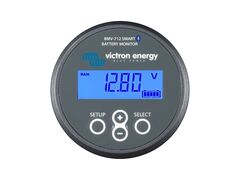
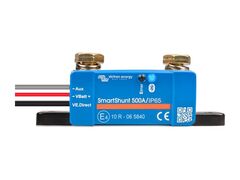
The Smart-Shunt supplied with this generation is stated to be noticeably more accurate than its predecessor, with a stated resolution of 0.1A and 0.1V. That is a decent resolution for everyday use, but a notch below the Victron SmartShunt and BMV-712, which share the same 500A/50mV shunt and state a resolution of 0.01A and 0.01V, ten times finer on paper.
Another difference: Votronic states no overall accuracy percentage for this model, where Victron states 99.6% for the SmartShunt and 0.4% on current / 0.3% on voltage for the BMV-712. Those Victron figures remain manufacturer data with no independent verification, but their mere existence at least gives the reader a ballpark, missing from the Votronic spec sheet.
No native Bluetooth: the S-BC module is optional, not standard
Out of the box, the LCD Battery Computer 100 S talks to nothing but its own screen: no app, no history, no data export. To get those, you need to add the Bluetooth Connector S-BC, a separate module that forwards the displayed values to the free Votronic Energy Monitor app (history, graphs, CSV export). This module has two inputs and two outputs: it can link both an LCD Solar Computer and this LCD Battery Computer to a single unit, which spreads its cost for anyone who already owns a Votronic solar controller, but remains a pure added cost for anyone who only has this monitor.
For anyone who has never needed to open an app just to check their battery, this lack of native Bluetooth is not necessarily a drawback: the screen works on its own, with no pairing, no account, no firmware update to keep an eye on. But as soon as charge history or a remote alert becomes a requirement, the real budget climbs above the price tag on the unit alone.
Compatible from lead-acid to lithium, but a rating that sets the ceiling
The unit covers wet lead-acid, Gel, AGM and LiFePO4 lithium batteries, with an adjustable capacity from 50 to 2000 Ah, in both 12V and 24V. That 2000 Ah ceiling comfortably covers a van or motorhome's leisure battery bank; only the shunt's own rating (100A) really limits the use case, particularly once a powerful inverter, air conditioning or a large one-off load can draw more than 100A.
| Specification | Value |
|---|---|
| Housing dimensions | 80 x 85 x 24 mm |
| Mounting depth | 22 mm |
| Weight (display + shunt) | 295 g |
| Own power draw | around 8 mA, varying with backlight intensity |
As with any shunt-based monitor, the wiring must electrically isolate the monitored battery from the rest of the installation: the shunt sits on the negative terminal, between the battery and the common negative bus bar. Every charging return path (solar, mains charger, alternator) must land on that bus bar rather than on the battery's own negative terminal, or the unit will fail to register charging phases correctly. This is not specific to Votronic: it applies to any shunt-based monitor, but is worth double-checking at install time.
A programmable cut-off output, no built-in alarm
The unit has a programmable switching output (PNP, 12V/24V, 0.3A max) able to automatically cut consumers once the charge drops below a set threshold, to protect the battery from a deep discharge. A NOT-ON function briefly restores power at the touch of a button when needed. This output does not switch a large load directly: it is designed to drive an external relay, working the same way as a dry contact.
The Victron BMV-712 offers a comparable function (a 60V/1A relay) paired with an audible and visual alarm directly on the unit, which the Votronic 100 S lacks. The SmartShunt, from the same Victron line, offers neither relay nor alarm at all, leaving all cut-off and alert logic to the app. The Votronic sits between the two: a genuine active safeguard, but with no perceptible alert unless you check the screen.
German manufacturing and a 60-month warranty: on par with Victron
Votronic develops, manufactures and services its devices in-house from its site in Lauterbach, Germany, under ISO 9001 quality certification. Every unit is function-tested before shipping, and repair support remains available regardless of where or how long ago it was bought. The manufacturer warranty runs for 60 months, matching the Victron SmartShunt and BMV-712, and well above the sector average.
The LCD Battery Computer S format has stayed stable for many years in the Votronic catalogue (the same 1263/1266/1269 part numbers still cover the 100/200/400A ratings), reflecting a mature line-up rather than a recently reworked product. No recall or recurring manufacturing issue turned up during the research for this review.
The special case of a LiFePO4 lithium battery
Like any monitor that computes state of charge by counting current, the Votronic needs to spot an end-of-charge threshold (high voltage paired with low residual current) to reset its percentage to 100%. That logic was originally designed around lead-acid's charge curve, with a clearly defined absorption stage. A LiFePO4 battery has a far flatter voltage curve near full charge: depending on the charger involved and its own end-of-charge threshold, the displayed percentage can settle a notch below 100% (around 90%, say) even after a genuinely full charge.
The unit's dedicated lithium profile (configurable to the exact battery reference via a numeric code listed in the manual) reduces this risk, but getting that profile and the paired charger's cut-off threshold right remains what actually matters. A regular full charge, already recommended in the unit's own manual for initial calibration, remains the simplest way to reset the display if a gap of this kind shows up.
Against the Victron BMV-712, the SmartShunt and the Renogy RBM500
How does the Votronic LCD Battery Computer 100 S compare with the most common battery monitors for vans and motorhomes?
| Criterion | Votronic 100 S | Victron BMV-712 Smart | Victron SmartShunt 500A | Renogy RBM500 |
|---|---|---|---|---|
| Physical display | Yes (LCD) | Yes (dedicated LCD) | No (app only) | Yes (wired LCD) |
| Shunt | 100 A | 500 A | 500 A | 500 A |
| Stated current resolution | 0.1 A | 0.01 A | 0.01 A (same shunt) | Not stated |
| Bluetooth | Optional, paid | Built in | Built in | Optional |
| Warranty | 60 months | 60 months | 60 months | 24 months |
| Observed price | £179.68 | £127.40 | £85.95 | Lower |
The Votronic 100 S is the only unit in this line-up to combine a physical screen with the absence of native Bluetooth: a combination that suits anyone who never wants to touch an app, but one that costs more than either Victron despite a shunt that handles five times less current. The BMV-712 remains the reference for anyone wanting screen and native Bluetooth together; the SmartShunt, with no screen, is the cheapest of the three Bluetooth-equipped monitors; the Renogy RBM500 remains the most budget option, at the cost of a shorter warranty and an unstated accuracy figure.
Who the Votronic LCD Battery Computer 100 S is for
A good share of buyers who pick this monitor over a Victron do so for exactly this reason: a screen that works straight out of the box, with no account to create and no app to keep updated. Judged on that single criterion, general owner satisfaction runs very high; the reservations in this review mostly concern technical criteria (stated resolution, unstated accuracy, connectivity) that this audience does not necessarily weigh against the equivalent Victron offering.
This monitor suits a van or motorhome whose biggest current draws stay under 100A (lighting, a water pump, a compressor fridge, a phone charger), with no powerful inverter or air conditioning. For the same use case on a tighter budget and with no need for a physical screen, the SmartShunt costs less. For a screen and native Bluetooth together, the BMV-712 Smart remains the reference in this segment. Beyond 100A of regular current draw, the 200 S from the same Votronic line-up becomes the logical choice.