
1200VA: the point where an inverter becomes a real onboard supply
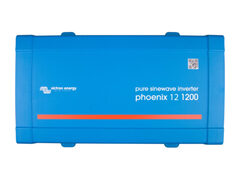
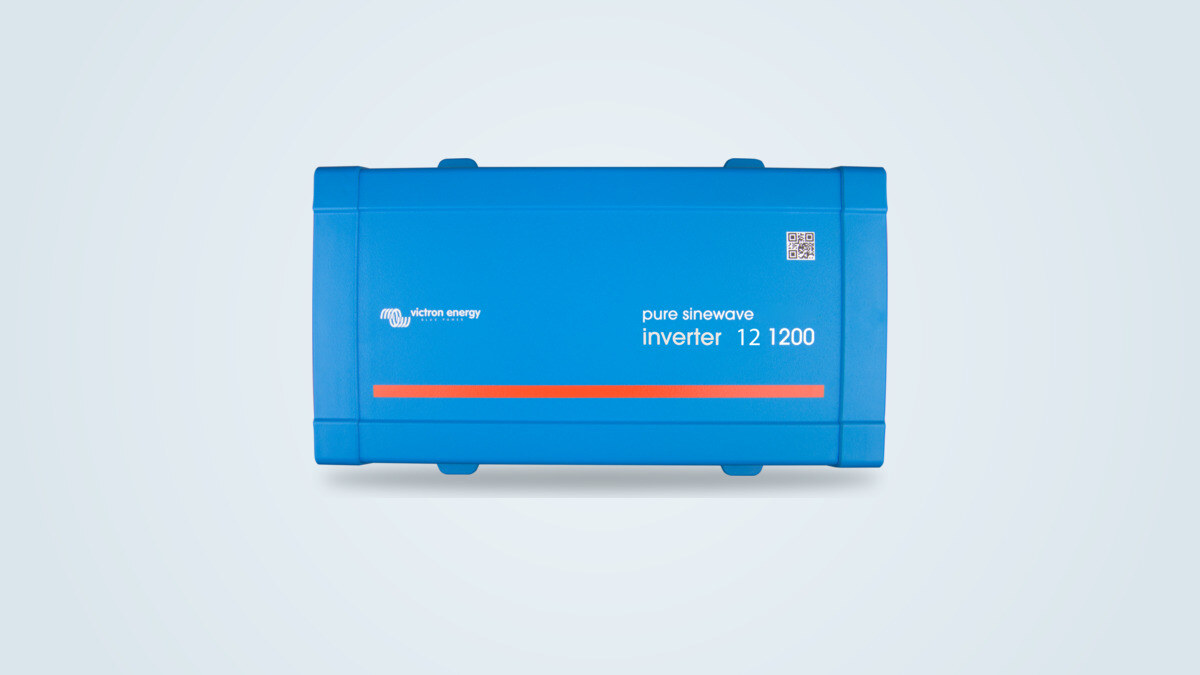
Motorhome, boat, remote job site or home backup power: the Phoenix 12/1200 VE.Direct turns a battery bank's 12 volts DC into 230-volt AC. It sits at the top of Victron's compact pure-sine inverter range, just above the Phoenix 12/500 and just below the Phoenix 12/2000. The "1200" refers to a nominal rating of 1200VA, not a continuous power figure you can use as-is: on the manufacturer's own spec sheet that works out to 1000 watts continuous at 25 °C, dropping to 850 watts once the internal temperature reaches 40 °C, with an admissible peak of 2200 watts for a few seconds to absorb a motor or compressor starting.
That gap between nominal and continuous rating is not a Phoenix marketing quirk: it's the same thermal derating that affects any semiconductor-based inverter worth its name, the difference being that Victron states it precisely, at 25 °C and 40 °C, two firm figures, rather than leaving it in the shadow of a single optimistic number on the box.
A pure sine wave that never has to apologise to sensitive equipment
A modified sine wave approximates mains current in steps: a lamp or a drill tolerate that, but a motor runs hotter, a transformer hums, and some switch-mode power supplies simply refuse to start. The Phoenix produces a genuine pure sine wave, generated by a full-bridge topology paired with a toroidal transformer, an architecture built from the ground up to absorb a high inrush current without flinching: that's what lets it start a laptop, a power tool or a small motor without the protection circuitry that cuts in early on a lighter high-frequency design. No independent measurement of total harmonic distortion is available to put an exact figure on signal purity, so the honest statement is what the design allows for, rather than a number.
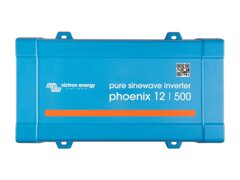
The peak margin genuinely changes the picture against the rest of the range. On the Phoenix 12/500, the 900-watt peak offered no universal guarantee of starting a compressor fridge, since inrush current can run up to ten times nominal draw depending on the unit plugged in. On the 12/1200, the 2200-watt peak gives a noticeably more comfortable margin against that same kind of load: most household compressors and consumer power tools stay well below that ceiling at start-up, which sharply cuts the risk of the protection tripping mid-manoeuvre. That's still not a universal guarantee, every motor having its own inrush current, but the uncertainty documented on the smaller sibling largely fades away here.
Ten watts idle, one in ECO mode: the gap that matters on a permanent installation
An inverter left permanently on a service battery draws power even with nothing plugged in, which is exactly what drains a reserve of energy over a few weeks of winter inactivity at the marina or on a storage lot. The Phoenix 12/1200 draws 10 watts idle in normal operation, a manufacturer figure mechanically higher than the Phoenix 12/500's 6.5 watts since its transformer and control electronics are larger, but one that stays proportionate to its power: measured against the 1000 watts it can deliver, that idle draw actually weighs a little less, proportionally, than the 12/500's against its 400 watts.
ECO mode changes the equation entirely: it brings idle draw down to 1 watt, an identical figure regardless of which model in the range. The unit goes to standby once load drops below an adjustable threshold, then wakes briefly every 2.5 seconds by default to check whether a load has reappeared; if it exceeds the wake threshold, fixed at the factory at 15 watts, the unit stays on. Below 15 watts, a load may go undetected: a single phone charger plugged in on its own, for instance, doesn't always pull the unit out of standby. The stated maximum efficiency reaches 91%, a figure that holds mainly at medium to high load, the zone where an inverter of this power spends most of its useful running time.
1000 watts held, but close to 90 amps to supply at 12 volts
The continuous rating of 1000 watts at 25 °C and 850 watts at 40 °C isn't just an isolated pair of figures: above 40 °C, the manufacturer states a further derating of 1.25% per additional degree, a gradual thermal behaviour rather than a hard cut-off past a single threshold. The 2200-watt peak, meanwhile, isn't measured on the same time basis: it's a few-seconds capability meant to absorb an inrush current, not power available continuously.
The flip side of that power shows up on the battery side. At full load, with efficiency close to 91%, the unit draws nearly 90 amps at 12 volts on the input. A 100 amp-hour lead-acid battery lasts only about thirty minutes under those conditions, discharged deeper than recommended: lithium, or a lead-acid bank of at least 200 amp-hours, is the safer target for comfortable use. The screw terminals take up to 25 square millimetres of cable, and it pays to get close to that on the run to the battery: at 90 amps, an undersized cable heats up and drops enough voltage to trip the low-voltage cut-off, adjustable from 9.3 volts (restart and alarm at 10.9 volts). A dynamic, load-dependent cut-off can also be enabled through VE.Direct to avoid a premature shutdown under heavy demand.
VE.Direct promises phone control: what you need to buy on top to get it
The VE.Direct port unlocks fine control normally out of reach on an entry-level inverter: low-voltage alarm and cut-off thresholds, load-dependent dynamic cut-off, output voltage adjustable from 210 to 245 volts, frequency at 50 or 60 hertz, and ECO mode on/off with its wake threshold. Getting connected to it is another matter: the port alone isn't enough, you need either a VE.Direct to USB cable for a computer or a VE.Direct Bluetooth Smart dongle for a phone or tablet, and both accessories are sold separately from the unit, roughly £30 to £40 extra for the dongle alone.
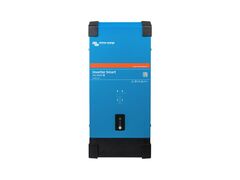
Once the dongle is paired, the VictronConnect app is mainly there for that configuration: on this VE.Direct generation, it doesn't consistently show a full real-time readout of instantaneous power or efficiency, a richer monitoring experience reserved for the newer Smart range, which builds Bluetooth straight into the unit with no extra dongle. Pairing itself is usually straightforward, but if the connection fails on the first attempt, the fix is to forget the Bluetooth device on the phone and rediscover it from the app, rather than repeatedly retrying the same pairing. Without either accessory, the unit runs perfectly well on its factory settings: configuration only becomes useful to anyone wanting to move away from those defaults.
Steel chassis, toroidal transformer: the weight of a design built to last
The Phoenix 12/1200 weighs 7.4 kg, built around a steel chassis under a plastic cover rather than an all-aluminium enclosure as sometimes assumed: most of that weight comes from the toroidal transformer, a heavier and costlier technology than a high-frequency design, but one with a reputation for holding sine-wave quality steady even at full load. The unit protects against an output short circuit, overload, battery voltage too high or too low, excessive temperature and excessive DC ripple on the input, six active protections rather than a simple fuse. The enclosure is rated IP21 and the unit runs from -40 °C to +65 °C thanks to fan-assisted cooling, with compliance to the ECE R10-4 automotive directive for installation aboard a vehicle.
Victron has built a reliability reputation that extends well beyond this one model, backed by a 5-year manufacturer warranty, unusually long at this power level against generalist competitors. Installations aboard boats that vibrate continuously or motorhomes that get properly hot in summer run for years without a documented incident, a noticeably tougher environment than a stationary household setting.
What the Phoenix 12/1200 doesn't do on its own
The unit doesn't automatically switch to another AC source: to hand over to mains power or a generator without manual intervention, you need to add the Filax accessory, an automatic transfer switch sold separately, which switches over in under 20 milliseconds once installed. Without it, the Phoenix remains a 12-volt to 230-volt converter in the strict sense, not a backup inverter in the way an IT professional would use that term.
The IP21 enclosure is also worth putting in context: that rating protects against solid objects larger than 12.5mm and vertically dripping water, not against splashing or sea spray. Despite its popularity on boats, the unit needs to be installed in a dry, ventilated space, never directly exposed to spray at an open helm station. Finally, the 7.4kg weight and the bulk that comes with it remain the price of admission against a high-frequency transformer inverter of comparable power, noticeably lighter but also noticeably less able to absorb a sustained inrush current.
Who this power level suits
The Phoenix 12/1200 is aimed primarily at a fixed, permanent installation: a motorhome or camper van for everyday household appliances (a coffee machine, an entry-level microwave, power tools), a boat for the same reason plus the added strain of vibration and ambient humidity, an off-grid site paired with a solar setup, or home backup power to keep the essentials running through an extended outage. On a job site it works just as well, but shares that ground with the petrol generators more commonly used there.
The North American market gets a specific NEMA-plug version with built-in ground fault protection (GFCI) right in the output outlet, a genuine plus for an installation near water, on a boat or in a motorhome bathroom. For a more modest need, limited to a laptop, a TV or charging tools, the Phoenix 12/500 does the job for a third of the price; to go beyond 1000 watts continuous, the Phoenix 12/2000 takes over within the same technology family.
Against the 12/500 and a generalist modified-sine unit
The table places the 12/1200 between its smaller sibling and a modified-sine inverter of similar advertised power.
| Criterion | Phoenix 12/1200 | Phoenix 12/500 | Modified sine 2000W |
|---|---|---|---|
| Continuous power | 1000 W | 400 W | 2000 W (claimed) |
| Peak | 2200 W | 900 W | 4000 W (claimed) |
| Waveform | Pure sine | Pure sine | Modified sine |
| Idle draw | 10 W (1 W in ECO) | 6.5 W (1 W in ECO) | Not stated |
| Observed price | ≈ £250 to £375 depending on market | ≈ £140 | ≈ £175 |
Against its own smaller sibling, the 12/1200 matches the 12/500 on signal quality and build (same architecture, same 5-year warranty), clearly beats it on real available power since its peak margin removes the compressor start-up ambiguity documented on the smaller model, but inherits the same accessory limitations (dongle sold separately, ECO threshold fixed without it) and adds a battery and cabling sizing burden that comes with its higher power. Against a modified-sine unit claiming double the wattage for sometimes less money, the comparison falls apart the moment a sensitive appliance is involved: a modified sine's real continuous output depends heavily on ventilation and battery voltage at the time, without the Victron's safety margin or ECO mode.