
The 30W promise, kept on a single port
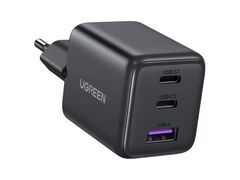
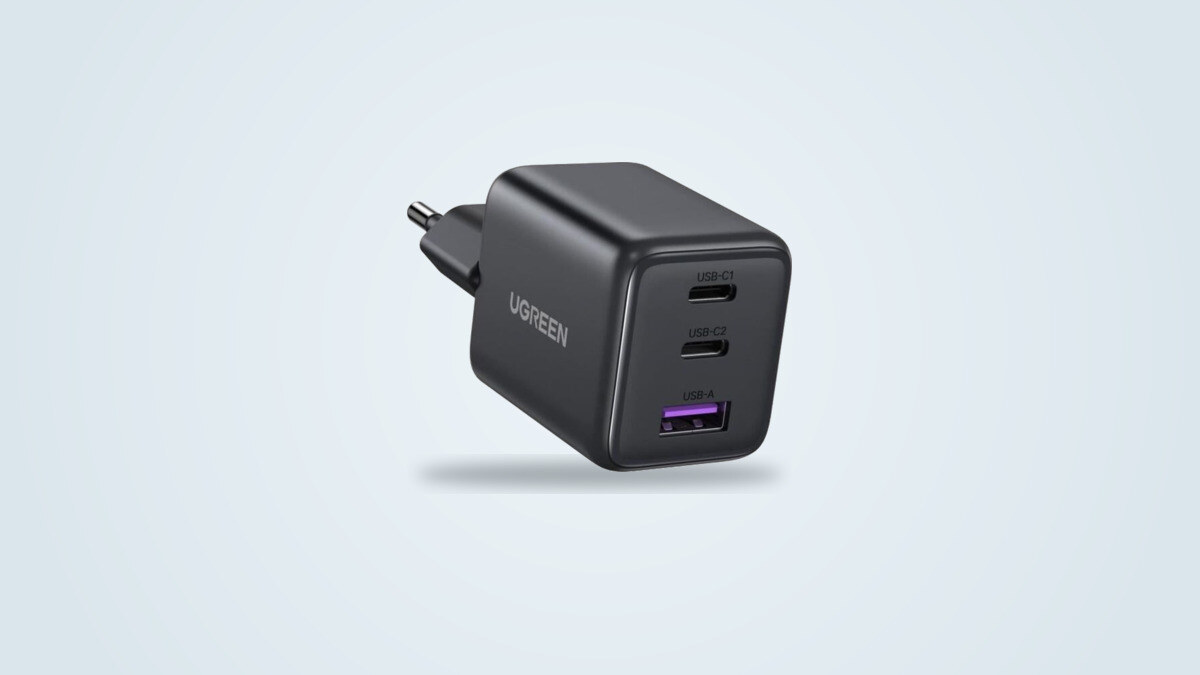
The Ugreen Zapix 30W is a small three-port wall charger: two USB-C sockets and one USB-A socket, packed into a case barely bigger than a matchbox. On the European market it carries EAN 6941876255368 and sits in Ugreen's entry-level range, in the spot once held by the single-port bricks that used to ship in the box with smartphones.
Used alone, each of the two USB-C ports delivers up to 30W over USB Power Delivery 3.0 with PPS (Programmable Power Supply, which fine-tunes voltage in small steps to reach a compatible device's fastest charging speed). The USB-A port, for its part, tops out at 22.5W. Both figures are the ones on the manufacturer's own spec sheet, with no hidden tier and no gap found.
The charger accepts a universal input voltage of 100 to 240V, which makes it usable in most countries without a voltage converter, only the plug shape needing an adapter depending on the destination. On a recent iPhone, Ugreen states a charge from 0 to 50% in roughly thirty minutes on the main USB-C port, a claim consistent with the 30W on offer. The case has no screen and no power readout: there is no way to see what charging speed is actually being negotiated with the connected device, a simplicity that also has its limits, covered further down.
Three devices at once, but not three fast charges at once
The Zapix 30W's headline pitch is its ability to power three devices at the same time without stacking bricks on a power strip. That much is true: all three ports do work simultaneously. What the marketing line does not spell out as clearly is what happens to charging speed once two of them are drawing power at the same time.
As soon as a second port kicks in, whichever one it is, each active output drops to around 15W. The 30W total does not grow: it gets divided up. Two devices plugged in together therefore each end up with roughly half of what they would have gotten alone, and a third device only shrinks everyone's share further, since the charger's total budget stays fixed. Ugreen does not publish an exact breakdown for three active ports: beyond the 15W figure that applies from the second port onward, the precise share of each output with all three ports running is not documented.
In practice, plugging in a smartphone and a pair of earbuds overnight suits this setup perfectly well: neither one needs 30W to charge. The limit shows up mainly if the goal is to fast-charge two recent smartphones at the same time: each then has to settle for roughly half of its top charging speed, a nuance the case, with no screen and no indicator, never signals in any way.
PD, PPS, QC, UFCS: broad compatibility, no gap found
The Zapix 30W supports USB Power Delivery 3.0 with PPS, Qualcomm's Quick Charge 3.0, and UFCS (Universal Fast Charging Specification), a newer protocol backed by a consortium of several Chinese smartphone makers and designed to cut down on the proliferation of proprietary fast-charging standards. The manufacturer also lists support for Samsung's AFC and Huawei's SCP, two older proprietary protocols.
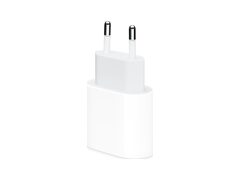
This broad compatibility covers the bulk of devices in use today: a recent iPhone gets PD and PPS for its fastest charge, a recent Galaxy also benefits from PPS (unlike the Apple 20W USB-C in the same catalogue, which does not support it and leaves Galaxy phones short of their top charging speed), a Pixel relies on standard PD, and older Huawei or Honor devices fall back on SCP whenever UFCS or PD are not enough. No incompatibility or particular limitation was found on any mainstream device, which puts the Zapix 30W among the strongest performers of its price bracket on this exact point.
The limit lies in available power rather than in the protocol itself: a MacBook Air can get a top-up charge over the USB-C port, but 30W is structurally not enough to charge it at full speed, which typically needs between 35 and 70W depending on the model. An iPad, on the other hand, reaches its full charging speed without trouble at this power level.
GaN II delivers on its miniaturisation promise
The case measures 44 x 38 x 33 mm. For three ports and 30W of total power, that is a very compact format, made possible by the GaN II chip (second-generation gallium nitride) that replaces the silicon components found in older chargers. Gallium nitride conducts electricity with fewer losses than classic silicon, which lets manufacturers shrink the cooling components without the case running any hotter.
| Model | Ports | Total power | Dimensions |
|---|---|---|---|
| Ugreen Zapix 30W | 2 USB-C + 1 USB-A | 30 W | 44 x 38 x 33 mm |
| Apple 20W USB-C | 1 USB-C | 20 W | about 45 x 37 x 24 mm |
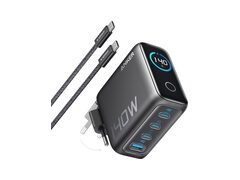
| Anker 140W GaN (4 ports) | 3 USB-C + 1 USB-A | 140 W | about 69 x 69 x 36 mm |
The comparison with the Apple 20W adapter is telling: lacking GaN, it takes up a comparable volume for both a lower power output and fewer ports than the Zapix. The difference in technology explains that gap directly, more than any difference in design philosophy between the two brands.
Standard protections, and a still-short track record
The Zapix 30W includes the usual protections for this kind of product: cutoff on overvoltage, overheating and short-circuit, paired with a fire-retardant plastic casing. Ugreen also advertises real-time thermal monitoring, branded ThermalGuard, checking temperature more than 238 times per second. That figure is a technical specification the manufacturer provides, to be taken as such: this small case has no visible feedback at all (no screen, no detailed status light) that would let a user see it happening for themselves.
No safety recall or incident is tied to this model so far. That said, this should be weighed against how young the product is: the first public sightings of the Zapix 30W date back to late 2025, which leaves a much shorter market history than references sold for several years, such as the Apple 20W adapter, with no incident on record since 2020. A clean record over less than a year and a clean record over six years do not carry the same weight.
Weight, warranty, listings: the documentation gaps
Two basic pieces of information are missing from the manufacturer's official spec sheet: the case's exact weight, and the contractual warranty length specific to this model. Ugreen's own pages show warranty lengths that vary considerably by product and by market, with no single reliable figure emerging for this particular Zapix 30W. The same missing weight also affects the Apple 20W adapter in the same catalogue: this is not an isolated exception on this kind of product, but it remains a useful piece of information missing for anyone trying to compare references objectively.
Several third-party listings also describe a port layout that does not match reality, for example 1 USB-C port and 2 USB-A ports instead of the 2 USB-C and 1 USB-A actually present on the case. This kind of copy-paste error between resellers says nothing about the product's own quality, but it is worth comparing a seller's description against actual photos of the product before completing a purchase.
No cable comes in the box, only the charger and its manual: a USB-C or USB-A cable has to be sourced separately depending on the device being charged, a now-common setup at this price point and not an anomaly in itself.
Against Nexode, and against its own all-USB-C successor
At Ugreen, Zapix marks the entry-level range, built for everyday smartphone and small-accessory use, while Nexode targets higher power levels (65W and above) sized for laptops. The Zapix 30W and the Nexode 65W share the same design logic (three ports run off a single GaN chip) but aim at different needs: the latter serves a smartphone just as well as a lightweight laptop, while the former is structurally limited to devices that make do with 30W or less.
A newer version of the same concept also exists at Ugreen, this time entirely in USB-C: three USB-C ports and no USB-A at all, which appeared on some European markets in early 2026 under a very similar look. Its power-sharing between active ports is tiered rather than split evenly, a different behaviour from the one described above for this exact model. Both versions currently sit side by side on the market under very similar visuals: checking for an actual USB-A port in the photos and description before ordering remains the most reliable way to make sure the version described in this review is the one being bought, or the opposite if a USB-A port is not needed.
Against the Apple 20W, the Anker Nano 3 and the Anker 140W GaN
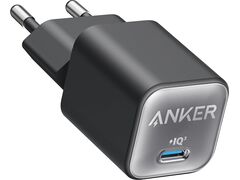
At an equal or lower price, the Zapix 30W mostly comes up against single-port chargers. The Apple 20W USB-C, limited to one port and without GaN or PPS, costs more for both lower power and weaker compatibility: its one real strength remains full integration with the Apple ecosystem. The Anker Nano 3 (511) 30W, also single-port but built with GaN and PPS, matches the Zapix on power and compatibility for a single port, without ever having to manage sharing since it only has one output.
| Criterion | Ugreen Zapix 30W | Apple 20W USB-C | Anker Nano 3 (511) 30W | Anker 140W GaN (4 ports) |
|---|---|---|---|---|
| Ports | 2 USB-C + 1 USB-A | 1 USB-C | 1 USB-C | 3 USB-C + 1 USB-A |
| GaN | Yes (GaN II) | No | Yes | Yes |
| PPS | Yes | No | Yes | Yes, capped at 20V |
| Multi-port sharing | around 15 W per port from 2 active | Not applicable | Not applicable | 134 W combined maximum across 4 ports |
Against the Anker 140W GaN, a charger built to power a laptop and three other devices at once, the comparison falls short: it belongs to a completely different price and power bracket. It is still useful for one shared point: the total power a multi-port charger advertises always gets divided up, whatever the brand, once several outputs draw power at the same time. The Anker does it with a very small total loss (134W combined out of the 140W in its name) and a split that favours whichever device needs the most; the Zapix splits evenly across active outputs, a simpler approach but a less generous one for a device that would need more.
Who this charger suits, and who should look elsewhere
The Zapix 30W makes the most sense for anyone wanting to replace several wall bricks scattered across a power strip with one compact case: a smartphone on a USB-C port, earbuds or a smartwatch on the other two, typically overnight or during a day at the office, with no need for top charging speed on all three at once. At around ten euros in most cases, it also works well as a backup or travel charger that will not strain a budget.
It suits less well anyone wanting to fast-charge two recent smartphones at the same time: the drop to around 15W per port from the second connection onward turns that into normal charging rather than fast charging. It is also not a fit for anyone wanting to power a laptop at full speed, or looking for a USB-A port above 22.5W for an older, more power-hungry accessory. Finally, anyone who has already spotted the Zapix 30W on a product page should check that it really is the 2 USB-C plus 1 USB-A version described here, and not its all-USB-C successor, if that difference matters for the intended use.