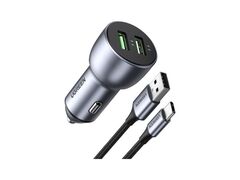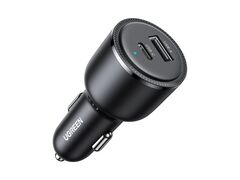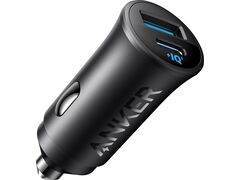


The bare essentials, honestly specified
Next to its own siblings' retractable cable or 100W port, the Ugreen 36W plays a different card: two plain USB-A ports, no frills, at the lowest price in the brand's whole cigarette-lighter range. Its product page states what pricier neighbouring models leave out: a clear weight, size and warranty length.
18W per port over Quick Charge 3.0: the protocol's promise
Each USB-A port delivers up to 18W over Quick Charge 3.0, across the protocol's three steps (5V/3A, 9V/2A or 12V/1.5A): the chip automatically picks the step that matches the connected device. Ugreen states that a QC 3.0 compatible smartphone reaches 80% charge in 35 minutes, up to 4 times faster than a basic cigarette-lighter charger limited to 5W. Both ports share a 36W total budget that matches exactly the sum of the two individual maximums (18 + 18): unlike a charger that only holds full power on a single port used alone, the stated design does not appear to cut watts when both are drawing at once.
Two devices at once, with no reported power cut
With two physically separate ports, the Ugreen 36W can charge the driver's phone running navigation and the passenger's phone or tablet at the same time, with neither port officially throttled by the other: the 36W total matches exactly the sum of the two 18W maximums. That is a simpler, and on paper more predictable, structure than a three-output charger from the same brand where a single port takes the lion's share of the power while the other two make do with a smaller cut.
QC 3.0, QC 2.0, AFC, FCP: wide on Android, blind to the iPhone
The auto-identification chip recognises Quick Charge 3.0 and 2.0, plus AFC (Huawei) and FCP (Huawei/Honor), on top of the generic BC 1.2 that guarantees basic charging for any USB device. That list covers a good share of the Android devices in circulation, whether cabled directly in USB-A or through a USB-A to USB-C adapter.
The flip side of that approach: with no USB-C port, the Ugreen 36W speaks neither Power Delivery nor PPS, the two protocols behind fast charging on the most recent smartphones, iPhone included as much as high-end Android. And for the iPhone specifically, Quick Charge has no effect anyway: Apple does not recognise this Qualcomm protocol, so an iPhone plugged into this charger caps out at basic USB charging, well below what it gets from a Power Delivery charger.
The most compact charger in the whole Ugreen cigarette-lighter range
At 65 x 30 x 30 mm for 40g, the Ugreen 36W is not just the cheapest but also the most compact and lightest in its own range, which runs all the way from this 36W model to a 145W charging station.
| Data point | 36W | 63W | 130W |
|---|---|---|---|
| Size | 65 x 30 x 30 mm | Not stated | 76 x 36 x 36 mm |
| Weight | 40g | Not stated | 45g |
| Stated warranty | 2 years | Not stated | Not stated |
On this specific point, the ranking flips compared with power output: the least powerful model in the range is also the one whose product page is most complete on criteria that ought to be simple to state.
4 standard protections and a stated warranty, a rarity in the range
The aluminium body includes the four standard protections expected on this type of accessory: overvoltage, overcurrent, overheating and short circuit. A blue light ring makes the port easier to find inside the car after dark, a detail also found on other Ugreen cigarette-lighter chargers, and one that stays lit permanently as soon as the unit is powered, with no switch to turn it off.
Ugreen states a 2-year warranty for this specific model, a duration the product pages for the Ugreen 60W and 130W in the same range do not give. In a market where contractual warranty length is rarely advertised, that is a rare and useful piece of information for a buyer, even though it says nothing by itself about the product's real long-term reliability.
What it cannot do: laptop charging and fast USB-C charging
The Ugreen 36W accepts a clear limit: with no USB-C port, it cannot power any laptop, not even a light one that would settle for 20 to 30W. It also misses out on Power Delivery and PPS, the protocols that let the newest smartphones and tablets reach their maximum charging speed. For those uses, the Ugreen 63W (45W USB-C port) or 130W (100W USB-C port) in the same range are better equipped, at a higher price.
Against the Ugreen 63W and the Anker 30W
How does the Ugreen 36W compare with other entry-level and mid-range car chargers?
| Criterion | Ugreen 36W | Ugreen 63W | Anker 30W |
|---|---|---|---|
| Ports | 2x USB-A | 1x USB-C + 1x USB-A | 1x USB-C + 1x USB-A |
| Total power | 36W | 63W | 30W |
| USB-C / Power Delivery | No | Yes, 45W | Yes, 30W |
| Size / weight | 65x30x30 mm, 40g | Not stated | Not stated |
| Stated warranty | 2 years | Not stated | Not stated |
| Observed price | ≈ £15.99 | ≈ £23.36 | ≈ £13 |
The Ugreen 36W stays the cheapest and simplest of the three, but also the only one to state a clear weight, size and warranty. The Anker 30W, at a very close price, adds a USB-C Power Delivery port that charges recent devices a little faster and accepts a cable that is not USB-A. The Ugreen 63W doubles the power and adds a 45W USB-C port able to keep a small laptop topped up, for more than double the budget. For anyone who just needs to charge two Android phones or tablets with no need for maximum speed, the 36W remains good enough, and the cheapest of the three.
Who the Ugreen 36W is for
This charger suits anyone wanting to fit out a car for charging two Android phones or tablets with no need for maximum speed, at the lowest price in the Ugreen range. For a USB-C port able to keep a light laptop topped up, the Ugreen 63W is better equipped; for an equally compact charger that adds a USB-C Power Delivery port, the Anker 30W is a close-priced alternative.