
What the shared 30W across three ports is really worth
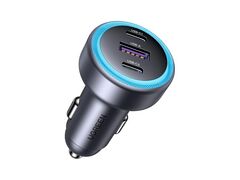
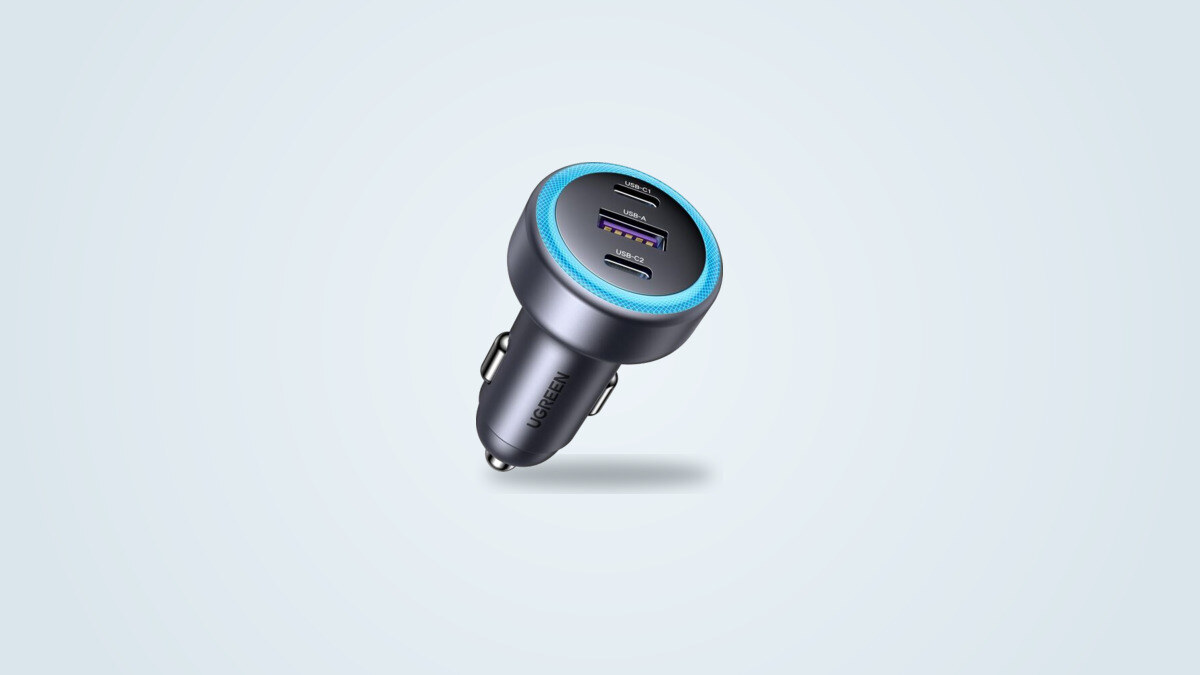
The Ugreen Car Charger 30W turns the cigarette lighter socket into a three-output charging point: two USB-C ports and one USB-A port, all usable at the same time. Each port has a clear individual ceiling: up to 30W on either USB-C port used alone, up to 22.5W on the USB-A port used alone. That is the most generous part of the promise, and it holds up exactly as stated.
The nuance appears as soon as a second device joins in. The manufacturer states a total output of 30W for the whole charger, distributed automatically across the active ports. Adding up the three individual ceilings (30 plus 30 plus 22.5), this charger could theoretically deliver 82.5W in total: in practice, the combined output never exceeds 30W once several devices share the socket.
In practice, a single device plugged in fully enjoys its port's ceiling (30W or 22.5W depending on the port). As soon as a second device joins the first, both share a common 30W budget, and each one's charging speed drops accordingly. Ugreen does not publish a precise table showing the exact split between two or three devices: only the principle of automatic distribution is stated. This is a structural difference from more powerful cigarette lighter chargers from the same brand, where two devices plugged in together can reach the full advertised power with no compromise at all.
Six fast-charging protocols across three ports
Six fast-charging protocols are supported in total: USB Power Delivery 3.0, PPS (Programmable Power Supply), Quick Charge 3.0, plus SCP, FCP and AFC, the protocols specific to Huawei/Honor and Samsung. This list is as complete as the one on the brand's own 30W USB-C mains charger, a sign that Ugreen reuses the same charge-negotiation base across several product formats.
| Port | Protocols supported |
|---|---|
| USB-C1 and USB-C2 | USB PD 3.0, PPS, QC 3.0, SCP, FCP, AFC |
| USB-A | QC 3.0, SCP, FCP, AFC (PD and PPS reserved for the USB-C ports) |
PPS deserves an explanation: rather than fixed voltage steps (5V, 9V, 12V), it adjusts voltage continuously in fine increments, which limits heat build-up in the cable and the phone during fast charging, a mechanism central to the adaptive charging used on recent Galaxy phones. Having AFC (Samsung), FCP and SCP (Huawei, Honor) alongside the usual PD/QC pairing widens compatibility well beyond the standard Apple/Android baseline, with no brand needing its own proprietary charger to get a decent fast-charging speed.
The LED ring: finding the ports in the dark
The feature that gives the product its name is a blue light ring surrounding the three ports, each labelled with its own silkscreen marking (USB-C1, USB-A, USB-C2). It instantly shows where each socket is and lets you plug in a cable without fumbling, a genuine comfort at night or in a dark cabin, without dazzling the driver since the light stays directed at the ports rather than out into the cabin.
This detail, missing from several direct competitors at the same price, is the main visual difference from a standard cigarette lighter charger: most equivalent models on the market settle for unlit ports, which means fumbling around or turning on the interior light to check the connection while driving at night.
Charging an iPhone, an Android phone, an accessory: the numbers stated
The manufacturer states that an iPhone 15 Pro Max goes from 0 to 55% battery in 30 minutes on either USB-C port, thanks to the PPS protocol. That figure places this small charger in the upper end of today's 30W chargers, without exceeding it: 30W remains an effective top-up power for a smartphone, but far from the 65W-and-up standard of higher-end chargers meant for laptops or tablets.
The USB-A port, capped at 22.5W via SCP, FCP or AFC depending on the connected device, offers decent fast charging for an Android smartphone or an accessory (smartwatch, earbuds, handheld console, dashcam), though it lags behind today's best phones, which accept 45W and more. For a GPS unit or a modest-power accessory, that ceiling changes nothing in practice: it is already more than enough.
Safety, input voltage and build
The aluminium body houses six electronic protections claimed by the manufacturer: against overcurrent, short circuits, overvoltage, undervoltage, overheating and overpower. That is a complete list for an accessory that stays connected to the vehicle's battery continuously while driving. The accepted input voltage runs from 12 to 24V, covering a passenger car as well as a truck or a van.
This same product reference shows up, under an identical catalogue identifier, on several of the manufacturer's regional stores, a sign of an established line rather than a brand-new launch. No safety defect or recall turned up in the research carried out on this specific model.
A very compact format, but no cable included
With an aluminium body measuring 53 x 25 mm, this charger ranks among the most compact formats in the cigarette lighter segment, far more discreet in the socket than a model with an integrated retractable cable. That compactness comes with a trade-off: no cable is included in the box, so you need a suitable USB-C or USB-A cable of your own to get fast charging from the first trip.
Leaving out the cable is a fairly common choice at this price point, but it is worth flagging explicitly: unlike a charger with a built-in cable, such as some more powerful models from the same brand, this one will not help a driver who has no cable on board at all.
Against direct competition and the Ugreen line-up
How does this Ugreen 30W stack up against a direct competitor of the same power, and against its own range?
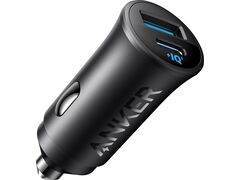
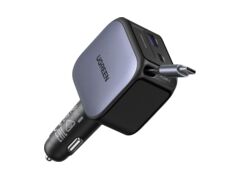
| Criterion | Ugreen 30W (2C1A) | Anker 30W | Ugreen 36W | Ugreen 90W |
|---|---|---|---|---|
| Ports | 2x USB-C + 1x USB-A | 1x USB-C + 1x USB-A | 2x USB-A | USB-C cable + 1x USB-C + 1x USB-A |
| Total power | 30W shared | 30W shared | 36W shared | 90W with 2 devices, 75W with 3 |
| USB-C port(s) | Yes, 2 PD/PPS ports | Yes, 1 PD port | No | Yes, cable + 1 PD/PPS port |
| Light ring or trim | Yes, blue ring | Yes, light trim | Yes, discreet | Not listed |
| Observed price | £8.97 | £12.82 | £15.99 | £15.99 |
Against the Anker 30W, cheaper but limited to two ports, this Ugreen adds a genuinely usable third port and a wider protocol list (the Anker sticks to USB PD and its own proprietary PowerIQ 3.0), at the cost of a power split that now involves three ports instead of two. Against the Ugreen 36W from the same brand, which has no USB-C or Power Delivery at all, this 30W gains real versatility for modern devices for a few pounds more. Against the Ugreen 90W, which belongs to a higher tier with a built-in cable, the difference is clear: two devices plugged in together reach the full advertised power on the 90W, whereas this 30W already imposes a split from the second device onward.
Who it suits, and who should look elsewhere
This charger suits anyone looking for an affordable backup solution to keep several people on board topped up (driver, passenger, GPS unit) without ever fumbling for the right port thanks to the LED ring. Its broad protocol compatibility (PD, QC, PPS, SCP, FCP, AFC) makes it a sensible choice whether the household runs Apple, Samsung, Huawei or generic Android devices.
It suits less well anyone who needs to fast-charge two or three devices at full speed at the same time: in that case, the 30W budget split is felt from the second device onward, and a model such as the Ugreen 90W from the same range, where two devices together reach full power, is the better fit.