
5,000mAh, 18.5Wh: what the promise actually covers
One figure dominates the box: 5,000mAh. Sunslice itself converts that into a more useful number in its spec sheet, 18.5Wh, at the pack's real voltage, 3.7V. The math is simple and checkable: 5,000mAh times 3.7V gives 18,500mWh, or 18.5Wh flat. That is the same reference voltage used on the brand's own Gravity 10 and 20, a sign of consistency rather than a one-off choice of a flattering voltage to inflate the stated energy.
That 18.5Wh figure has a concrete travel consequence: the limit generally applied for carrying a power bank in the cabin without prior authorisation sits at 100Wh. The Gravity 5 clears that with a very comfortable margin of over 80Wh, and the manufacturer's manual confirms it explicitly. It is only allowed in carry-on luggage, though: lithium batteries remain banned from checked baggage regardless of capacity.
The question that matters most to a buyer is how many phone charges that actually represents once it passes through the output ports. A recent smartphone typically stores between 13 and 19Wh depending on the model. Accounting for a common conversion loss of 15 to 20% on a plain USB-A output with no Power Delivery regulation, the Gravity 5's 18.5Wh deliver roughly 14.8 to 15.7Wh of usable energy to the connected device. That is enough for a full charge on the most modest phones, and most of a charge on the largest ones. The claim of a near-complete charge holds up across the market without being inflated.
10W across two ports: an honest limit, no fast charging
The Gravity 5 offers two active outputs, both USB-A, each rated 5V/2.1A on the manufacturer's technical diagram, which adds up to a bit over 10W if both ratings are added together. Sunslice nonetheless caps the combined output of the two ports at 10W total, a limit stated consistently on the product page, the official site and the manual. Unlike some other models from the same brand, this Gravity 5 makes no claim of simultaneous full-speed charging across multiple devices: the ceiling is low, but it is stated without ambiguity.
No fast-charging protocol equips this battery: no Power Delivery, no Quick Charge. Both USB-A ports deliver a fixed 5V output with no negotiation with the connected device. In the sub-£30 5,000mAh segment, that is now a choice against the grain: most direct rivals at this price point have moved to a USB-C port with Power Delivery at 18W or more, which noticeably cuts the time needed to top up a recent smartphone.
For occasional backup use rather than an emergency top-up, the difference mostly shows up in duration: on this Gravity 5, fully charging a smartphone mechanically takes longer than on a rival at 20W or above. Plugging in two devices at once on the two ports remains possible, but it necessarily splits the available 10W between them.
Charging the 18.5Wh: a dual input that makes a difference
The Gravity 5 charges via either its USB-C port or its Micro-USB port, both capped at 10W (5V/2A). That dual input is rarer than it looks at this price point: most recent rivals have dropped Micro-USB in favour of USB-C alone. For anyone travelling with companions who carry older devices, or who simply keeps an old Micro-USB cable in their bag, that is a genuine everyday convenience.
Sunslice does not publish an official full-charge time for this model. As a calculation, at a constant 10W from start to finish, filling the pack's 18.5Wh would take just under two hours; in practice, the current a lithium cell accepts tapers off towards the end of a charge, which stretches that estimate slightly further. That 10W input ceiling is nothing unusual for such a compact pack, though: total charging time stays noticeably shorter than on the brand's own Gravity 10 and 20, which have to fill a much bigger tank with an input ceiling only slightly higher (18W).
No fast-charging protocol speeds up this input: no Power Delivery, no Quick Charge. A plain mains charger or a laptop is enough to charge it, with no special requirement beyond a standard USB-C or Micro-USB cable.
125 grams, 98 x 64 x 14mm: compact, but not the densest in its own range
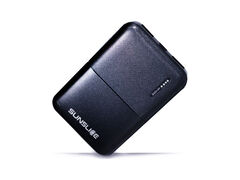
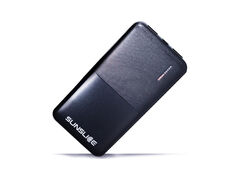
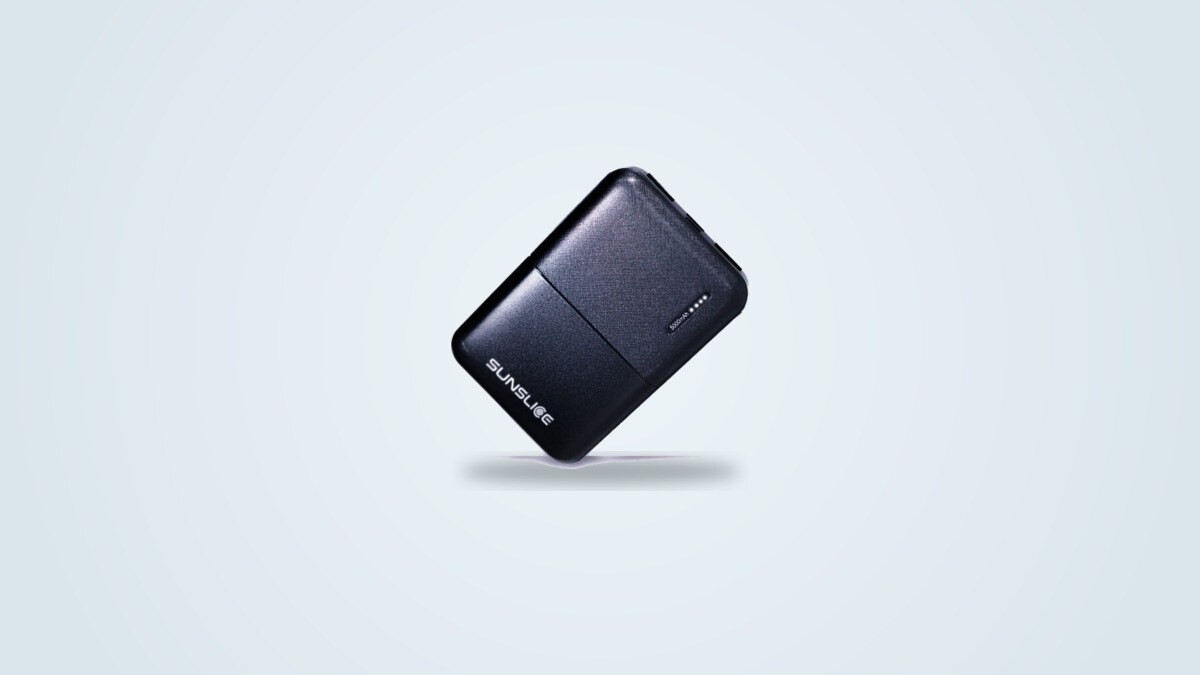
On the scale, the Gravity 5 weighs 125 grams for a footprint of 98 x 64 x 14mm, barely larger than a thick credit card. It is the most compact and lightest shape in the entire Sunslice Gravity range, well ahead of the Gravity 10 (220g) and the Gravity 20 (400g).
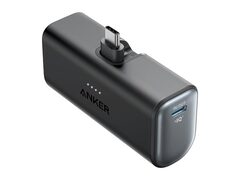
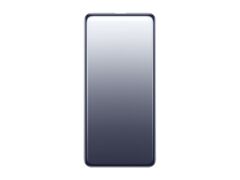
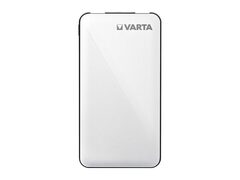
Against three similarly priced 5,000mAh power banks, the Gravity 5 sits mid-table: heavier than the Anker Nano A1653 and the Xiaomi Ultra Slim 5000, lighter than the Varta Energy 5000.
A simple calculation puts that compactness in perspective, though: relative to its real energy, the Gravity 5 weighs 6.8 grams per Wh stored, against 5.9 for the Gravity 10 and 5.4 for the Gravity 20. The bigger a battery in this range gets, the more efficient it becomes per gram, a mechanical effect of electronics and casing that do not shrink in the same proportion as the cell inside. The Gravity 5 remains the easiest to slip into a pocket, but not the most efficient per gram in its own family.
Four LEDs, no light: connectivity pared to the essentials
Four LED indicators show remaining charge in 25% steps, with no digital screen or exact percentage. That is a simpler solution than on newer models, but enough to tell at a glance whether there is enough energy left for the day.
Unlike the Gravity 10 and 20 in the same range, the Gravity 5 has no built-in LED light. That is a real trade-off for anyone counting on that feature while camping or during a power cut: on this specific point, the two larger models in the family do better, at a noticeably higher weight and size, admittedly. The Gravity 5 also skips pass-through charging (charging the bank while it powers a device), wireless charging, and a built-in or retractable cable: a USB-A to USB-C cable ships in the box, easy enough to replace if lost or worn thanks to its standard format.
The manufacturer highlights a built-in voltage stabilisation circuit, said to protect connected devices against voltage spikes or drops. That is a common safety claim for this type of product, hard to verify from the outside, but consistent with the absence of any reported fault or incident for this model so far.
No waterproofing rating, and no Extreme version for this size
No IP protection rating is published for the Gravity 5. The manufacturer's manual sticks to standard precautions: keep it away from rain and water, do not expose it to fire or excessive heat, do not puncture or drop it, and stop using it if it produces an unusual smell, heats up, or shows any deformation.
That detail matters, because Sunslice sells ruggedised versions for two other sizes in its range: a Gravity 10 Extreme and a Gravity 20 Extreme Pro, both advertised as shock and water resistant. There is, however, no Extreme version of the Gravity 5 at this time: this size only comes in the standard variant covered in this review.
For the standard version, caution outdoors remains sensible: a light shower on a closed casing is generally not an immediate problem, but immersion or prolonged exposure to heavy rain fall outside the use the manufacturer intends.
Works with Fusion Flex solar panels: the real math
The Gravity 5 charges via its USB-C or Micro-USB port, which makes it compatible with Sunslice's foldable Fusion Flex solar panel range with no extra adapter. That is a genuine ecosystem argument, one none of the three direct rivals in this review can offer.
A simple calculation shows what that means in real use. With the smallest panel in the range, the Fusion Flex 6 (6W rated), refilling the Gravity 5's 18.5Wh from empty would take, at constant power and in uninterrupted full sun, a little over three hours. That figure is a theoretical floor: a flexible panel laid on the ground or on a backpack rarely keeps an optimal angle to the sun, and its output drops sharply as soon as a cloud passes. Over a real day of hiking or camping, reaching a full charge this way likely means spreading that math over several hours of cumulative sunshine rather than one continuous session.
Sunslice itself recommends plugging its Fusion Flex panels into a power bank rather than directly into a phone, precisely to smooth out these swings in output. The Gravity 5 plays exactly that intermediary role in the brand's ecosystem: a coherent fit for anyone who already owns or is considering a Sunslice panel, but of no benefit to anyone who does not.
Sunslice: a Belgian brand that nearly went under before bouncing back
Sunslice is a Belgian company founded in 2017 in Louvain-la-Neuve by two civil engineers out of UCLouvain, Geoffroy Ghion and Henri Gernaey, from a solar charger project they designed during their studies. The company, Sunslice SRL, is based on Chemin du Cyclotron, in the same Walloon university town.
Its journey has been anything but smooth. Riding demand for autonomous energy solutions after 2022, the company topped €1 million in revenue that year, largely thanks to its portable generators. Demand for those same generators then dried up abruptly, and a Belgian investor who had been negotiating for nine months pulled out in September 2023, leaving the founders with near-empty coffers and a sizeable stock of unsold units. The company found its footing again by moving into an unexpected market: powering satellite connectivity equipment, with kits combining batteries, solar panels and transport systems for players in the sector such as Marlink, riding the growth of Starlink. Business momentum turned positive again from 2025.
On the consumer side, the Gravity 5 is still sold through Amazon in several European countries and via the brand's own site, alongside specialist outdoor retailers. The Gravity 5 carries a two-year warranty, the standard length for the category, with after-sales support handled by email through Sunslice. No product recall or safety issue has been reported for this model to date.
Against Anker, Xiaomi and Varta: what justifies the gap
In the 5,000mAh segment selling for roughly £13 to £30, the Gravity 5 faces dense competition. Three models of identical capacity compete for the same shelf space: the Anker Nano A1653, a benchmark for fast charging; the Xiaomi Ultra Slim 5000, one of the thinnest on the market; and the Varta Energy 5000, a cheaper safe bet.
| Criterion | Sunslice Gravity 5 | Anker Nano A1653 | Xiaomi Ultra Slim 5000 | Varta Energy 5000 |
|---|---|---|---|---|
| Capacity | 5,000mAh (18.5Wh) | 5,000mAh (18Wh) | 5,000mAh | 5,000mAh |
| Output power | 10W (2x USB-A) | 22.5W (USB-C, PD) | 20W (USB-C) | 15W |
| Weight | 125g | ≈ 100g | ≈ 93g | ≈ 150g |
| Pass-through | No | Yes | Not stated | Not stated |
| Works with solar panels | Yes (Sunslice ecosystem) | No | No | No |
| Observed price | £24.94 | ≈ £26 | ≈ £18 | ≈ £13 |
The Anker Nano A1653 wins clearly on charging speed thanks to its 22.5W USB-C port and pass-through function, and the Xiaomi Ultra Slim stays thinner on the scale. The Varta Energy 5000 plays the price card, at the cost of a heavier casing and lower power. The Gravity 5 wins on neither price nor raw power: it stands out through its dual USB-C and Micro-USB input, and above all through its direct compatibility with Sunslice's foldable solar panels, an argument none of the other three can claim.
Gravity 5, 10 or 20: which one to pick in the Sunslice lineup
Sunslice spreads its Gravity range across several capacities, including the Gravity 10 and 20 also reviewed on this site. All three share the same compatibility with Fusion Flex solar panels and the same two-year warranty, but differ sharply on ports and equipment.
| Specification | Gravity 5 | Gravity 10 | Gravity 20 |
|---|---|---|---|
| Capacity | 5,000mAh (18.5Wh) | 10,000mAh (37Wh) | 20,000mAh (74Wh) |
| Weight | 125g | 220g | 400g |
| Density | 6.8g per Wh | 5.9g per Wh | 5.4g per Wh |
| Power | 10W total (2x USB-A) | 18W per port (1 USB-C, 2 USB-A) | 18W per port (1 USB-C, 2 USB-A) |
| Built-in light | No | Yes | Yes |
The step up is not just about capacity: the Gravity 10 and 20 add a USB-C output port, a built-in LED light and a far higher per-port power ceiling, at the cost of noticeably higher weight and bulk. The Gravity 5 remains the only one of the three that fits in a trouser pocket without drawing attention, but also the only one with neither a light nor a USB-C port. For occasional, very light use it makes sense; for extended outdoor use or hungrier devices, the Gravity 10 strikes a better balance between weight and real capacity.
Pocket, handbag, travel pouch: who it's for
Day to day, the Gravity 5 fits a simple backup role: giving a smartphone whose battery is fading by the end of the day some extra runtime, without carrying anything bulky. Its size and weight make it easy to forget in a pocket, a handbag or a wash bag until it is actually needed.
While travelling, its dual USB-C or Micro-USB input simplifies things when sharing a cable with travel companions who carry a different type of device. On light hikes or the occasional camping trip, its compatibility with Fusion Flex solar panels lets it build up a modest reserve over the hours of sunshine available.
It suits anyone after a minimalist energy reserve for a smartphone, who puts weight and size above all else, and who likes being able to recharge it with whatever cable is on hand.
It suits less anyone who regularly charges several devices at once, wants the fastest charging on the market, needs a built-in light or a USB-C port, or plans to expose it to rain often without extra protection.